

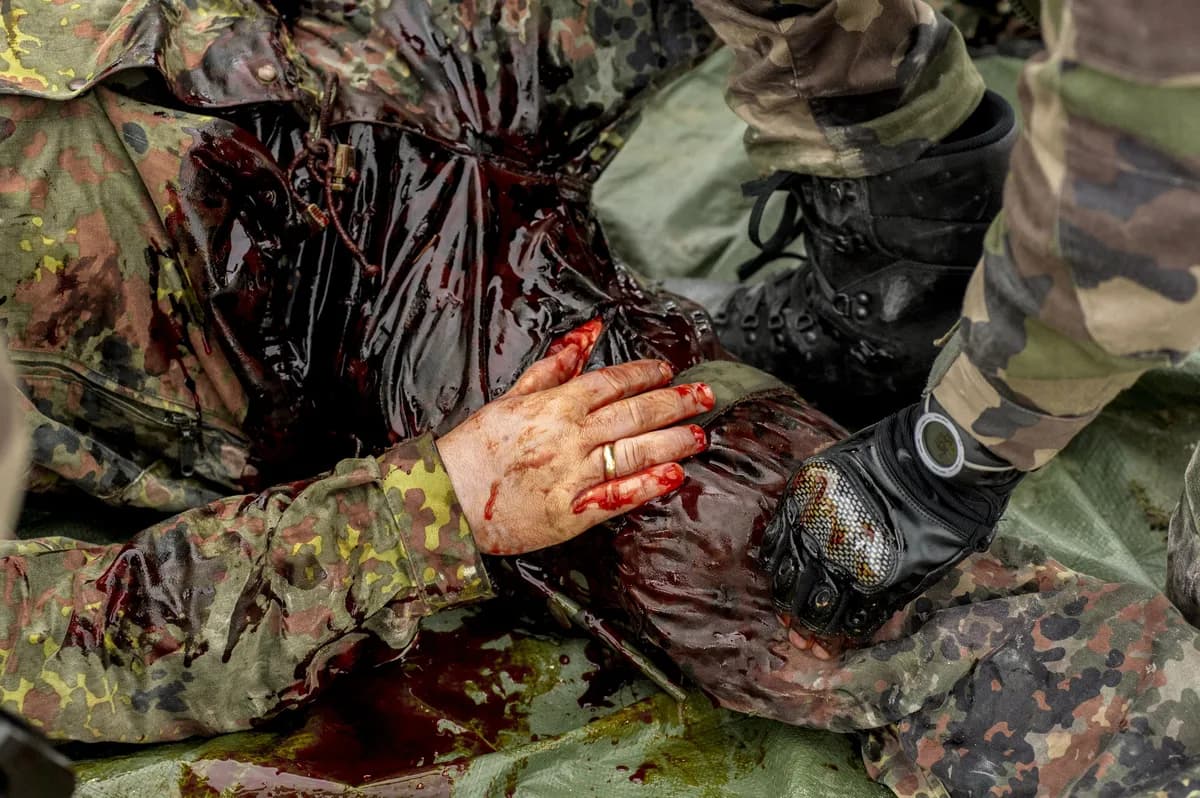
A failed Ukrainian attack near Pokrovsk on March 31, 2026, has sparked harsh internal criticism over unnecessary losses. The mechanized attack by Ukraine's 425th Assault Regiment, known as Skelia, outside Pokrovsk in Donetsk Oblast has prompted a wave of criticism from key Ukrainian figures online concerning the reckless loss of manpower. On April 1, Serhii Sternenko spoke out about the failed attack the previous night, sharing Russian drone videos of the destroyed equipment that had been posted on Telegram. The original video, posted by Russia's elite Rubicon drone unit, shows their drones destroying a Ukrainian M1 Abrams tank, a BMP-2 infantry fighting vehicle, and a M1117 armored mobility vehicle, as well as several hits on individual soldiers in the field. Later in the day, more footage of the destroyed vehicles emerged online, quickly geolocated to confirm the attack occurred on the E-50 highway running west from Pokrovsk, near the village of Hryshyne, now contested.
Sternenko described Skelia's tactics in this attack as just the latest example of a systemically wasteful approach to offensive operations in the unit that leads to excess Ukrainian personnel losses, often for little to no tangible gains. Skelia responded to Sternenko on social media, acknowledging the loss of the vehicles, and of two soldiers killed in action nearby. The unit claimed the attack was a success, as the infantry managed to dismount the vehicles and continue the mission, while the fifth armored vehicle in the column survived unscathed, having successfully evacuated the crews of those that had been destroyed. On the same day, veteran Ukrainian war journalist Yuliia Kyriienko visited Skelia, where she filmed a radio exchange purportedly with one of the infantrymen dropped off in the attack, saying that everything was quiet and going to plan. The Kyiv Independent could not independently verify the fate of the Skelia assault soldiers involved in the attack.
Four years since Russia’s February 2022 full-scale invasion of Ukraine, Russia still occupies roughly 20 percent of the country after gaining almost five thousand square kilometers of territory in 2025. Russia continues to bombard Ukrainian cities, while Ukraine maintains drone attacks on Russian oil infrastructure and military sites. Fighting and air strikes have inflicted nearly 56,000 civilian casualties, while 3.7 million people are internally displaced, and 5.9 million are registered as refugees, with 10.8 million people needing humanitarian assistance. Since January 2022, Ukraine has received about $188 billion in aid from the United States and $197 billion from the European Union.
In a significant tactical shift, Ukrainian forces liberated territory including part of the city of Kupyansk in a counterattack in the Kupyansk direction. According to the Ukrainian 2nd Khartiya Corps, Ukrainian forces conducted a successful counterattack to stabilize the situation in the Kupyansk direction and liberated Kindrashivka, Radkivka, areas in northern Kupyansk, and broke through to the Oskil River, cutting Russian ground lines of communication to the Kupyansk area. The corps also reported that Ukrainian forces have encircled roughly 200 Russian personnel in Kupyansk as of December 12. Ukrainian President Volodymyr Zelensky published a photo of himself on the southwestern outskirts of Kupyansk along the P-07 Kupyansk-Shevchenkove highway on December 12, indicating that Ukrainian forces have likely pushed Russian forces much farther back from this area. Other Russian and Ukrainian sources corroborated the Ukrainian counterattack.
A source reportedly affiliated with Ukrainian military intelligence stated that Ukrainian forces encircled Russian forces within Kupyansk, cleared northwestern Kupyansk, and liberated Myrove, Kindrashivka, and Radkivka. A Russian milblogger noted that Russian forces do not control eastern Kupyansk and the Oskil River complicates Russian efforts to reach central Kupyansk. However, some Russian milbloggers rejected the extent of observed Ukrainian advances, claiming Ukrainian forces launched a counterattack and made some advances but the extent is overstated. The Ukrainian Joint Forces Task Force began efforts to push back Russian advances in the Kupyansk direction on November 16, and these recent advances are likely the result of a multi-week effort to retake Kupyansk. This Ukrainian counterattack demonstrates that Ukrainian forces remain capable of defending and counterattacking against significant Russian offensive efforts, contrary to the claims of Russian President Vladimir Putin that the Ukrainian lines are collapsing.
Russian military efforts face multiple challenges, with a slowdown in Russian activity this year due to freezing weather, Russian units in Ukraine being unable to access Starlink communications, and problems with quantity and quality of manpower. Some Ukrainian sources report that Russia is now struggling to replace losses with more men, with reports of foreigners being tricked into front-line service. Russia’s failures to seize Kupiansk and Pokrovsk, and even being expelled from the former, undermine the Kremlin’s narrative of inevitable victory. The New York Times has just published its latest in a series, which began in August 2024, predicting the imminent fall of Pokrovsk. Because Russian forces had overstated claims of gains near Oleksandrivka and Huliaipole, they were now reporting non-existent Ukrainian counterattacks to explain why they don’t actually hold these positions.
Frontline dynamics remain intense, with the front line stretching about 1,200 kilometres, and drone-determined kill zones of up to 15–20 kilometres. The number of Russian troops deployed on Ukrainian territory has remained largely unchanged over the past six months at about 711,000–712,000 personnel, including operational reserves, with losses at an average of 1,000 to 1,100 troops per day.
Diplomatically, Trump shocked European allies this week by calling Russian President Vladimir Putin without consulting them or Kyiv beforehand and declaring an immediate start to peace talks. U.S. and Russian officials will meet in Saudi Arabia in the coming days to start talks aimed at ending Moscow’s nearly three-year war in Ukraine. The Trump administration pledged to seek a settlement to end the war, setting out a twenty-point draft peace deal and a June deadline. Although Ukraine accepted the proposal after discussions, many terms of the deal—including territorial concessions and security guarantees—remain unclear. Russia will not agree to an amended deal that departs from the “spirit and letter” of President Putin’s August summit with President Trump in Alaska.
Ukrainian President Volodymyr Zelensky held talks remotely yesterday with US special envoy Steve Witkoff, Jared Kushner, and US Senator Lindsey Graham as part of ongoing effort to negotiate an end to the conflict. Talks with Russia are deadlocked over the vital question of land, with Ukraine refusing to cede to Russian demands that it relinquish the remaining parts of the eastern, industrialised region of Donbas that Russia has been unable to conquer.
In a related development, Trump threatened to stop supplying weapons for Ukraine in an effort to pressure European allies to help reopen the Strait of Hormuz. People briefed on the discussions said the US president was rather hysterical at the Europeans’ refusal to help protect the key global passageway for the transport of oil from the Middle East. A group of countries including the UK, France and Germany expressed their readiness to contribute to appropriate efforts to ensure safe passage through the Strait of Hormuz.
Across Europe, Russian-linked actors have sabotaged critical infrastructure, disrupted aviation and energy systems, penetrated digital networks, surveilled military facilities, and targeted political opponents and defense officials. Since 2022, these activities have become more tightly synchronized with Moscow’s broader war aims in Ukraine. Russia’s shadow warfare is a system of conflict rooted in ideology, embedded in institutions, and biased toward escalation.
On the ground, Russia carried out a rare daytime drone attack on Ukraine yesterday, killing four people in the central Cherkasy region and damaging energy infrastructure and industrial facilities in the west of the country. Separately, Cyprus has asked Britain to discuss new security arrangements for the UK’s sovereign military bases on the island after Iranian drone attacks earlier this month. The Ministry of Defence stated that the status of the UK’s sovereign military bases in Cyprus is not in question and there are no plans to change current arrangements.
International diplomatic coordination continues, with British Prime Minister Keir Starmer discussing the widening Middle East conflict with Saudi Crown Prince Mohammed bin Salman on 24 March, as London sought to coordinate with Gulf partners amid the Iran war.
The Ukrainian counterattack near Kupyansk demonstrates that Ukrainian forces remain capable of defending and counterattacking against significant Russian offensive efforts, contrary to the claims of Russian President Vladimir Putin that the Ukrainian lines are collapsing. This tactical success provides a counter-narrative to Russian assertions of inevitable victory.