

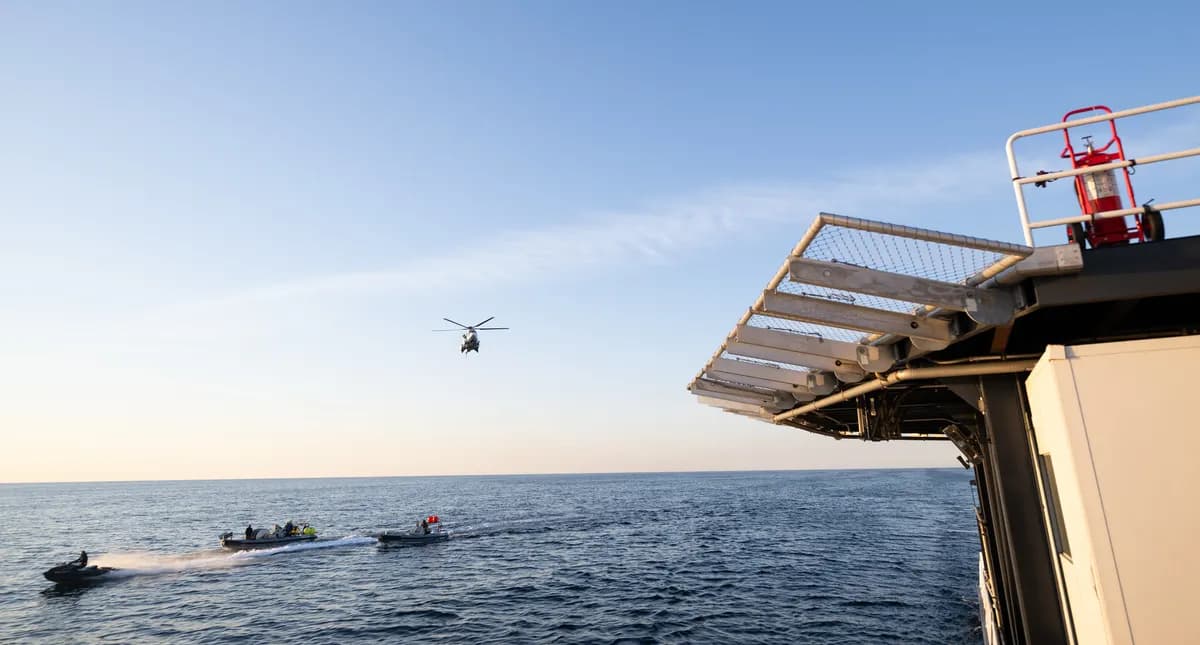
US forces attacked and seized the Iranian-flagged cargo ship Touska near the Strait of Hormuz on Sunday. The US Navy said the ship attempted to evade its naval blockade, which was established last week in response to Iran's closure of the vital waterway. According to the US, it issued repeated warnings over a six-hour period before intercepting the vessel. The US Navy disabled the Touska by blowing a hole in its engine room. US Marines subsequently took custody of the ship and are inspecting its cargo.
Iran condemned the seizure as piracy and a violation of the existing ceasefire. Tehran vowed to retaliate against the United States for the seizure, and multiple reports indicate Iran attacked several US ships with drones overnight Sunday to Monday in retaliation.
The seizure occurred against the backdrop of heightened naval tensions in the region. The US naval blockade of Iranian ports began last week in response to Iran's closure of the Strait of Hormuz, a critical chokepoint for global oil shipments. Iran's Revolutionary Guard warned that any ship approaching the closed strait would be considered hostile and targeted. At least two ships were shot at while trying to pass through the Strait of Hormuz on Saturday, according to multiple reports.
The seized vessel Touska was traveling from China to Iran, according to Iranian state media. Official sources indicate the 294-meter-long cargo ship was traveling from Malaysia toward the Strait of Hormuz and was located in the Gulf of Oman when intercepted. The US says the Touska is under US Treasury sanctions due to prior illegal activity.
US Central Command released footage showing the interception of the cargo ship. Former President Donald Trump commented on the vessel's size, noting it was nearly 900 feet long and weighed almost as much as an aircraft carrier.
The U.S. warship stopped them by shooting holes in the engine room.
The current conflict originated with US and Israeli strikes on Iran on February 28, according to multiple reports. A two-week ceasefire is currently in place and is due to expire on Wednesday.
In a separate but related development, a US submarine sank the Iranian frigate IRIS Dena off the southern coast of Sri Lanka on Wednesday. According to the Chairman of the Joint Chiefs of Staff Gen. Dan Caine, this marked the first time a US attack submarine had used a torpedo to sink a combat ship since 1945.
Casualty figures from the IRIS Dena sinking vary between sources. Research indicates 87 people were killed in the sinking, while authorities in Sri Lanka report more than 80 crew were killed. Sri Lankan officials say at least 87 bodies have been recovered so far, while some 32 others were rescued by the Sri Lankan Navy. According to Iran's foreign minister Abbas Araghchi, some 130 people were believed to have been on board the vessel when the first distress call was received on Wednesday.
Iran identified the vessel as the IRIS Dena and vowed vengeance for what it described as an 'atrocity'. The frigate had been sailing home from an east Indian port, where it had participated in an international naval conference hosted by India in February, according to research sources.
The sinking of the IRIS Dena is part of a broader US military campaign against Iranian naval assets. Research indicates that since the beginning of Operation Epic Fury, US forces have destroyed or incapacitated more than 120 Iranian naval vessels across both the IRIN and IRGCN. However, Adm. Brad Cooper, commander of US Central Command, states US forces have destroyed more than 17 Iranian ships thus far, including the most operational Iranian submarine that now has a hole in its side.
The US has perpetrated an atrocity at sea, 2,000 miles away from Iran's shores. Mark my words: The US will come to bitterly regret precedent it has set.
Major naval facilities, including Bandar Abbas, Chabahar, and Konarak, were targeted within the first hours of the conflict using Tomahawk land-attack cruise missiles, according to research sources.
Diplomatic efforts to de-escalate the situation face significant challenges. The US is deploying a delegation led by Vice President JD Vance to Pakistan for a second round of talks with Iran on Monday. However, Iranian state media reported that Iran will not participate in the talks while the US blockade remains, and suggested the talks would not happen.
The seizure has already impacted global markets, with oil prices rising following the incident. Multiple reports indicate Brent crude opened at $95 a barrel on Monday.
Several key unknowns persist in the aftermath of these events. The specific cargo on board the Touska remains unknown. The exact number of casualties from the IRIS Dena sinking is uncertain as reports conflict. Whether Iran will ultimately participate in talks remains uncertain. The current status of the ceasefire is also uncertain as diplomatic channels appear strained. The full extent of damage from the reported Iranian drone attacks on US ships remains unclear.
Rescue operations for the IRIS Dena were initiated promptly by regional actors. Sri Lanka's navy responded to a distress call from the vessel at 5:08 a.m. and dispatched boats and Air Force for rescue efforts by 6 a.m., according to Sri Lanka's foreign minister Vijitha Herath.