

The deployment, part of NATO's Arctic Sentry mission, involves six JAS 39 Gripen aircraft and approximately 110 personnel from Skaraborgs flygflottilj (F 7). The jets are on 24-hour alert against suspicious air traffic, with the mission aimed at the collective defence of Icelandic airspace. Lieutenant Colonel Johan Legardt, contingent commander, stated that Sweden is stepping up as a new NATO member on the northern flank, focusing on the Arctic.
Major General Jonas Wikman, Commander of the Swedish Air Force, noted that the strategic importance of the Arctic area is increasing. The contingent arrived at Keflavik Air Base on 2 February 2026, constituting the 55th rotation for Iceland within NATO Air Policing. Stormy weather in Iceland has grounded some Gripen flights, with weather being a bigger threat than Russian bombers.
The Swedish force includes two meteorologists to provide refined weather forecasts for pilots. Lieutenant Greta De Ridder, a meteorologist, said weather in Iceland can change rapidly, from sunshine to heavy snowfall in five minutes. The JAS 39 Gripen is a fourth-generation multi-role aircraft suitable for harsh weather, built for the Swedish climate, according to Lieutenant Colonel Robin Arvidsson.
The Gripen can be refuelled and rearmed by one officer and four conscripts in as little as 10 minutes. NATO's Arctic Sentry mission aims to reassure allies and address US President Trump's pressure for increased military spending in the region. Swedish fighters are mainly watching for Russian long-range bombers from the Kola Peninsula.
According to The Independent, Major General Frode Arnfinn Kristoffersen described Iceland and the Arctic as important as a warning chain for attacks against the US or Canada. He also noted that Russia has built up new Arctic bases and reopened former Soviet military sites. Arctic Sentry is a multi-domain activity led by Joint Force Command Norfolk, integrating Allied exercises like Cold Response and Arctic Endurance with expanded patrols by NATO's AWACS aircraft.
Norwegian Army Major General Frode Kristoffersen, Deputy Chief of Staff Operations at JFC Norfolk, explained that Arctic Sentry synchronizes all Arctic activity conducted by Allies to increase Arctic security, gain deterrent effect, and improve common situational awareness. The operation is taking place during February and March 2026. Meanwhile, on NATO's eastern flank, French Rafale jets scrambled from Šiauliai Air Base in Lithuania to intercept a Russian Il-20 reconnaissance aircraft and supersonic bombers with fighter escorts over the Baltic Sea.
NATO scrambles jets when Russian planes fly in Baltic airspace without transponders, flight plans, or radio communication. According to The Independent, Lt. Col.
Alexandre described interactions between NATO and Russian pilots as a 'game of cat and mouse, or rather cat and cat,' with both sides watching and filming each other. Swedish Gripen jets also identified two Russian Tu-22M3 strategic bombers escorted by fighter jets over the Baltic Sea near Gotland. The bombers flew in via the Gulf of Finland, passed between Sweden and the Baltics, went south to Bornholm, then turned back to Russia.
The Tu-22M3 is a supersonic bomber capable of carrying conventional and nuclear weapons, with a range of about 7,000 km. The Russian bombers were escorted by various types of fighter jets, with armament visible under wings, according to Överstelöjtnant Robert Krznaric. Similar flights have previously originated from Olenya airbase on the Kola Peninsula.
Russian defence ministry TV channel Zvezda reported that the Tu-22M3 bombers flew a four-hour mission over international waters in the Baltic, escorted by Su-35 fighters, and that NATO fighters monitored the bombers. Russia claims all flights are conducted in strict accordance with international rules. Lithuania's Ministry of National Defence reported that NATO air policing jets were scrambled four times between April 13 and 19 to intercept Russian aircraft breaching flight regulations near the Baltic States.
Former Estonian defence chief Riho Terras called for a firm and consistent response to such violations.
On April 13, an IL-20 was intercepted flying without transponder, flight plan, or radio contact between Kaliningrad and back. An AN-26 was also intercepted; it had transponder and radio but no flight plan. On April 14, the IL-20 was intercepted again; on April 15, two SU-30SM jets were intercepted; on April 17, the IL-20 was intercepted once more.
Airspace violations have also occurred. Poland scrambled F-16s in response to a Russian Il-20 reconnaissance aircraft flying without a flight plan and with transponder off over the Baltic Sea. Poland's Deputy Prime Minister called the Russian actions provocative and testing of air defense systems.
A Russian fighter jet violated Estonian airspace near Vaindloo Island on Wednesday, the first such violation this year. According to GB News, Riho Terras called for a firm and consistent response to such violations. Russian military aircraft also breached Baltic airspace for twelve minutes last September, though Moscow's Defence Ministry rejected allegations of the violation as fabricated.
Russian drones penetrated Polish and Romanian airspace, flying toward NATO installations; Poland invoked Article 4 consultations. Polish Foreign Minister Radosław Sikorski urged NATO to intercept Russian drones and missiles over Ukrainian territory. Undersea threats have also emerged.
Britain revealed Russia staged a secret submarine operation threatening undersea cables, with an Akula-class submarine as diversion and two GUGI spy submarines conducting surveillance. Swedish Gripen jets and allied forces tracked a Russian Kilo-class submarine in the Kattegat, following it into the Baltic Sea. The submarine is likely heading to a base in St.
Petersburg or Kaliningrad, according to Pär Pihlqvist of Försvarsmakten. A Norwegian defence spokesperson described the submarine transit as routine, with the vessel using its transponder for safety. Broader Russian military posture includes two Tu-95MS 'Bear' nuclear bombers intercepted over neutral waters of the Barents and Norwegian Seas, escorted by Su-30SM fighters and refuelled in air.
Dmitry Medvedev warned that nuclear apocalypse is genuinely possible and that conflict with the West is existential. Russia dismisses claims of seeking to take over Greenland or being a threat in the Arctic as false 'horror stories'. However, Russia alleges Finland and Baltic states allowed their airspace to be used by Ukrainian drones attacking Russian oil ports, which Western states and Kyiv strongly deny.
Russian officials, including Sergei Lavrov and Sergei Shoigu, have warned of possible responses, with Shoigu invoking Russia's right to self-defence under Article 51 of the UN Charter. Sergei Shoigu also issued a 'final' warning to Baltic states against acting with 'impunity' against Russia. Sweden's Chief of Defence, Michael Claesson, warned Russia may be scheming to occupy a Baltic island to test NATO's Article 5.
NATO air policing missions on the eastern flank aim to deter, not provoke, and reassure Baltic states without their own airpower. Romanian F-16s are also deployed at Šiauliai Air Base for air policing. The Suwałki Gap between Poland and Lithuania is described as NATO's 'weakest link'.
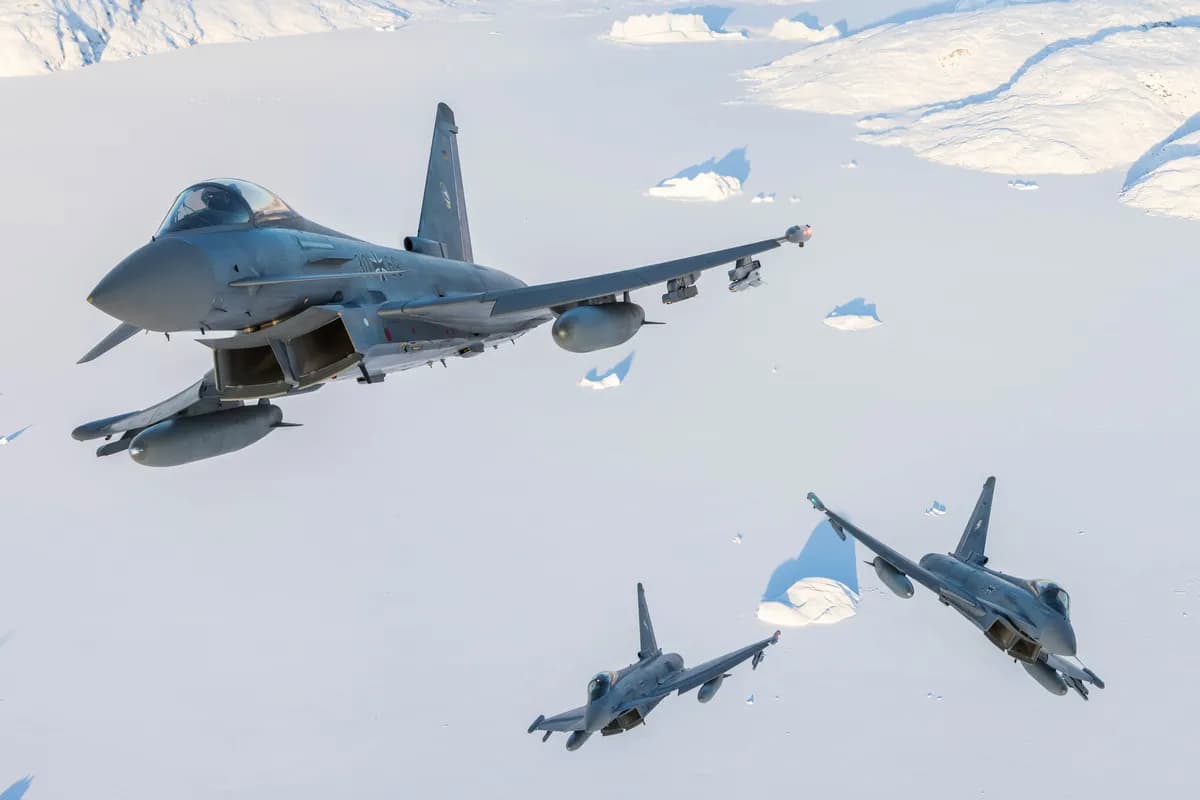
In the High North, the Swedish jets trained with F-35 Lightning IIs from the Royal Danish Air Force and Eurofighter Typhoons from the German Air Force at Keflavik. The training focused on integrating the Gripen and the Eurofighter with the F-35's advanced capabilities, according to Swedish Air Force officials.