

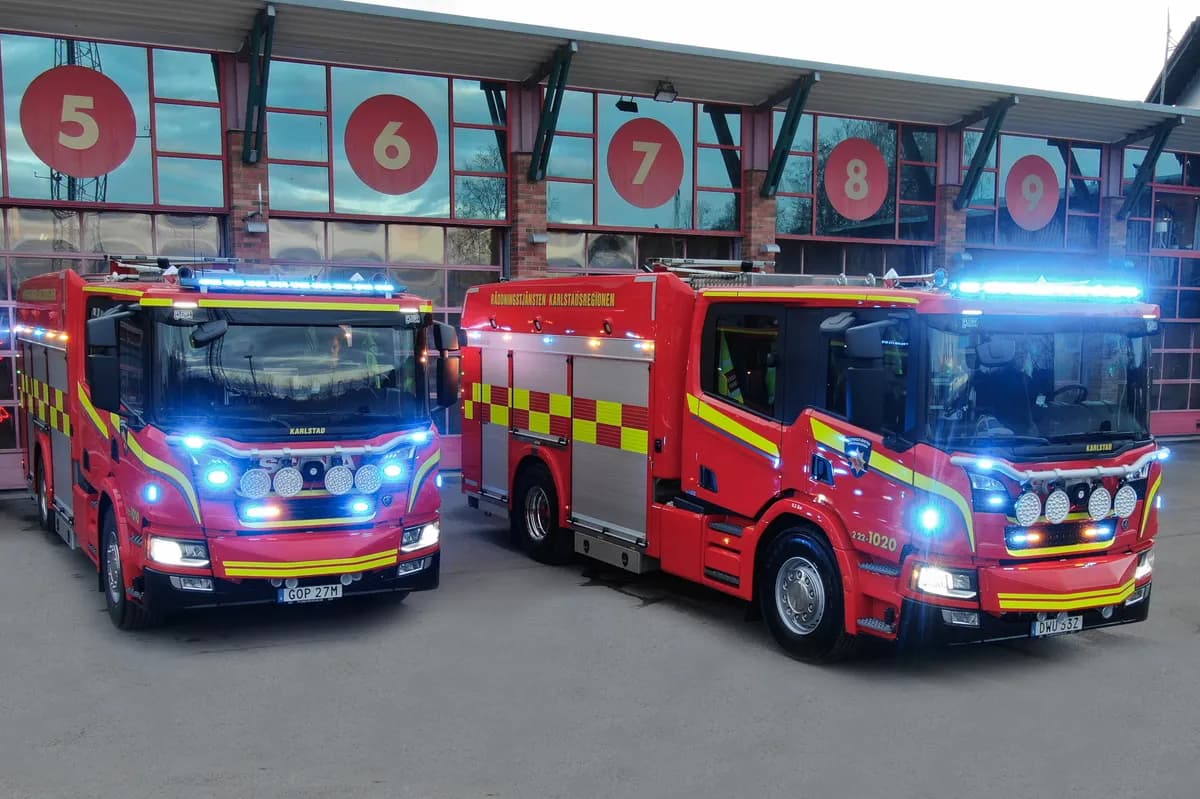
The Swedish Meteorological and Hydrological Institute (SMHI) has declared a high risk for grass fires in extensive parts of Sweden, with specific alerts for Kalmar County. SMHI has issued warnings for grass fire risk in large parts of Svealand, Götaland, southern Norrland, and southern Västerbotten, with a high risk on Gotland and Öland, valid for Saturday. SMHI urges great caution when lighting fires outdoors, stating that grass fires can easily occur and spread in last year's dry grass. Grass fire risk alerts are usually issued in the spring when there is a high risk of fires occurring and spreading in areas of dry grass.
Current weather conditions are exacerbating the fire risk, with reports indicating it is very warm. This warmth coincides with an outdoor dining premiere, as noted by media sources.
A recent incident in Skåne highlighted the tangible impacts of these conditions, as train traffic between Malmö and Trelleborg was stopped on Saturday afternoon after a grass fire broke out on the tracks. Service resumed at 3:30 p.m., but with major delays.
In response to the elevated threat, the Swedish Civil Defence and Resilience Agency (MSB) is heightening preparedness for extinguishing grass and forest fires, deploying four helicopters to enhance rapid response capabilities. MSB urges everyone to be careful and grill in safe and permissible places, preferably where there is access to water.
Satellite technology has become a critical component in early fire detection, with SMHI beginning to send satellite detections directly to SOS Alarm ahead of the 2023 wildfire season. Satellite data is now an integrated part of the emergency response chain, where a fire can be detected from space and immediately trigger an alert to SOS Alarm.
However, satellite detection has its limitations; for wildfires detected by satellites from 2022 to 2024, satellites were the first to detect the fire in 29% of cases. Satellites cannot detect all fires due to delays between ignition and overpass, cloud cover, or instrument sensitivity. Even when satellites are not the first to raise the alarm, they provide an accurate geographical location of the fire, facilitating firefighting operations.
To address these gaps, new satellite capabilities are on the horizon, with the launch of Metop-SG-A1 in August 2025, Europe’s first satellite in the second generation of the polar satellite programme. Once operational, Metop-SG-A1 will be renamed Metop-D and carries the METimage instrument for fire detection. With the Metop-SG satellites, coverage will be gained in the morning and evening, when high-resolution observations are currently lacking.
The technical specifications of the new satellite instruments include the METimage sensor, which is not quite as sensitive as VIIRS, meaning somewhat larger fires are required for detection.
Official warnings and public safety guidance emphasize the importance of individual responsibility, with SMHI urging great caution when lighting fires outdoors and noting that grass fires can easily occur and spread in last year's dry grass. Grass fire risk alerts are usually issued in the spring when there is a high risk of fires occurring and spreading in areas of dry grass.
Understanding fire risk forecasts involves interpreting different types of maps, with explanations provided on how to read them. There are two different types of fire risk messages: risk for grass fire and risk for forest fire, and these messages cannot escalate to a warning.
For further information, SMHI's Customer Services can order data, statistics, forecasts, publications, official reports, etc., and help get in touch with experts or answer questions about customer-tailored products and services. Contact details include phone: +46 11 495 82 00, fax: +46 11 495 80 01, email: customerservice@smhi.se, open weekdays 8 a.m. to 4:30 p.m.
Key unknowns persist in this evolving situation, including the exact current date or timeframe for the reported events, such as the outdoor dining premiere, the train disruption in Skåne, and the Saturday warnings. Additionally, the specific 'safe and permissible places' for grilling as urged by MSB have not been detailed. The operational status and timeline for the Metop-SG-A1 satellite becoming fully functional for fire detection also remain unclear.