

NASA's SPHEREx mission has mapped interstellar ice at an unprecedented scale, covering regions in the Milky Way galaxy more than 600 light-years across. The interstellar ice was found inside giant molecular clouds, vast regions of gas and dust where dense clumps of matter collapse under gravity, giving birth to stars. Researchers believe these ice reservoirs, attached to the surfaces of tiny dust grains, are where most of the universe's water is formed and stored. The water in Earth's oceans and the ices in comets and on other planets and moons in our galaxy originates from these regions. A study describing these findings was published Wednesday in The Astrophysical Journal.
One of SPHEREx's main goals is to map the chemical signatures of various types of interstellar ice, including molecules like water, carbon dioxide, and carbon monoxide. Thanks to its spectral capabilities, SPHEREx can measure the amounts of various ices and molecules, such as polycyclic aromatic hydrocarbons, in and around molecular clouds. The SPHEREx observatory is the first infrared mission specifically designed to find such molecules over the entire sky via the mission's large-scale spectral survey. The SPHEREx observatory launched March 11, 2025. SPHEREx has the unique ability to see the sky in 102 colors, each representing a different wavelength of infrared light.
NASA's James Webb Space Telescope and Hubble Space Telescope have teamed up to capture new views of Saturn, revealing the planet in strikingly different ways. Observing in complementary wavelengths of light, the two space observatories provide scientists with a richer, more layered understanding of Saturn's atmosphere. Hubble reveals subtle color variations across Saturn, while Webb's infrared view senses clouds and chemicals at many different depths in the atmosphere. The Hubble image was captured as part of the OPAL monitoring program in August 2024, while the Webb image was captured a few months later using Director's Discretionary Time. In the Webb image, a long-lived jet stream known as the 'ribbon wave' meanders across Saturn's northern mid-latitudes. Just below the ribbon wave, a small spot represents a lingering remnant from the 'Great Springtime Storm' of 2010 to 2012. Several other storms dotting the southern hemisphere of Saturn are visible in Webb's image. Several of the pointed edges of Saturn's iconic hexagon-shaped jet stream at its north pole are faintly visible in both images. These are likely the last high-resolution looks we'll see of the famous hexagon until the 2040s, as the northern pole enters winter and will shift into darkness for 15 years.
In Webb's infrared observations, Saturn's poles appear distinctly grey-green, indicating light emitting at wavelengths around 4.3 microns. This distinct feature could come from a layer of high-altitude aerosols in Saturn's atmosphere that scatters light differently at those latitudes, or possibly from auroral activity. Saturn's icy rings glow in an infrared view from NASA's James Webb Space Telescope released on March 25, 2026. In Webb's infrared image, the rings are extremely bright because they are made of highly reflective water ice. Astronomers used NASA's James Webb Space Telescope to examine 29 Cygni b, an object about 15 times as massive as Jupiter orbiting a nearby star. They found multiple lines of evidence that 29 Cygni b indeed formed from a bottom-up process where small bits of rock and ice clump together and grow larger over time. Balmer's observing program used Webb's NIRCam in its coronagraphic mode to directly image 29 Cygni b. The planets targeted by the program were all young and still hot from their formation, ranging in temperature from about 1,000 to 1,900 degrees Fahrenheit (530 to 1,000 degrees Celsius).
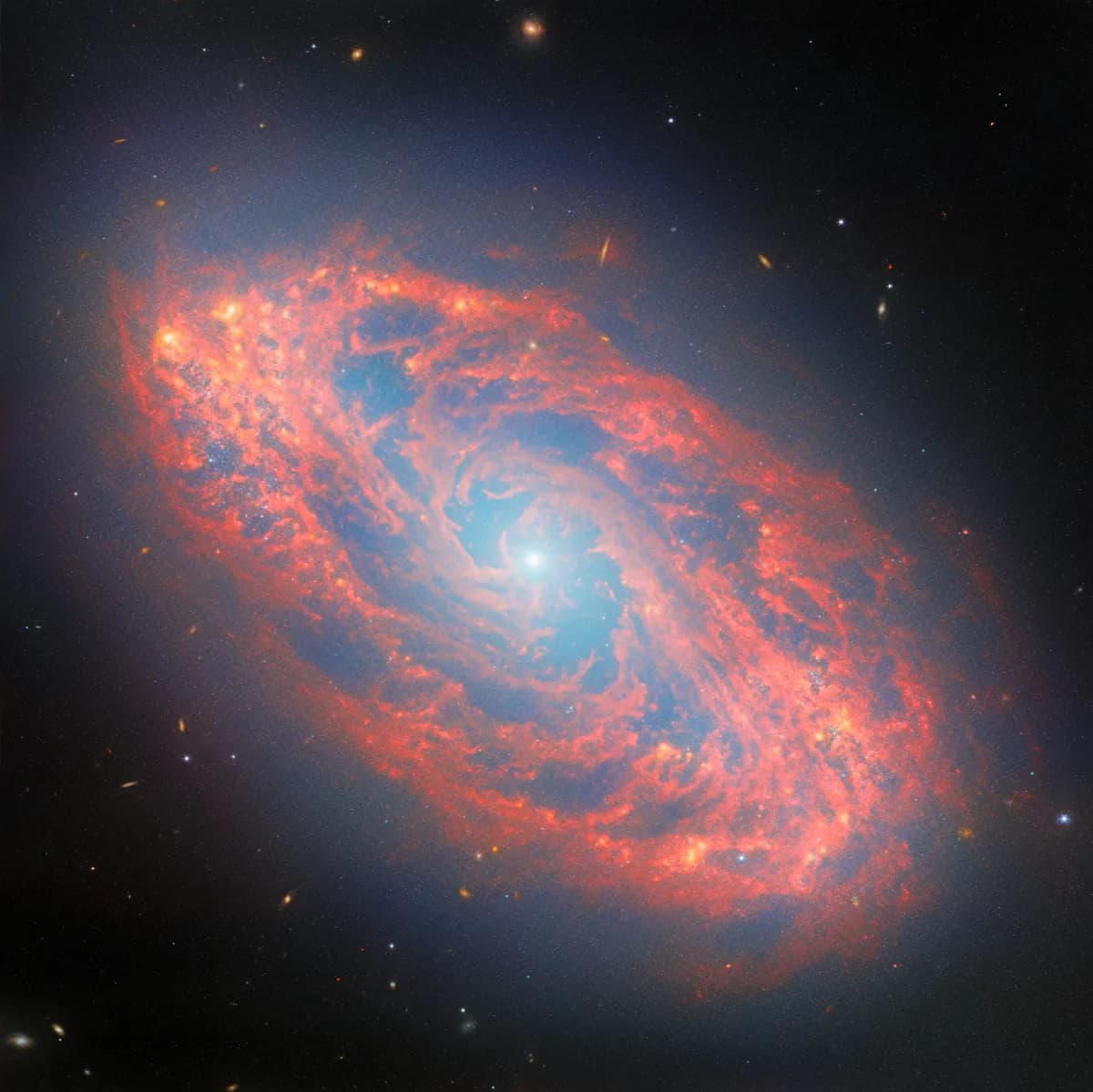
Stars peek through the dusty, winding arms of NGC 5134, a spiral galaxy located 65 million light-years away, in a Feb. 20, 2026, image from NASA's James Webb Space Telescope. Webb's Mid-Infrared Instrument collects the mid-infrared light emitted by the warm dust speckled through the galaxy's clouds, tracing the clumps and strands of dusty gas. The telescope's Near Infrared Camera records shorter-wavelength near-infrared light, mostly from the stars and star clusters that dot the galaxy's spiral arms. A March 16, 2026, image from NASA's Hubble Space Telescope and the James Webb Space Telescope takes a closer look at the core of Messier 101, also known as the Pinwheel Galaxy. At 25 million light-years away, M101 is one of the closest 'face-on' spiral galaxies to us.