

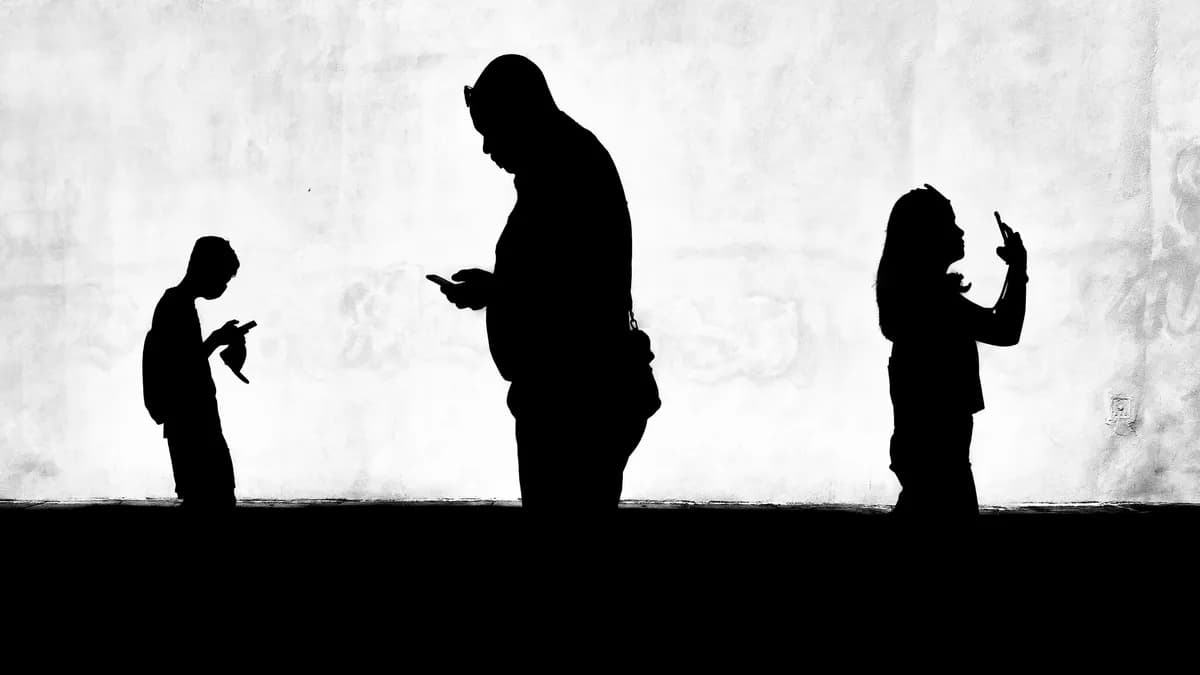
Children who spend more than three hours a day on social media are more likely to develop mental health problems, including depression and anxiety, than those who spend 30 minutes a day, according to researchers at Imperial College London. Sleep disruption, particularly less sleep on school nights and later bedtimes, is a primary factor driving this link, the researchers noted. Extensive social media use has a direct link to poorer self-reported well-being, studies indicate. According to Professor Mireille Toledano, principal investigator of the Scamp study, children who use social media apps for longer and later into the evening may be offsetting the sleep they need to function healthily, which she described as the key reason for lasting mental health impacts.
Social media platforms that encourage algorithm-driven scrolling, such as Instagram and TikTok, are worse for mental health than platforms that prioritize social connection, such as Facebook and WhatsApp, the World Happiness Report found. Social media platforms are no longer primarily connecting people to each other but are optimized to keep users scrolling by promoting influencers and celebrities, an IPPR report stated. Fewer than one in five of the top four posts on users' feeds on Instagram, Facebook, X, Bluesky, and TikTok are from someone they actually know, according to an IPPR analysis. Only one in 10 posts seen by users on TikTok and X are from friends and family, the analysis showed. It remains unclear what specific mechanisms or features of algorithm-driven platforms make them worse for mental health compared to connection-focused platforms.
It suggests we need to put the social back into social media, and nudge both the providers of these platforms, as well as the users, to leverage these tools for social purposes and connecting with real people.
Excessive use of social media is causing unhappiness among young people globally, with a worse impact in English-speaking countries and Western Europe, the World Happiness Report reported. Young people in the USA experience a sharp decline in well-being, with those aged 15 to 24 ranking low in global comparisons, the report added. Overall happiness levels in the UK are at the lowest level since the World Happiness Report was first published in 2012. Prof Jan-Emmanuel De Neve, director of the Wellbeing Research Centre, suggested putting the social back into social media to leverage these tools for connecting with real people.
The average social media usage time in the data is about two-and-a-half hours per day, the World Happiness Report noted. Teenagers in the USA spend an average of about five hours per day on social media platforms, research cited by CNBC found. The relationship between social media use and mental health is complex and not as straightforward as a direct causal link like smoking and lung cancer, according to Dr. Chen Shen. He described it as not too much, not too little, with positive moderate use seeming optimal.
There's a bit of a Goldilocks proposition here – not too much, not too little. Positive moderate use seems to be optimal.
Only 13% of Reform UK voters see content from someone they know on social media, compared to 23% of Green party voters, an IPPR analysis revealed.
There is growing support for a total ban on social media use for under-16s and for a legal ban on phones in schools, Professor Mireille Toledano said. Australia has implemented a total ban on social media for under-16s, including Facebook, Instagram, TikTok, and X, but excluding messaging apps like WhatsApp, the World Happiness Report confirmed. Prof Jan-Emmanuel De Neve called Australia's move the biggest test of a complete ban, urging other countries to note the results and not jump the gun. The effectiveness of such interventions in improving mental health outcomes is not yet known.
But the average social media usage time in the data was not an hour or less, it's more like two-and-a-half hours.
Social media platforms have changed enormously over the last decade and are likely to change as much or more in the next five to 10 years, Dr. Chen Shen observed. The IPPR calls for the BBC to create a new social media platform as an alternative to tech giants' profit-driven services, according to its report. Sofia Ropek-Hewson, a senior research fellow with the IPPR, argued that platforms are making users less visible to each other and more isolated by prioritizing profit-driven algorithms.
Limited social media use of an hour or less a day leads to higher life satisfaction than no social media use at all, excluding people without internet access, the World Happiness Report found. Finland topped the happiness leaderboard for the ninth consecutive year in the World Happiness Report. A large proportion of young people's calorie intake comes from ultra-processed food, which can affect mood and stress management, research indicates. The role of other factors, such as diet or socioeconomic conditions, in the decline of well-being among young people compared to social media use remains unclear.
This is really critical – it's the biggest test of a complete ban of social media for under-16s, and all other countries really should take note of the results and not jump the gun.