

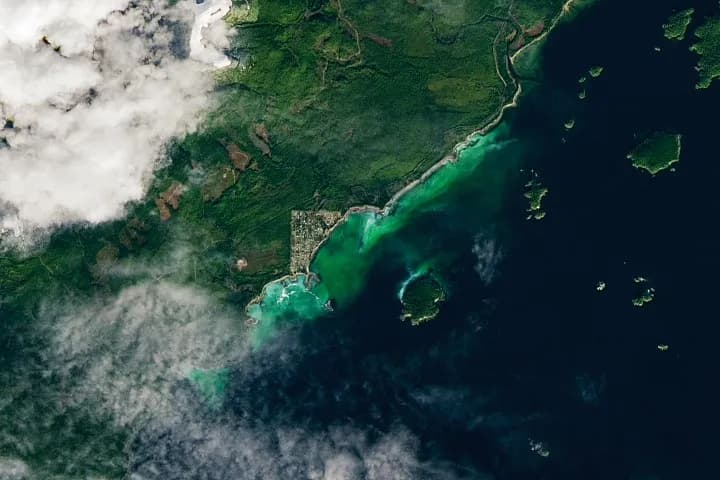
Pacific herring spawning season occurs from mid-February through early May each year in the waters off British Columbia, Canada, with thousands of fish congregating in shallow coastal areas around Vancouver Island. Sheltered waters in Barkley Sound, on the southwestern side of Vancouver Island, are regular sites for herring spawn events, and herring spawns near Forbes Island have been observed most years since the 1970s, according to Fisheries and Oceans Canada records. During spawning, female herring produce eggs that stick to materials like kelp, seagrass, or rock surfaces, and males release milt, giving the water a cloudy green or turquoise appearance, as seen in the satellite observation.
Herring prefer spawning locations that are protected, have rocky substrate, and allow selection of areas with reduced salinity, and Barkley Sound meets many of these conditions. Collective memory, predation pressure, and other factors influence herring spawn size and location, with spawning events lasting from several hours to several days and herring schools sometimes arriving up to two weeks before spawning. Spawning events often include increased wildlife presence, such as whales, sea lions, eagles, wolves, and bears, and after spawning, herring migrate back to summer feeding areas in deeper, nutrient-rich waters, sometimes staying with the same large school for several years.
Pacific herring are a forage fish species vital to salmon and other marine life, and they and their roe are valuable as a cultural food source and harvest practice for First Nations and for British Columbia's commercial fisheries. Historical records of herring spawn activity have been constrained by the timing of aerial and dive surveys, availability of reports from remote locations, and fisheries priorities, but satellite observations, including from Landsat, can help monitor herring activity over larger areas and longer periods. Researchers at the University of Victoria have used decades of satellite observations to augment historical spawn records and develop methods to streamline future detections, and a fuller picture of herring spawning areas could provide clues about changes in the marine ecosystem.