

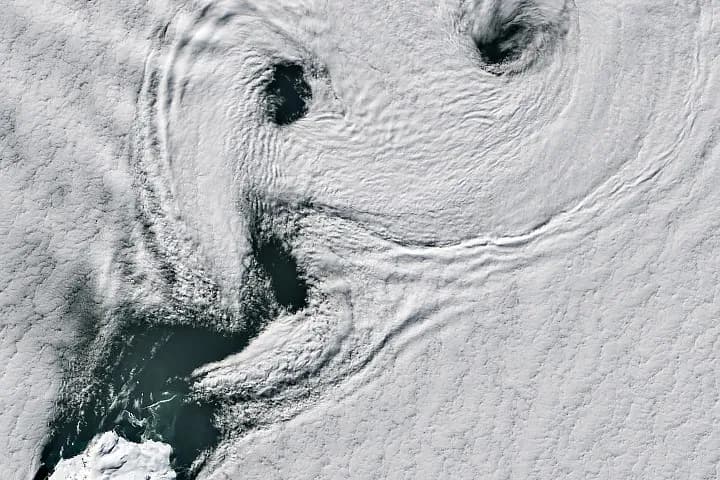
Peter I Island is an ice-cloaked volcano located at 68.86 degrees south latitude in the Bellingshausen Sea, approximately 400 kilometers off the coast of West Antarctica. Discovered in 1821 by Russian explorer Fabian Gottlieb von Bellingshausen, no one landed on the island until 1929. The island's summit features a 100-meter-wide circular crater, 1,640 meters above sea level. The Smithsonian Institution's Global Volcanism Program describes it as a 'shield-like volcano,' but there are no records of recent eruptions.
Von Kármán vortex streets are counterrotating spirals that form as flowing air is deflected, slows, and spins into eddies. Wind speeds typically need to be 18 to 54 kilometers per hour for vortices to form; with stronger gales, the eddies cannot maintain their shape. The following day, vortex streets appeared within a complex array of cloud types near the island.
Scientific research on Peter I Island has been limited due to its remote location and challenging ice conditions. NASA surveyed the island during an Operation IceBridge campaign in 2011, when the crew caught a rare glimpse of the remote island while flying back to Chile from Antarctica.