

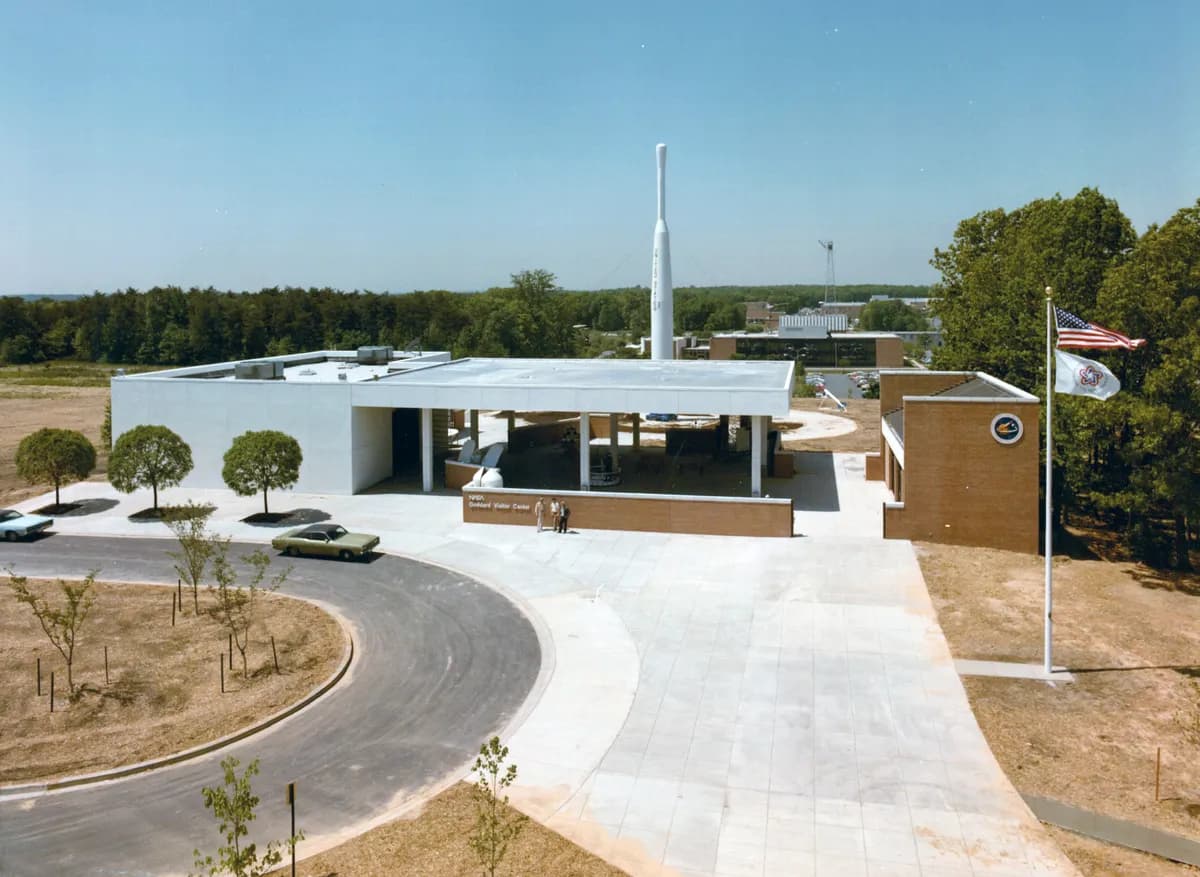
The center opened just weeks before the Smithsonian's National Air and Space Museum, according to NASA officials. Much of the visitor center was open-air at the time. Initial exhibits included a full-scale mockup of the Orbiting Astronomical Observatory, a phone station that transmitted voices 45,000 miles round trip via the Applications Technology Satellite-3, and an active meteorology station displaying satellite views of Western Hemisphere weather.
The original structure and grounds once housed WWV, a radio station for the Bureau of Standards. WWV relocated to Colorado in the mid-1960s, and campus legend holds that its broadcasts interfered with Apollo Program tests, necessitating the move. NASA Goddard used the transmitter building for facility maintenance storage until renovations for a visitor center began in 1975.
Today the center features a 4K science film theater, Hubble telescope artifacts, and a custom-programmed Roman telescope video game arcade. The facility operates with a team of volunteers and is staffed by employees of the NASA Communication Services contract, including engagement coordinator Amanda Harvey and longtime staffer D.J. Emmanuel. Harvey said the center serves the community by providing engaging exhibits focused on NASA and Goddard. Emmanuel noted that he keeps discovering new details in the exhibits, making it a great way to introduce children to science and space. The exact opening date in May 1976 and annual visitor numbers are not specified by NASA.