

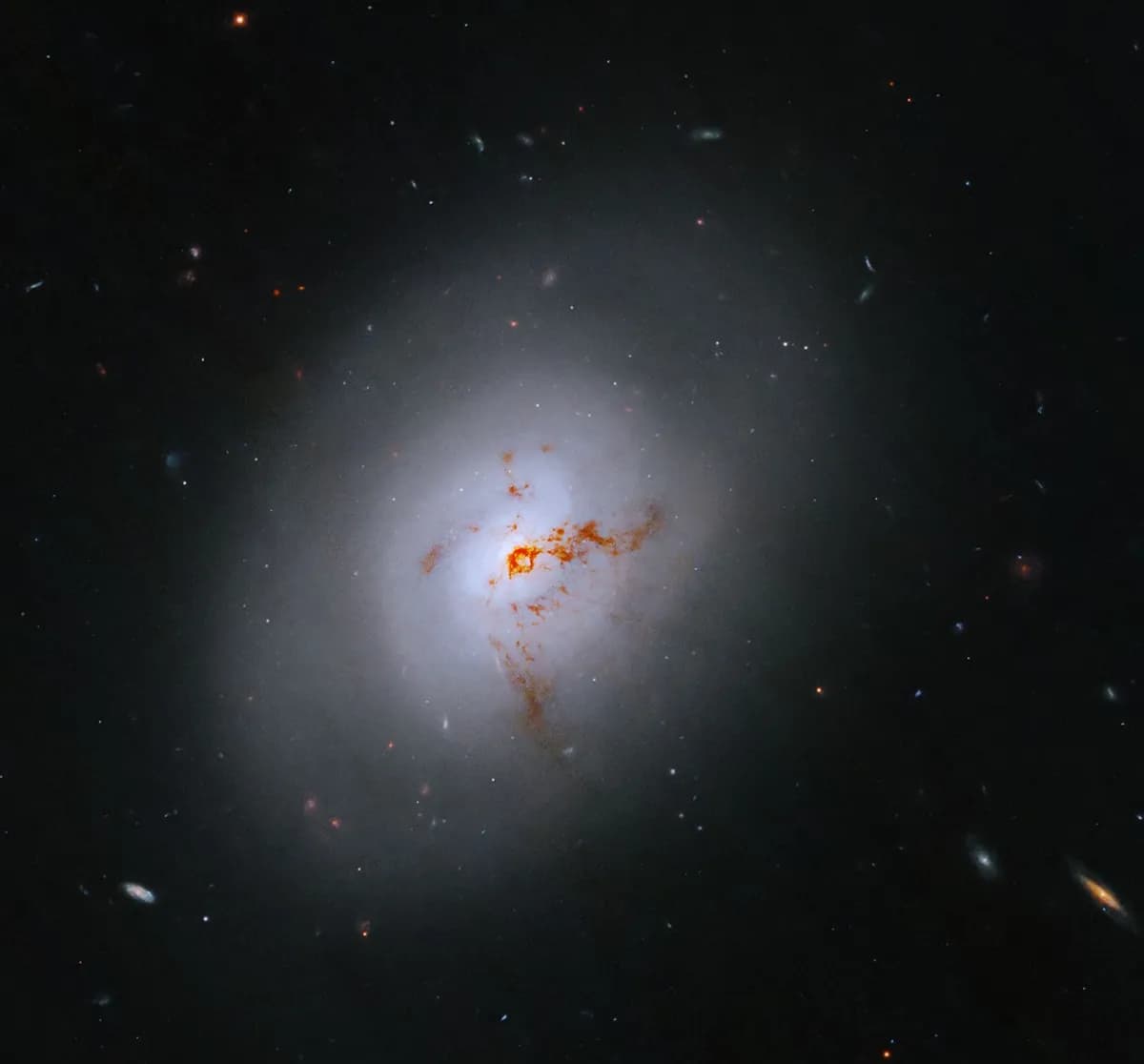
The galaxy, located in the constellation Eridanus, is a lenticular type—transitional between spirals and ellipticals—with a bright bulge and disk but no spiral arms. Only about one percent of local galaxies are post-starburst, meaning they have experienced a major burst of star formation and are now quieting down.
Astronomers believe a minor merger with another galaxy about 500 million years ago triggered the starburst and fueled the central supermassive black hole, creating an active galactic nucleus. The black hole's activity generated powerful winds and jets that, along with the burst of new stars, depleted the galaxy's star-forming gas. Turbulence from the black hole's jets also suppressed new star formation by disturbing gas and dust, preventing gravitational collapse.
Observations from Hubble and other telescopes reveal a strong outflow of shocked or highly disturbed gas from NGC 1266. Any remaining stellar nurseries are confined to the galaxy's core, with little to no star formation beyond. The exact mass of the supermassive black hole and the duration of the post-starburst phase remain unknown.