

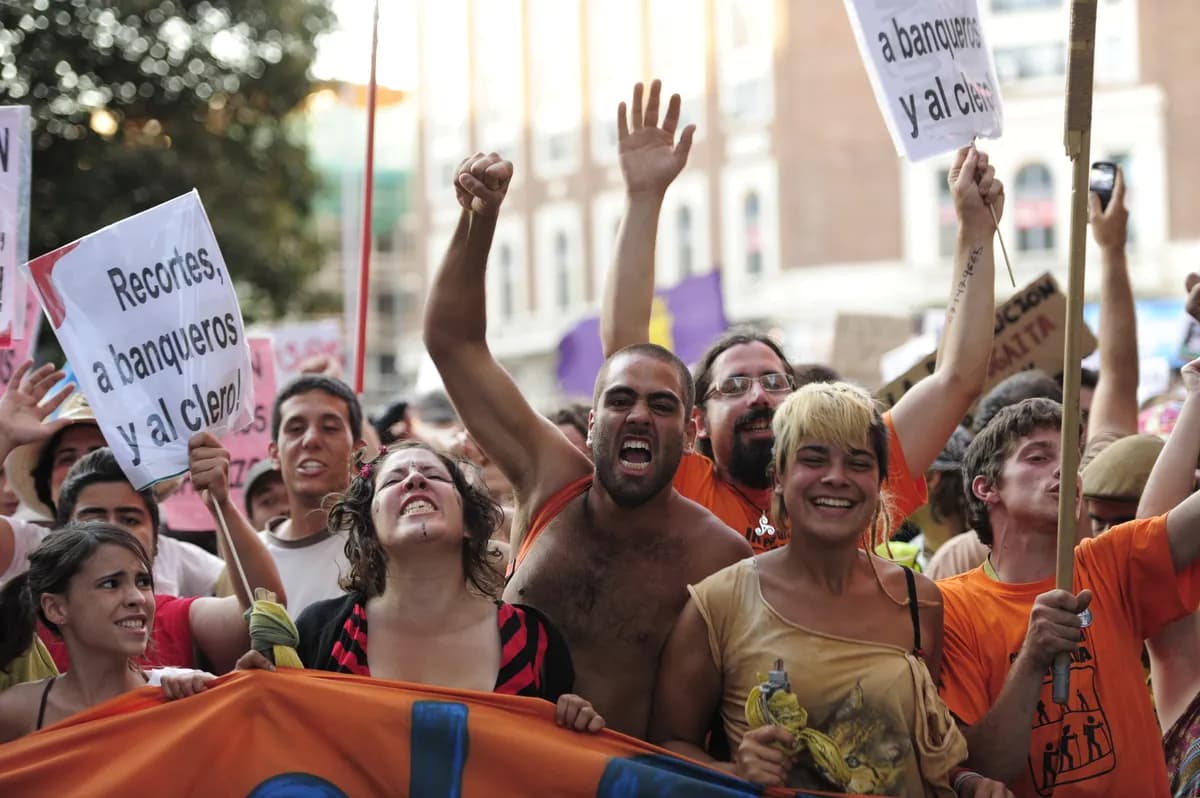
Demonstrations occurred in around thirty locations in Sweden on Saturday against the government's and Sweden Democrats' migration policy. The focus of the demonstrations was on the debated 'teenage deportations' that were paused on March 6. However, protests against the Tidö parties' strict migration policy continue, with about thirty manifestations for a more humane migration policy, mostly on the weekend.
Asylum immigration in Sweden is the lowest since 1985, and the government and Sweden Democrats have passed laws and proposals to change migration policy. Migration Minister Johan Forssell argued that stricter reforms by the government and the Sweden Democrats were necessary to bring down asylum immigration numbers and that it is impossible to return to old migration policies without unfortunate consequences. Several legal changes to tighten migration policy have led to relatives of people granted residence permits being deported from Sweden after turning 18, even if they have lived there.
In Stockholm, organizers claimed around 2,000 people joined the demonstration at Norrmalmstorg square, featuring speakers such as Green Party MEP Alice Bah, climate activist Greta Thunberg, and former Social Democrat heavyweight Carl Tham. An estimated 1,000 people joined a protest in Stockholm's Sergels Torg on Saturday in support of the estimated 600 people facing deportation as a result of the government's decision to scrap the 'track change' law in April last year. The Stockholm protest followed protests in Stockholm, Malmö, Lund, Umeå, Norrköping, Linköping, Skövde, Härnösand, Mora, and Biskops-Arnö on December 18th, which the UN has designated International Migrants' Day.
A manifestation with speeches and music was held at Rådhustorget in Umeå on Saturday, with around 500 participants advocating for a more humane migration policy. Hundreds of protesters joined the biggest procession in Umeå. Around 30 different organizations co-organized the manifestation in Umeå. In Malmö, there was a good turnout to the demonstration despite heavy rain, with several hundred people coming to chant, drum, and listen to speeches. The Malmö protest was led by pro-migration groups such as Refugees Welcome Sverige, Ensamkommandes Förbund, Malmö Antirasistiska Förening, and Amnesty Malmö, as well as the Church of Sweden, ABF Malmö, and the Malmö Red Cross. 500 people participated in the demonstration in Örebro, co-organized by trade unions, the Swedish Church, and Stadsmissionen.
A manifestation against the government's migration policy was held in Kisa, attracting about 20 people. Maj-Viol Thostrup (V) participated in the manifestation in Kisa. Five of the Church of Sweden's bishops are participating as speakers in the protests. Raymond Lilja was one of several speakers when the Church of Sweden manifested for a humane migration policy at Stora torget in Borås on Saturday, part of efforts at several locations in the country.
Sisters Diya and Kani Hassan, aged 21 and 19, were speakers at the Örebro demonstration, stating their lives are at stake and they are worried due to having received deportation decisions. Anzhelika Yanus-Andriievska, from Ukraine, has lived in Sweden for 15 years without a residence permit and protested against the migration policy. Najj Ibed has a deportation decision confirmed by the Migration Court in October 2024 but remains in Sweden, where he has tried to get a residence permit for over thirteen years after arriving from Sudan in February 2013.
Cross-country protests in Sweden were coordinated by the group För en human migrationspolitik (for humane immigration policy). The campaign aims to highlight consequences of current migration laws and gather support for a policy that is legally secure, predictable, and humane. Organizations behind the protests include Rädda Barnen, Bris, Svenska kyrkan, Vision, and Akademikerförbundet SSR. Some 4,700 people affected by the track change abolition have formed a protest group on Facebook which is helping to coordinate their campaign.
A group of about 500 migrants traveled through southern Mexico on Wednesday, protesting long waits for paperwork and requesting authorization to move to areas with greater employment prospects. The group left Tapachula, near the border with Guatemala, on Tuesday night to highlight their situation and gain permission to find work elsewhere while their immigration status is processed. On the day the march began, the Mexican government announced a new agreement to boost labor inclusion for people in transit across southern states such as Campeche, Chiapas, Tabasco, and Quintana Roo.
Tapachula has long served as a hub for transient populations and has seen an influx of third-country nationals, particularly Cubans deported by the Trump administration, although the Mexican government has not released official figures. The Southern Border Monitoring Collective warned that people in transit are paying up to 40,000 Mexican pesos (about $2,300) for documentation that is legally free. The Southern Border Monitoring Collective denounced increased militarization of Mexico’s southern border and the Northern Triangle, stating it has intensified risks and abuses faced by migrants.
Joandri Velázquez Zaragoza arrived in Tapachula in August 2024, sought a U.S. asylum appointment via the CBP One app unsuccessfully, filed for asylum in Mexico after the program ended under Trump, and had his application and appeal rejected. On Monday, Mexican authorities discovered 229 migrants trapped inside a truck in Veracruz, found when migrants shouted for help after the vehicle was towed to a police impound lot.
Police were present at the Umeå manifestation and took the matter seriously. The group marched under the observation of the National Guard, the National Migration Institute, and local police, none of whom attempted to stop them.
Another manifestation is planned for Saturday at Tyska torget in Norrköping, with protests continuing around the country over the weekend. A demonstration was arranged on Fristadstorget in central Eskilstuna on Saturday afternoon due to recent deportations of young people of high school age. 'Demonstration for a humane migration policy' is arranged at 32 locations in Sweden, with Storgatan in Luleå being one site on Saturday. About ten manifestations are planned from Luleå in the north to Malmö in the south, with the message that children should not sit in prison, aiming to show massive opposition to a lowered age of criminal responsibility.
These protests called for the government to scrap a proposal which would abolish permanent residency for asylum-based immigrants and recall permanent residency permits already issued. A petition against the recall of permanent residency permits has now received more than 7 signatures.
Protesters have not specified detailed legal demands beyond a general call for a humane migration policy, and the exact number of people facing deportation in Sweden due to the 'track change' law abolition and other changes remains unclear. The Mexican government has not officially responded to allegations of migrants paying for free documentation and increased militarization at the southern border. Organizers have not outlined next steps after these demonstrations, and the effectiveness of previous protests in influencing Swedish policy changes is uncertain, though organizers believe they have had an effect given the government's backtracking on some criticized immigration policies.