

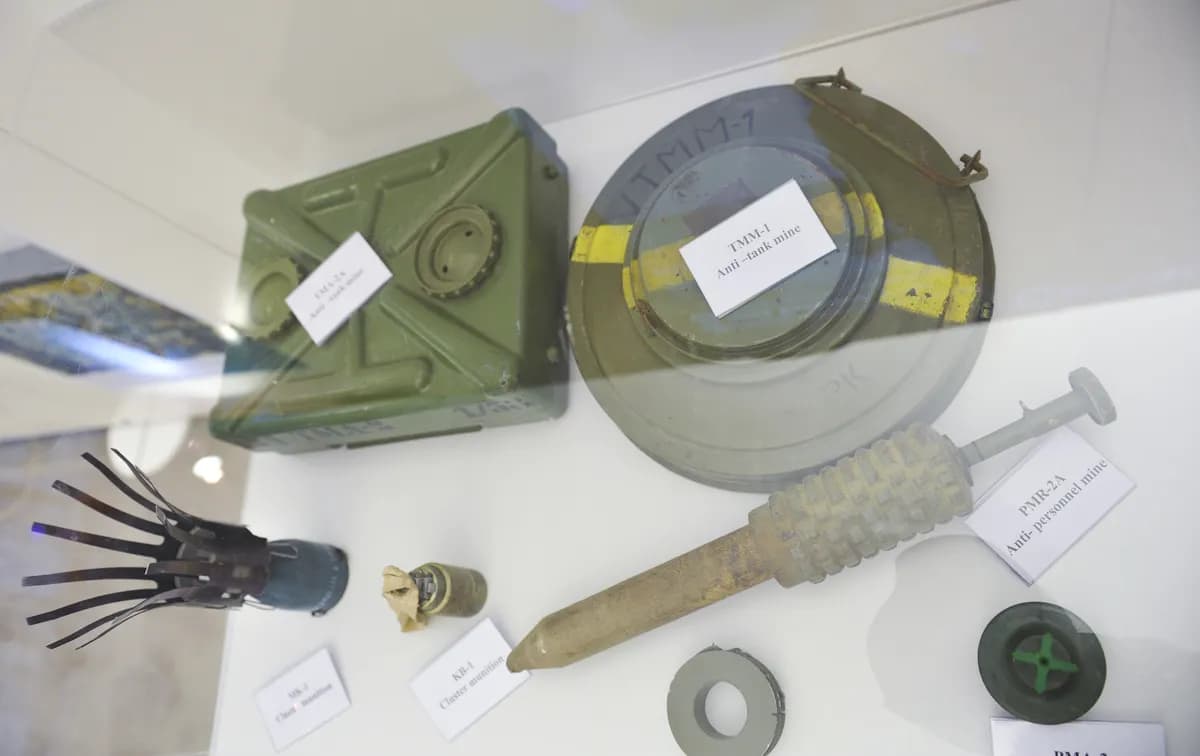
Prince Harry visited Bucha, Ukraine, where thousands of unexploded landmines left by Russian forces continue to endanger civilians, according to multiple reports. The town was the site of a massacre in April 2022, when hundreds of Ukrainian civilians and prisoners of war were killed as Russian forces withdrew. Harry, who has been a patron of Halo Trust since 2019, walked across a minefield wearing a protective vest with the charity's logo. According to Daily Mirror - Main, Prince Harry described the cleanup as a multi-decade effort, saying it will take two, three, even four decades. He also praised Halo Trust's work and noted parallels to Princess Diana's landmine walk in Angola in 1997, which he retraced during a visit in 2023. Prince Harry thanked HALO Trust charity workers clearing explosives on the front line in Ukraine during a video call on Friday, according to reports.
Ukraine is now Halo Trust's biggest operation anywhere in the world, according to multiple reports. The charity has cleared more than 123,000 landmines since 1994, but the scale of contamination in Ukraine is immense. At least 60,000 people have been killed or injured by landmines in Angola since 2008, illustrating the long-term toll of such weapons. Prince Harry joined MAG and Halo Trust at a joint event at Kensington Palace calling for a landmine-free world by 2025. While 27 countries have been declared landmine-free, over 51 million stockpiled landmines destroyed, and global trade halted since the Ottawa Treaty, more than 60 million people still live with the daily fear of unexploded munitions.
Prince Harry told ITV News that the cleanup will take two, three, even four decades.
Russian forces made significant territorial gains in Ukraine in 2025, according to multiple analyses. The Institute for the Study of War (ISW) reported that Russian forces seized 4,831 square kilometers in Ukraine and regained roughly 473 square kilometers in Kursk Oblast in 2025. AFP analysis, however, put the figure at more than 5,600 square kilometers, a discrepancy of about 769 square kilometers that may stem from different methodologies or inclusion of disputed areas. ISW and Ukrainian commander-in-chief Oleksandr Syrskii stated that Russian gains amounted to 0.8 percent of Ukraine’s territory, while other sources estimate about 0.94 percent. The average daily Russian rate of advance in 2025 was 13.24 square kilometers per day, higher than 9.87 square kilometers per day in 2024, according to ISW. Russian forces began employing a new operational template relying on battlefield air interdiction, tactical interdiction, infiltration missions, and mass small group assaults, ISW reported. They also scaled production of fiber optic UAVs resistant to electronic warfare, increasing range from 7 km to 20 km by summer 2025, and later to 50-60 km, and introduced 'mothership' drones that extend the range of FPV drones. At its furthest advance in March 2022, Russia occupied roughly 27 percent of Ukrainian territory, according to research from five sources. By late November 2022, Ukraine had reclaimed approximately 74,000 square kilometers, reducing Russian control to about 19 percent, per the Institute for the Study of War. Pokrovsk was captured by Russia in early December 2025, Reuters reported. AFP analysis noted that Russia's gains in 2025 exceed those made in 2023 and 2024 combined, with the largest monthly advance in November capturing around 701 square kilometers. However, the advance slowed in December 2025 to 244 square kilometers, the smallest monthly gain since March. Russia made its largest territorial gains in Ukraine last year since the early months of the full-scale invasion in 2022, according to multiple sources.
Ukrainian forces have had to rapidly design new technologies to clear landmines, according to multiple reports. These include a Robo dog named Spot and AI-powered drones, reflecting the urgent need for innovation in the face of widespread contamination. The exact number of landmines remaining in Bucha and the specific technologies Prince Harry tested during his visit have not been disclosed. The discrepancy between ISW and AFP territorial gain figures also remains unexplained, though it may stem from differing definitions of controlled territory.
Prince Harry praised Halo Trust's work and noted parallels to Princess Diana's landmine walk in Angola.