

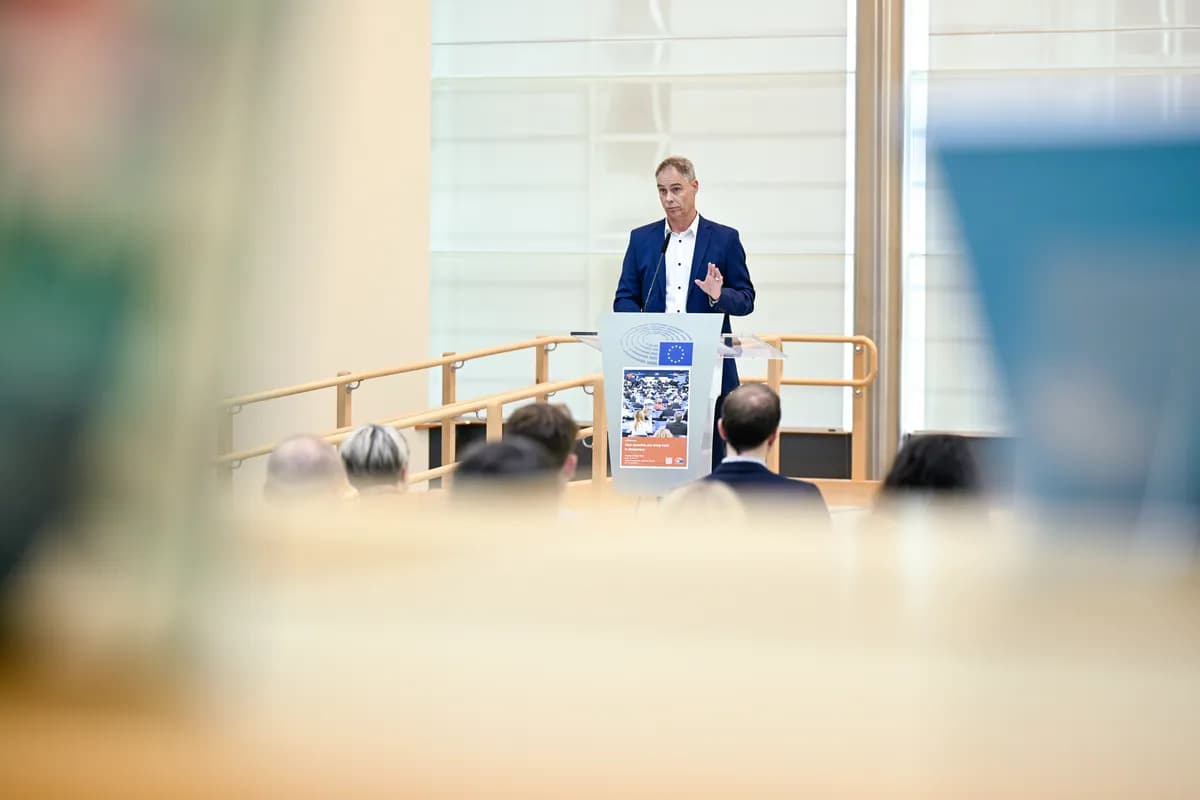
Prince Harry condemned what he described as normalized exploitation across the tech sector in a keynote at the IAPP Global Summit 2026 in Washington DC on Tuesday, speaking to an audience of 4,000 privacy professionals. His remarks came as Buckingham Palace announced King Charles and Queen Camilla will undertake a state visit to the United States in April, marking the 250th anniversary of American independence and the first such visit by a British sovereign since 2007. Harry drew on his personal battles with media intrusion to highlight privacy as a foundational issue crucial for trust, safety, and societal stability.
Earlier, at a men's mental health charity event in Melbourne, Prince Harry made personal comments about being a dad to his children Prince Archie and Princess Lilibet. He visited the Whitten Oval, the training and administrative headquarters of Australian rules football club Western Bulldogs, for the Movember charity event.
I had stuff from the past that I needed to deal with before having children.
These reflections are rooted in Harry's ongoing legal battles against British tabloids, which he has described as a central piece in destroying his relationship with his family, according to a 2024 ITV documentary. He and others, including Baroness Doreen Lawrence and Sir Elton John, are waiting to hear whether they have won their High Court cases against Associated Newspapers Limited, which include allegations of voicemail interception, landline tapping, and obtaining information by deception. Harry was awarded £140,600 in damages by a judge from Mirror Group Newspapers in 2023 for unlawful information-gathering, and he settled a claim against News Group Newspapers in 2025, receiving substantial damages and a full apology for intrusion and unlawful activities by The Sun.
Through Archewell Philanthropies, Prince Harry and Meghan Markle have been tackling digital harms via The Parents' Network, a pilot launched in 2022 that was partially inspired by Harry's lived experiences with privacy in the royal spotlight. The network aims to connect parents and caregivers with shared experiences around social media harms, including trauma or suicide. Harry indicated that plaintiffs in recent landmark platform liability cases involving Meta and YouTube are members of The Parents' Network, and he and Meghan spent time with impacted parties before and during platform liability proceedings.
I see parenting evolving over time and that kids are an upgrade, not to judge or blame parents.
In response to a US court finding Meta and Google liable for a woman's childhood social media addiction, Prince Harry and Meghan Markle issued a passionate statement, though its exact content has not been disclosed.
At the IAPP Global Summit, described as the world's largest annual gathering of digital responsibility professionals, Prince Harry participated in a discussion with Joe Jones, the IAPP's director of research and insights.
I needed to deal with past issues to be the best version of myself for my kids.
Family dynamics remain strained, as Prince Harry will not travel to the East Coast to visit his father during King Charles's US state visit, according to Harry's spokesperson. The two last met in September when Harry visited the UK and had private tea at Clarence House, but Harry has had a troubled relationship with King Charles and an ongoing rift with Prince William, worsened post-Megxit and after his Netflix documentary and memoir.
Prince Harry currently lives in California with Meghan and their children, Prince Archie and Princess Lilibet, where they continue their advocacy work.
I felt a disconnection in early fatherhood because my wife was creating life and I was there to witness it.
In mid-April, Prince Harry and Meghan are set to travel to Australia for engagements spanning private, business, and philanthropic activities, marking their first visit since their royal tour in 2018. Meghan Markle is scheduled to appear as the special guest at a women-only 'Her Best Life' retreat in Sydney from April 17-19.
Prince Harry's personal experiences, from media intrusion to fatherhood, deeply shape his advocacy against digital and media harms.
My therapist advised me to be aware of how I feel once the baby is born, and my son Archie would cry when held if I was stressed, suggesting Archie could 'pick up' on my energy.
Reactions to Harry's efforts and the outcomes of his legal battles remain uncertain, with the High Court cases against Associated Newspapers Limited yet to be decided.
I used my experience with Archie to advocate for men to be more open about their mental health struggles.
I drew on my personal battles with media intrusion to condemn what I described as normalised exploitation across the tech sector.
I believe digital governance professionals can ultimately prevail in finding answers to complex privacy and online safety questions with AI and emerging technologies.
I had no idea there were so many people working on digital governance issues.
I hope that progress can be made on mitigating growing digital harms through the work of professionals in digital governance.
I thank attendees for their work, comparing taking on powerful institutions to 'turning an oil tanker'.
Progress on digital governance has taken too long but I feel we are 'on the cusp of something transformational'.
When Meghan and I moved to the U.S. in 2020, we noted how everyday life was 'deeply affected' by the online landscape, particularly mental health.
Even one child taking their own life because of content pushed through social media is fundamentally wrong.
I expect legal wins in platform liability cases will spur justice for thousands of plaintiffs seeking redress for platform harms.
One of the biggest hurdles to addressing children's online harms is a child's modern perception of privacy and safety.
I have experienced a lack of privacy 'from birth'.
There has been a personal and reputational cost for me, my wife, and our children from legal battles against 'powerful institutions'.
Privacy is a 'foundational issue' crucial for 'trust, safety and the stability of our societies'.
I've spent the past seven years in litigation against three media organisations in the UK over systemic and unlawful invasions of privacy.
My legal fight was 'absolutely' worth it despite the personal and reputational cost to me and my family.
I described the 'worst examples of an industry that too often behaves as though it owns people's privacy'.