

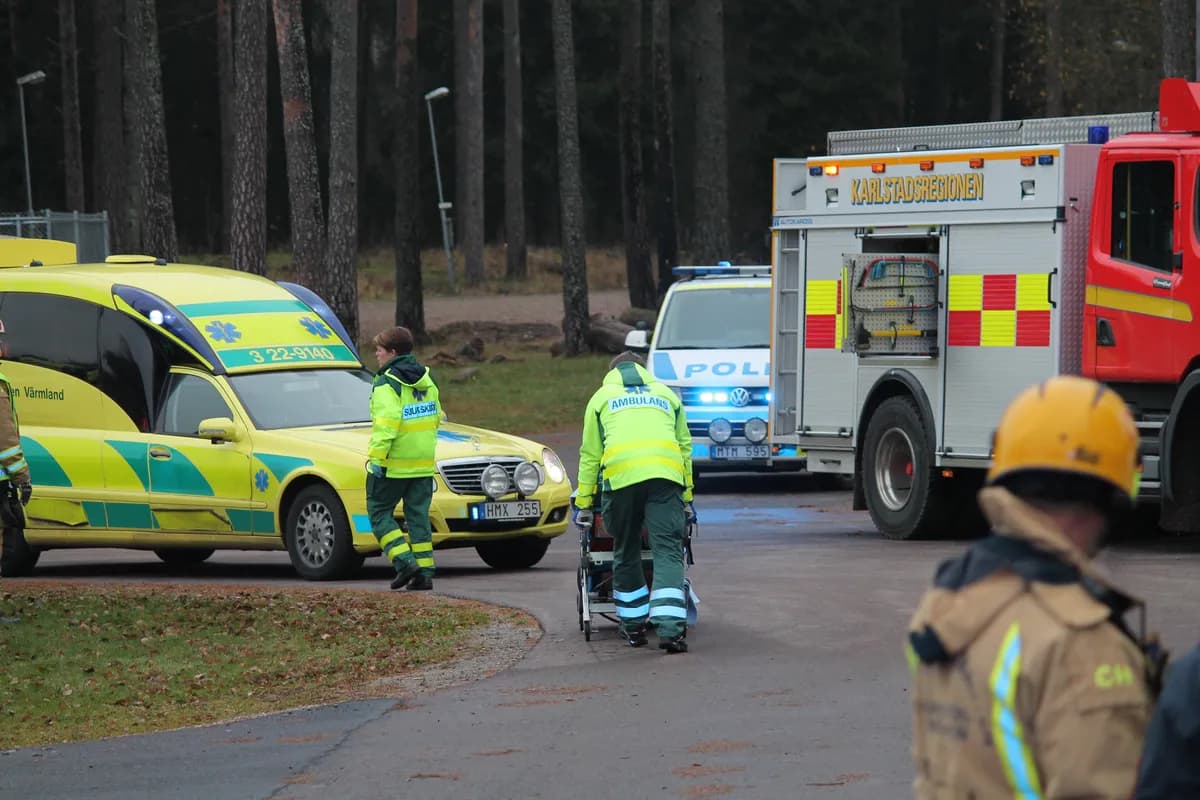
In Norrköping, police and ambulance crews are on site in the Hageby district following a report of a serious crime. According to Pernilla Svensson, RLC-befäl at the police, the operation is ongoing and involves a serious offence. The alarm was received around 7 PM, and police have stated there is no danger to the public. One person has been transported to hospital by ambulance, though the nature and severity of their injuries have not been disclosed.
Meanwhile, in Drammen, Norway, police and an air ambulance responded to an address on Sunday morning after a report of a serious violent incident. The Sør-Øst police district confirmed that one person was injured and has been airlifted to Ullevål hospital for treatment. Police said they are still in the initial phase of the investigation and are working to establish what happened. No suspects have been identified or arrested in either case, and the specific location in Drammen has not been released.
Authorities have not indicated whether the two incidents are connected. In Norrköping, the police have not provided details on the type of crime or the condition of the injured person. In Drammen, the investigation is at an early stage, and further updates are expected as more information becomes available.
In a separate development, new research sheds light on pre-Christian ritual and political structures in Scandinavia. According to two research sources, the sacred horse—referred to as a mare or steed—functioned as a ritual and political focal point in pre-Christian Europe and Scandinavia. The term 'Sal', as in Uppsala, originally referred to a saddle, not a hall, and the saddle may have served as a ritual throne. This reinterpretation challenges long-held assumptions about early power centers.
The research also highlights the role of female leadership. The term 'Val' or 'Vala' (not völva) denoted a protective and maternal authority function that shaped early power centers. The study argues that female leadership and pre-Christian structures were systematically obscured through medieval linguistic shifts, place-name alterations, and cultural memory manipulation.
Methodologically, the study employs what researchers call 'the historical X-ray machine'—a systematic cross-referencing of digital registers and primary sources. The dataset includes historical cadastral maps from Lantmäteriet, place-name archives of Isof, SAOB, Fornsök, and the Swedish Runic Registry. AI tools are used as advanced analytical support to test hypotheses and identify recurring frequencies within the data. The document is a revision document (Edition 1, February 2026) and is continuously updated.
Broader archaeological context is provided by noting that over the last two decades, archaeological explorations, theoretical advances, and new methodological strategies have changed understanding of Northern Iron Age societies. The profound effect of 6th century climatic events on social structures in Northern Europe is also noted. The volume 'Re-imagining Periphery' is an edited volume on Iron Age and Early Medieval research in the North, while a second source is a book on Swedish design history from the 1840s to the 2000s.