

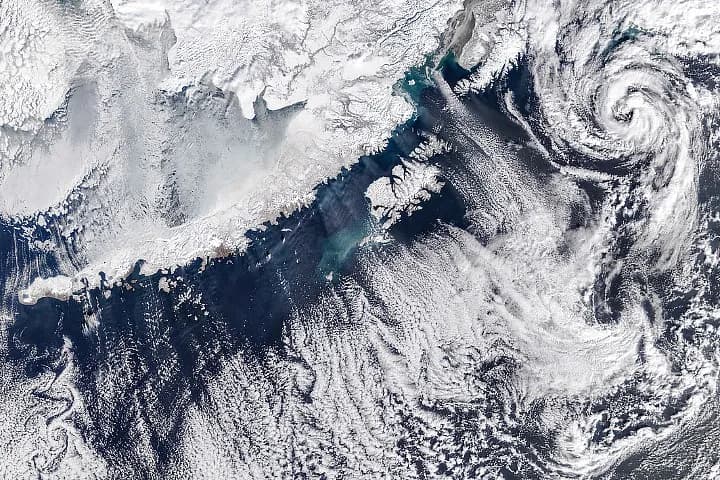
According to NASA, cold Arctic air poured over warmer ocean waters as a low-pressure system over the Gulf of Alaska combined with high pressure over eastern Russia and northern Alaska. This created cloud streets aligned with the wind direction, while near the shore the air mass had not yet gained heat and moisture, keeping skies mostly cloud-free. Farther over the gulf, the cloud streets matured into open-cell clouds, and von Kármán vortex streets were visible on the lee side of Unimak Island.
The formations were captured by a NASA satellite on March 19, 2026, the final day of astronomical winter. The extent of damage from the polar low's winds and the total snowfall from March's moderate to heavy snow remain unknown. By the end of April, weather had warmed, but an atmospheric river was approaching Southcentral and Southeast Alaska, bringing unsettled, wet weather.