

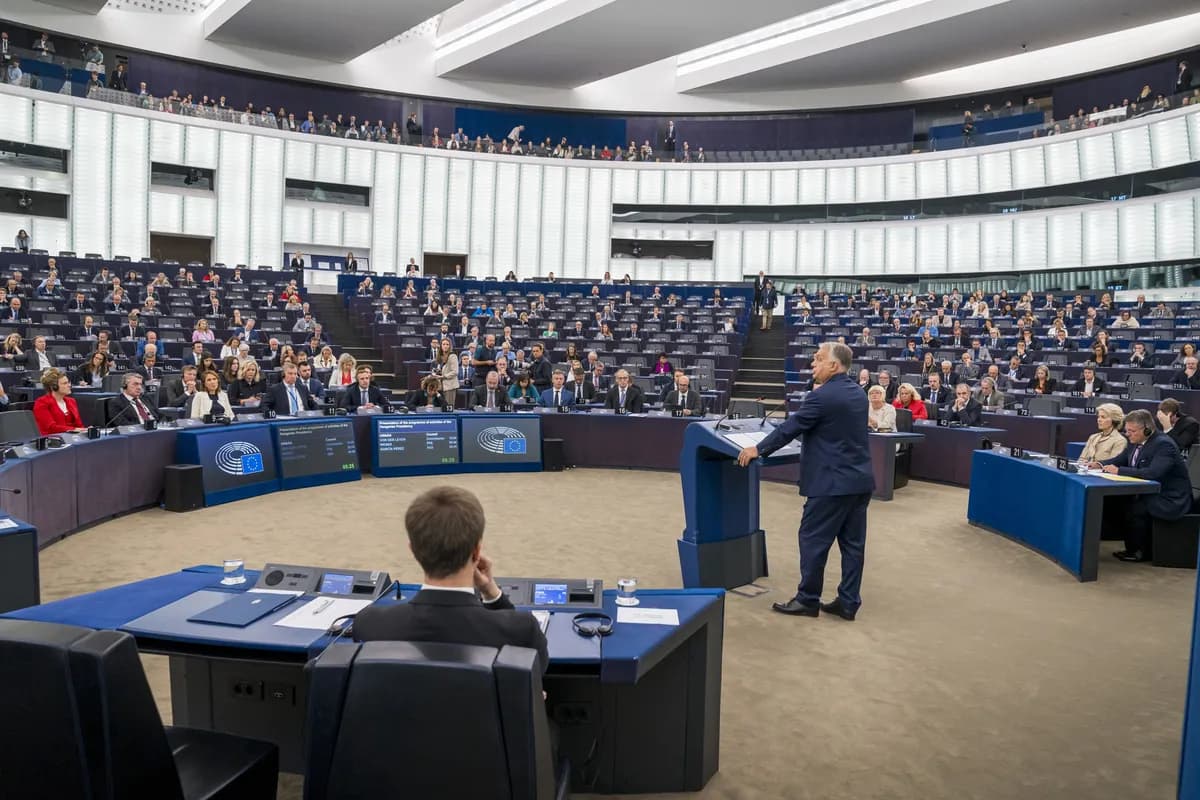
Sveriges Radio Nyheter reported that Orbán's defeat is not particularly good news for Russian leader Vladimir Putin. Orbán's government had close contact with Russia, according to NRK Urix, and had blocked key EU actions: a 90 billion euro loan to Ukraine, the EU's 20th sanctions package against Russia, and formal EU membership negotiations with Ukraine. According to NRK Urix, Varg Folkman described the hope that the new Hungarian government will be more cooperative on Ukraine matters and that the EU will no longer have an active listening post for Russia in its highest assembly. He also described how, under Orbán, Hungary conducted large-scale financing of an alternative media and idea universe in Brussels that sowed discord with a fairly extreme mindset.
Orbán has been an inspiration, lodestar, and muse to US Republicans, according to The Guardian. The same outlet reported that Orbán visited Donald Trump at Mar-a-Lago and the White House three times during 2024 and 2025, and that Trump and Orbán shared admiration for Russia's president Vladimir Putin. The Guardian also reported that Vice-President JD Vance was dispatched to Hungary last week in an appeal to Hungarian voters, and that the White House was keen for Orbán to retain power.
The hope is that the new Hungarian government will be more cooperative in matters related to Ukraine, and that we will no longer have an active listening post for Russia in the EU's highest assembly.
Domestically, The Guardian reported that Orbán's defeat was due to a public groundswell against corruption, and that Orbán and his allies consolidated power over media, judiciary, and universities. The election outcome represents a significant shift after years of centralized control.
Within the European Union, Orbán has blocked EU decisions with vetoes or delays, according to NRK Urix. The EU has withheld about 200 billion kroner from Hungary due to rule of law concerns, the outlet reported. Hungary has also opposed decisions in NATO, according to NRK Urix. Europe's far-right is reacting to Orbán's historic election loss, Göteborgs-Posten reported. European Commission President Ursula von der Leyen stated that there is reason to celebrate today, that Hungarians have freed themselves as in 1956, and that the EU will now talk with the Hungarian government about those matters.
Under Orbán, Hungary has also conducted large-scale financing of an alternative media and idea universe in Brussels that has sown discord with a fairly extreme mindset.
Reactions to the change have been varied. Svenska Dagbladet reported that Orbán's loss has many cultural workers cheering and hoping for normalization of cultural life. The Guardian reported that Orbán's defeat carries symbolic and psychological significance for American politics. Sweden's Foreign Minister Maria Stenegård said she attended EU meetings expecting everything would be told to the Russians. According to NRK Urix, Varg Folkman described that it has long been rumored that Orbán took the brunt for several other EU leaders who were also skeptical of policy towards Ukraine, and that with Orbán gone, the resistance axis's foremost spokesperson disappears, though others may now take his position. Steven Cash, executive director of The Steady State, said Orbán is not only an autocrat whose loss demonstrates the resilience of democratic opposition; he is also directly relevant here. He added that the message from Hungary is unmistakable: when citizens mobilize in large numbers, even entrenched authoritarian leaders can be defeated, and autocrats may rise but are not invincible, falling when confronted by sustained democratic participation.
Key uncertainties remain following the election. It is unclear whether the new Hungarian government under Péter Magyar will agree to all EU proposals, including the Ukraine loan, sanctions on Russia, and EU membership talks for Ukraine. Questions also persist about whether other EU countries like Slovakia or the Czech Republic will take over Orbán's role in blocking EU decisions related to Ukraine and Russia, and how the change in Hungarian leadership will affect NATO decisions given Hungary's previous opposition within the alliance. The EU has not confirmed whether it will release the withheld 200 billion kroner to Hungary or what specific reforms in judiciary and prosecution will be required. The impact of Orbán's defeat on US politics, particularly the Republican Party's strategies and Trump's foreign policy alignments, also remains to be seen.
It has long been rumored that Orbán has taken the brunt for several other EU leaders who have also been skeptical of the policy towards Ukraine.
There is a possibility that others now take his position, but with Orbán gone, the resistance axis's foremost spokesperson disappears.