

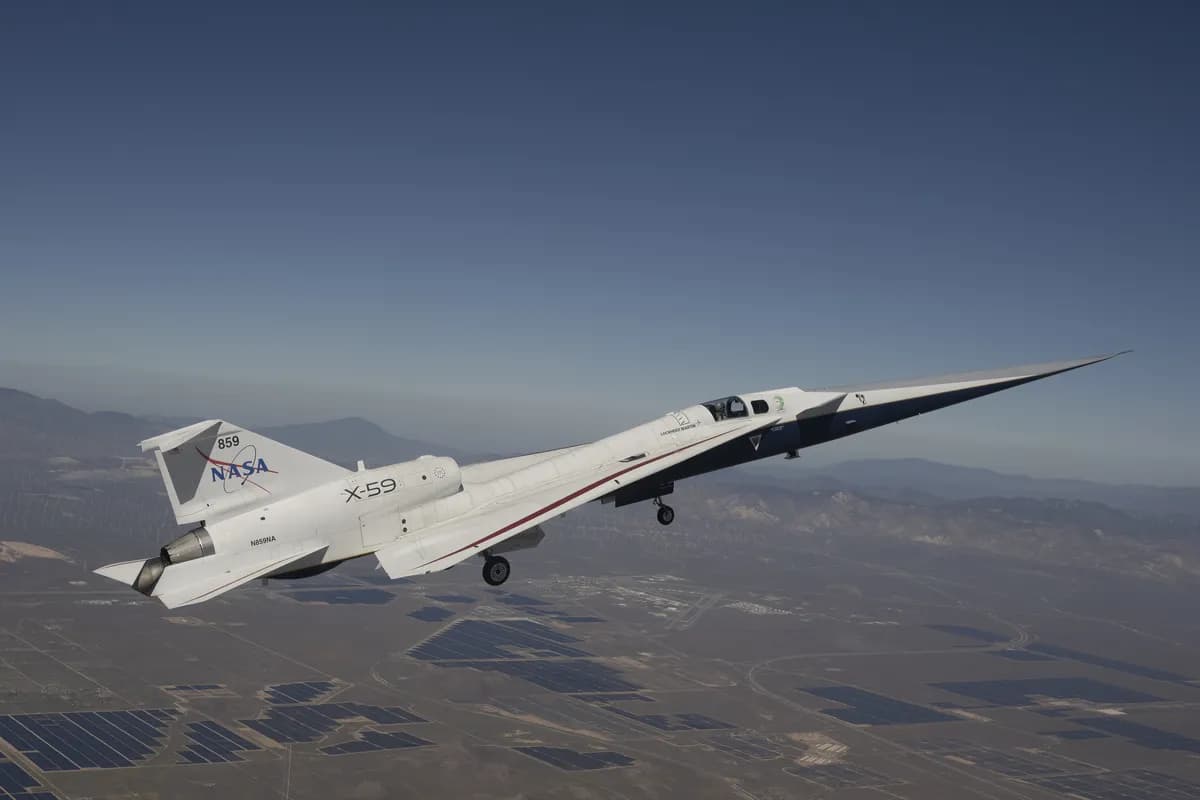
Pilot Jim 'Clue' Less saw a vehicle system warning in the cockpit several minutes into the flight, according to NASA officials. The specific technical issue that prompted the early landing has not been disclosed, and it remains unclear what data was collected during the abbreviated flight and how it will inform future tests.
This flight follows the X-59's previous milestone on April 3, when it flew with its wheels up for the first time, according to major media reports. That wheels-up flight lasted 90 minutes and reached 20,000 feet. Experimental aircraft typically make their earliest test flights with the landing gear down, then begin retracting it after successfully meeting performance benchmarks, NASA has noted.
As we like to say, it was just like the simulator – and that's what we like to hear.
The X-59 is designed to fly supersonic while generating only a quiet thump instead of a loud sonic boom. It is the centerpiece of NASA's Quesst mission, which aims to make commercial supersonic flight over land a reality. According to major media reports, the X-59's relatively quiet flying should help solve the noise problem that has made supersonic planes unsuitable for flying over populated areas.
Looking ahead, the X-59 is set to accelerate testing in 2026, demonstrating performance and airworthiness during envelope expansion, NASA officials said. According to major media reports, the X-59 is projected to fly at Mach 1.5, or about 990 mph (1,590 kph). At that speed, it could potentially fly non-stop from London to New York in approximately three hours 44 minutes.
This is just the beginning of a long flight campaign.