

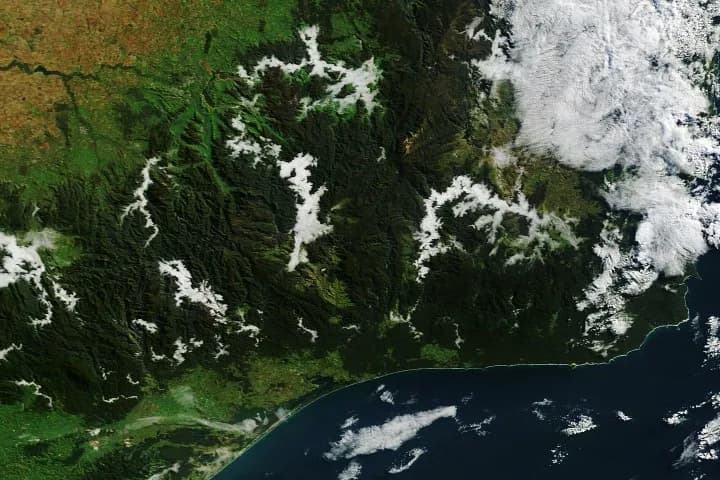
The fog, known as radiation fog, forms in clear, calm conditions at night as the atmosphere cools and water vapor condenses. Cold air sinks into valleys, allowing fog to develop there first. In low-elevation areas, radiation fog usually fades as the Sun warms the ground, but it tends to linger in mountain valleys because they remain shaded longer.
Geostationary satellite imagery shows the fog persisting for about two hours on that day. A blast of cold, soggy weather primed the region by moistening land surfaces a few days prior to the arrival of a slow-moving high that brought calmer, warmer conditions conducive to fog formation. Many valleys in the mountains have rivers, streams, and lakes, which amplified the fog formation process by providing a ready supply of water vapor.
Zones of fog formed along several water bodies, including the Mitta Mitta River, Buffalo River, Livingston Creek, Lake Dartmouth, and Snowy River. m. local time, the Terra satellite also captured an arch-shaped cloud over Port Phillip Bay, roughly stretching from St.
Leonards on the bay’s western shore to Mount Eliza on the eastern side. The arch-shaped cloud likely formed as converging land and sea breezes interacted with the horseshoe-shaped terrain that defines the bay. Geostationary satellite imagery shows the arch-shaped cloud moving southward across the bay as the valley fog to the northeast faded.
Fog is a low-lying type of cloud composed of tiny water droplets suspended in the air. The main difference between a cloud and fog is that the base of fog reaches the ground, while the base of a cloud is generally well above the surface.