

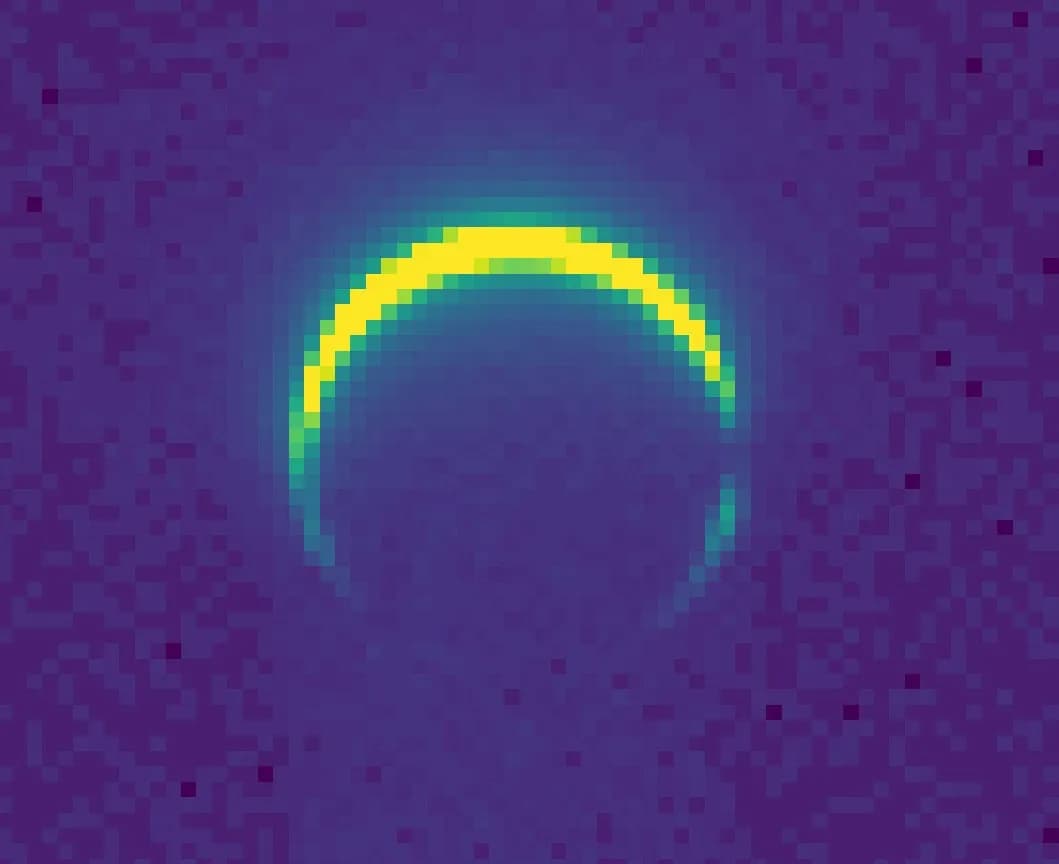
The spacecraft is approaching Mars for a gravity assist on May 15, 2026, to boost speed and adjust trajectory toward asteroid Psyche, where it is expected to arrive in 2029. According to NASA, Mars appears as a thin crescent in the image due to the spacecraft's high-phase angle viewing geometry. The image was acquired using the multispectral imager's panchromatic filter with a 2-millisecond exposure time.
Parts of the image are oversaturated because the crescent is extremely bright even with a short exposure. The light in the image is sunlight reflected off Mars' surface and scattered by dust particles in its atmosphere. The dustiness of Mars causes the crescent to appear extended farther around the planet than if it had no atmosphere.
A gap appears on the right side of the extended crescent, coinciding with Mars' north polar cap. NASA mission specialists hypothesize that seasonal clouds and hazes may be blocking atmospheric dust's ability to scatter sunlight in that region, as the north polar cap is currently in winter. The Psyche imager team will acquire similar images leading up to the May 15 close approach.
The images are primarily for calibrating cameras and characterizing performance in flight as a practice for the 2029 asteroid approach.