

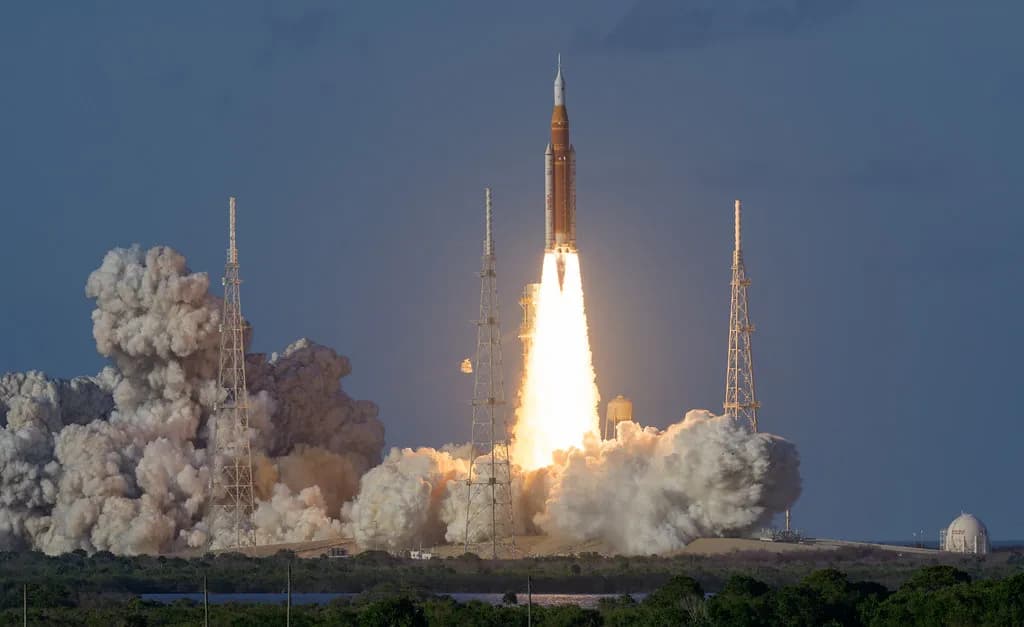
Artemis II will carry NASA astronauts Reid Wiseman, Victor Glover, Christina Koch, and Canadian Space Agency astronaut Jeremy Hansen, according to research from multiple sources. The mission will follow a free-return trajectory around the Moon, reaching a distance of roughly 4,700 miles beyond the lunar surface before returning to Earth. The Orion spacecraft will reenter the atmosphere at approximately 25,000 miles per hour, testing critical systems for future deep-space exploration. This flight represents the first crewed mission of NASA's Artemis program, which aims to establish a sustainable human presence on the Moon and eventually send astronauts to Mars.
The crew includes several historic firsts. Victor Glover will become the first person of color, Christina Koch the first woman, and Jeremy Hansen the first non-US citizen to travel beyond low Earth orbit to the Moon's vicinity, according to research from five sources. Hansen, selected as a Canadian astronaut in 2009, waited 14 years for a mission; his seat on Artemis II was secured by Canada's contribution of the Canadarm3 robotic arm, according to multiple reports. If successful, Hansen will become the first non-American to leave low-Earth orbit, Koch the first woman to do so, and Glover the first person of color to achieve that milestone, major media outlets report. The four-member crew has been training extensively for the mission, which will test life support, navigation, and communication systems in deep space.
Artemis II is scheduled to launch in early 2026, with a specific earliest potential launch date of April 1, 2026, according to research from three sources. NASA has completed stacking of its Space Launch System rocket and Orion spacecraft for the mission, according to five sources. The mission was originally designated Exploration Mission-2 and was initially intended to support the now-canceled Asteroid Redirect Mission, according to research. Artemis II will use the last two of the discontinued Interim Cryogenic Propulsion Stages (ICPS), while Artemis IV and beyond will use the new Exploration Upper Stage (EUS), according to multiple sources. The ten-day flight will test the Orion spacecraft's capabilities in a deep-space environment, including its heat shield during reentry at high speed.
I hope that humanity will stop and be reminded that we can do a better job of lifting each other up.
Artemis III is planned as a crewed demonstration mission in low Earth orbit to test lunar landers, according to research from five sources. However, the purpose and timeline of Artemis III are unclear, affecting understanding of the Artemis program's progression. Some sources describe Artemis III as a docking test of Orion in Earth orbit planned for 2027, while others emphasize its role in testing landers. Artemis V, planned for late 2028, will land two astronauts on the Moon and begin building a Moon base, according to five sources. NASA's long-term goal is to send astronauts to Mars using technology developed during Artemis, according to two sources. The agency recently paused work on the Gateway space station and is instead focusing on building a moon base, according to Space.com, though the future of Gateway remains uncertain, impacting international partnerships and mission architecture.
NASA introduced 10 new astronaut candidates in September 2025, selected from more than 8,000 applicants, according to five sources. Sean Duffy is serving as acting NASA administrator, awaiting confirmation of Jared Isaacman, according to NASA. Isaacman's nomination hearing took place in early December 2025 and passed out of committee with bipartisan support, NASA reported. NASA named Amit Kshatriya to associate administrator, the agency's highest-ranking civil servant position, according to NASA. In 2025, NASA and its partners landed two robotic science missions on the Moon, launched a joint satellite mission with India to monitor Earth's land and ice-covered surfaces, identified and tracked the third interstellar object in our solar system, achieved 25 continuous years of human presence aboard the International Space Station, and flew a test flight of the X-59 supersonic plane for the first time, according to research from five sources each. These achievements underscore NASA's broad portfolio of exploration and science.
According to BBC News - Science, Jeremy Hansen described his hope that humanity will be reminded to lift each other up. The interview was conducted by Rebecca Morelle and Tim Peake, according to major media. Several unknowns remain: the exact launch date for Artemis II has not been confirmed, the specific purpose and timeline of Artemis III are unclear, and it is uncertain whether the Gateway space station is paused or still part of the plan. Additionally, the timing of Jared Isaacman's confirmation as NASA administrator is unknown, and the exact distance and speed profile for Artemis II have not been fully detailed.