

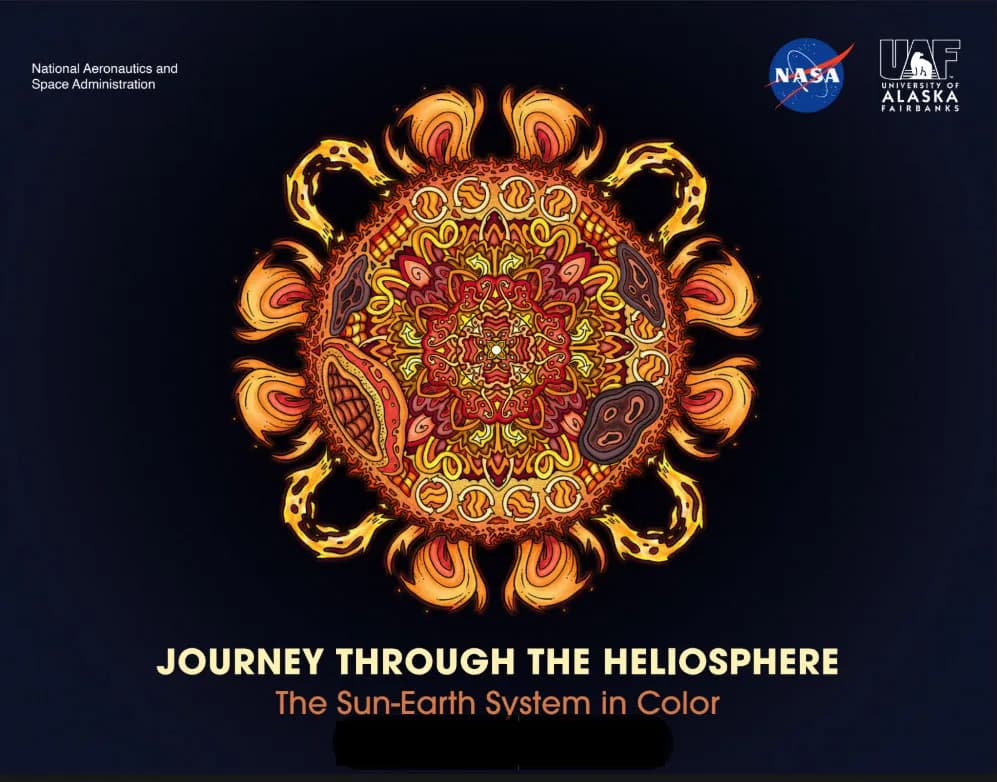
The coloring book features a reference chart of solar terms in seven of Alaska's Indigenous languages, with input from 13 Alaska Native language speakers. Links within the book connect to an online pronunciation guide for correct pronunciation. Staff from NASA, Oregon State University, the UAF International Arctic Research Center, and the Geophysical Institute collaborated over two years to create the book, which was conceived as part of NASA's Heliophysics Education Activation Team (HEAT).
The book has twenty-eight 11x14-inch pages and includes a glossary of scientific terms on the last two pages. It is designed for students in grades 6-12 and adults. Lynda McGilvary, leader of the Geophysical Institute's education outreach team, said the project leveraged each organization's strengths to increase heliophysics literacy.
It leveraged the strengths of each organization in a way that resulted in something that will support the goal of increasing America’s heliophysics literacy one coloring page at time.
She described it as a 'labor of love' and expressed hope that it would encourage people to explore heritage languages. The book's availability in print or digital format has not been specified.
I think it was a labor of love for us.
We hope that it will lead people to independently seek out and use other languages, especially the heritage languages of their friends and neighbors.
This coloring book is a tangible reflection of that relationship and the fact that it extends beyond the amazing science that NASA and UAF conduct together.
It was such a privilege to work with NASA’s heliophysics experts on this publication, and I personally learned so much more about the Sun and our solar system in the process.