

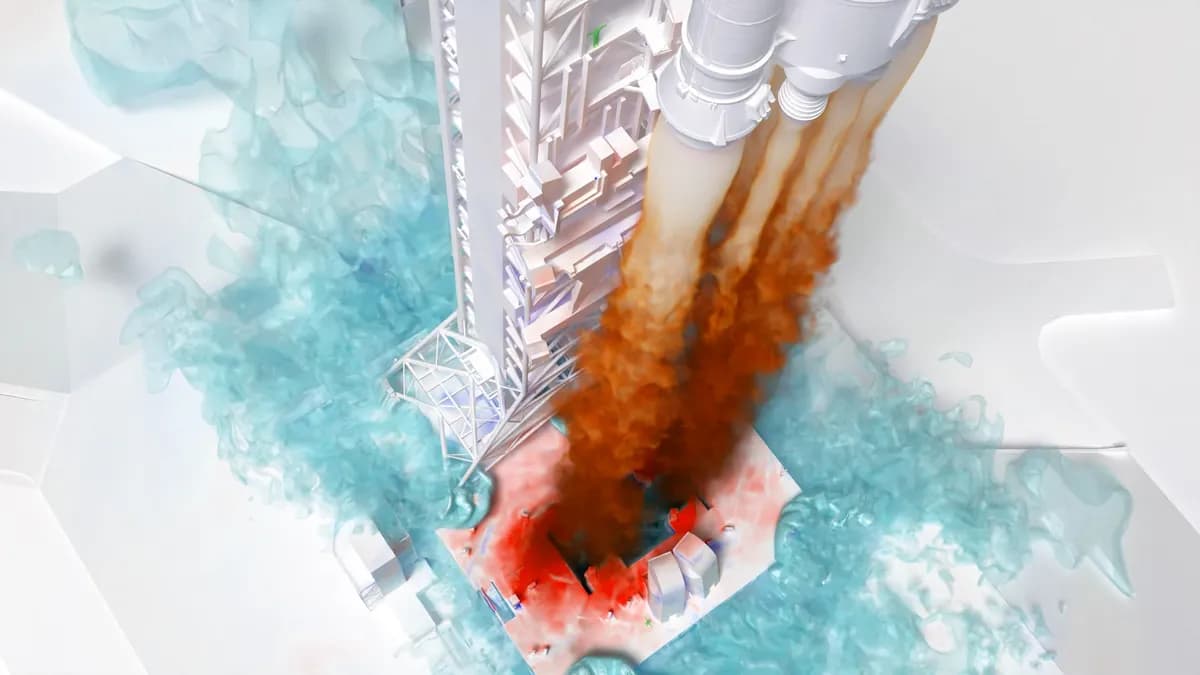
The software, which helps predict how air moves around rockets, aircraft, and spacecraft with high accuracy, is compatible with computer hardware using graphics processing units (GPUs). GPUs can run many tasks simultaneously and reduce power consumption. LAVA has yielded stand-out efficiency on NASA's flagship GPU-based supercomputer, Cabeus.
The tool enables scale-resolving simulations that capture high-fidelity renderings of phenomena such as pressure waves, turbulent swirls, and acoustic signatures. NASA has used LAVA to help launch and land spacecraft on the Moon and Mars and to drive innovation for next-generation aircraft. For example, LAVA was used to understand supersonic parachute deployment for Mars missions.
This isn’t only about releasing software; it’s about accelerating innovation. When university researchers can run more complex simulations and when small companies can optimize designs with NASA-grade precision, we’re not only sharing tools, we’re unleashing potential.
"This isn't only about releasing software; it's about accelerating innovation," said Jared Duensing, LAVA team lead at NASA's Ames Research Center. "When university researchers can run more complex simulations and when small companies can optimize designs with NASA-grade precision, we're not only sharing tools, we're unleashing potential."
Specific licensing terms for the release have not been disclosed, and it remains unclear which researchers or companies have already begun using LAVA. Hardware requirements for running the software on modest computing resources have also not been detailed.