

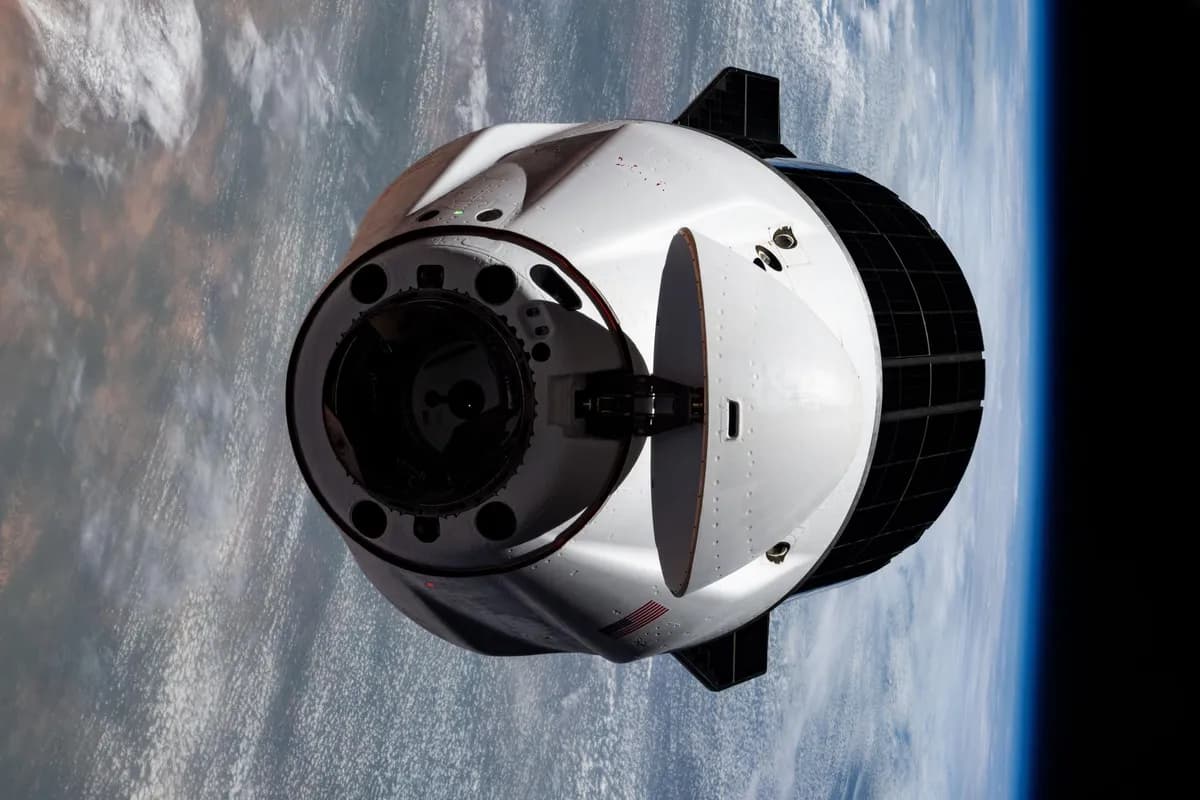
Media accreditation is open for the next U.S. launch to deliver NASA science investigations, supplies, and equipment to the International Space Station, according to NASA. This launch is the 34th SpaceX Commercial Resupply Services mission to the orbital laboratory for NASA, and it will lift off on SpaceX's Falcon 9 rocket. NASA and SpaceX are targeting no earlier than Tuesday, May 12, to launch the SpaceX Dragon spacecraft from Space Launch Complex 40 at Cape Canaveral Space Force Station in Florida.
Credentialing to cover prelaunch and launch activities is open to United States media, with the application deadline for U.S. citizens set for 11:59 p.m. EDT, Wednesday, April 29. All accreditation requests must be submitted online at https://media.ksc.nasa.gov, and credentialed media will receive a confirmation email after approval. NASA's media accreditation policy is available online, and for questions about accreditation, or to request special logistical support, email: ksc-media-accreditat@mail.nasa.gov. For other questions, please contact NASA's Kennedy Space Center newsroom at: 321-867-2468.
Each resupply mission to the space station delivers scientific investigations in the areas of biology and biotechnology, Earth and space science, physical sciences, and technology development and demonstrations. Cargo resupply from U.S. companies ensures a national capability to deliver scientific research to the space station, increasing NASA's ability to conduct new investigations aboard humanity's laboratory in space. In addition to food, supplies, and equipment for the crew onboard the station, Dragon will deliver several new experiments, including a project to determine how well microgravity simulators mimic microgravity conditions and a bone scaffold made from wood that could produce new treatments for fragile bone conditions like osteoporosis. The experiments also include equipment to help researchers evaluate how red blood cells and the spleen change in space. The Dragon spacecraft also will carry a new instrument to monitor charged particles around the Earth that impact power grids and satellites and an investigation that could provide a fundamental understanding of how planets form.
For more than 25 years, people have lived and worked continuously aboard the International Space Station, advancing scientific knowledge and making research breakthroughs that are not possible on Earth. The station is a testbed for NASA to understand and overcome the challenges of long-duration spaceflight, expand commercial opportunities in low Earth orbit, and prepare for deep space missions to the Moon, as part of the Artemis program, in preparation for future human missions to Mars.