

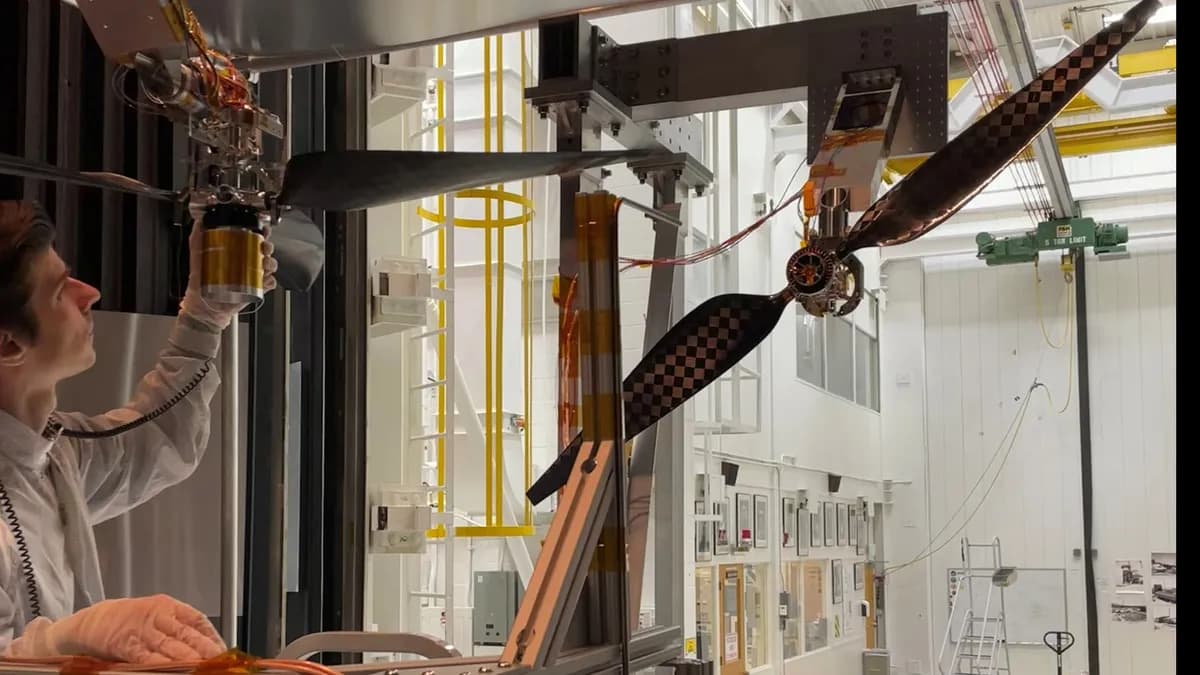
Data from 137 test runs will enable engineers to design aircraft capable of carrying heavier payloads, including science instruments, NASA said. The SkyFall project and other future Mars aircraft are expected to carry such payloads, unlike the Ingenuity helicopter, which performed the first powered flight on another world on April 19, 2021, but carried no science instruments.
Ingenuity's rotor speed never exceeded 2,700 rpm during its 72 flights, with blade tips kept at Mach 0.7 to avoid supersonic speeds, given Mars' atmosphere is only 1% as dense as Earth's. Jaakko Karras, rotor test lead at JPL, said: "If Chuck Yeager were here, he'd tell you things can get squirrely around Mach 1." He added that while Ingenuity's flights were planned to avoid supersonic conditions, "we want more performance from our next-gen Mars aircraft. We needed to know that our rotors could go faster safely." Al Chen, Mars Exploration Program manager, noted: "NASA had a great run with Ingenuity, but we are asking these next-generation aircraft to do even more at the Red Planet."
NASA had a great run with the Ingenuity Mars Helicopter, but we are asking these next-generation aircraft to do even more at the Red Planet.
That's not an easy ask. While everything about Mars is hard, flying there is just about the hardest thing you can do. That's because its atmosphere is so incredibly thin that it is hard to generate lift, and yet Mars has significant gravity.
If Chuck Yeager were here, he'd tell you things can get squirrely around Mach 1.
With that in mind, we planned Ingenuity's flights to keep the rotor blade tips at Mach 0.7 with no wind so that if we encountered a Martian headwind while in flight, the rotor tips wouldn't go supersonic. But we want more performance from our next-gen Mars aircraft. We needed to know that our rotors could go faster safely.