

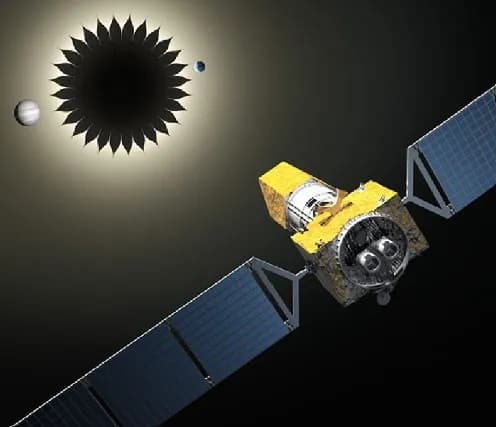
A starshade is a giant, flower-shaped spacecraft roughly half the size of a football field, designed to be positioned between a space telescope and a distant star to cast a shadow. According to NASA, a starshade can block unwanted starlight to less than one part per billion. However, a starshade must also suppress stray light from our Sun that scatters from its petal edges.
Previous methods to address stray sunlight included razor-sharp edges made from amorphous metals, only 300 nanometers thick. Even such thin metal edges would still scatter too much sunlight into the telescope, NASA said. Existing black coatings were too thick, making starshade edges thicker and increasing scatter.
Carbon nanotube coatings are several microns thick, much thicker than the 300-nm starshade edge, and other existing coatings relying on 3D microstructures to trap light were also too thick. David Sheikh, founder of ZeCoat Corporation, researched the concept of a 'black mirror' in 2004, according to NASA. Sheikh used modern computing techniques and more accurate material property data to improve a decades-old methodology.
The exact composition and manufacturing process of the new coating have not been disclosed, and its specific performance metrics remain unknown.