

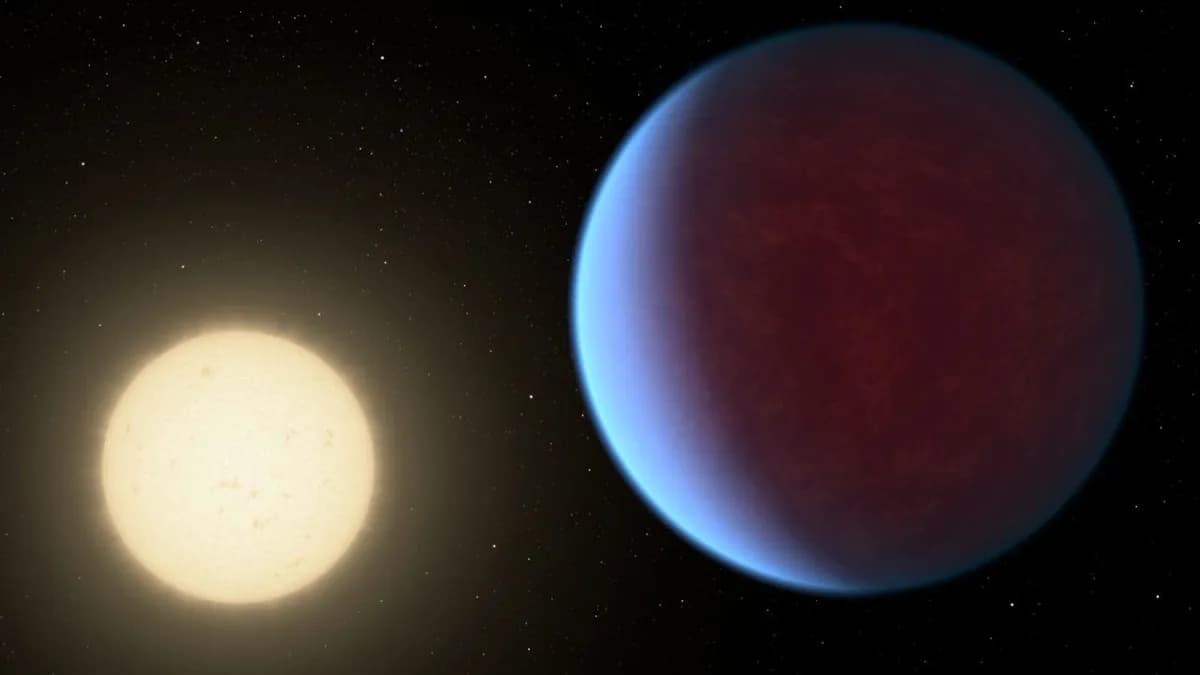
One of the goals of NASA’s Astrophysics Division is to carry out a census of nearby solar systems to search for habitable worlds around nearby stars, and ultimately, to determine whether life might be present outside our own solar system. NASA’s future Habitable Worlds Observatory mission will be the first telescope designed specifically to search for signs of life on planets orbiting other stars. Most exoplanets are not favorably aligned to pass in front of their stars; to detect them, HWO must be able to distinguish the very small bit of light coming from an exoplanet from the overwhelming glare of the very bright nearby host star. An Earth-like planet orbiting a star similar to our Sun would be only about 1 ten billionth as bright as its host star. To see faint potentially habitable worlds in nearby solar systems, we must remove the incoming starlight to such an extent that the much smaller bit of light arriving from the exoplanet can be distinguished.
Telescopes don’t produce perfect point-like images of stars due to scattering and diffraction, which blur and spread the starlight across the region of the image where exoplanets are likely to be found. Scattering of starlight is caused by surface irregularities in the mirrors that make up the telescope’s optical system and can be mitigated by using a high-performance adaptive optics system to correct the wavefront errors. Diffraction is the angular spread of a light beam that occurs as the wave passes through an aperture, such as a telescope’s light-collecting mirror, and causes the starlight to spread across the focal plane into a ringed light distribution called an Airy pattern. The Airy pattern can be many times brighter than the light emitted from an exoplanet and also needs to be removed, with suppression usually done with an optical instrument.
A team of NASA researchers is developing new types of optical masks that could help enable the many orders of magnitude of starlight suppression needed for future space observatories to pick out very faint habitable exoplanets from the far brighter glare of their stellar hosts.