

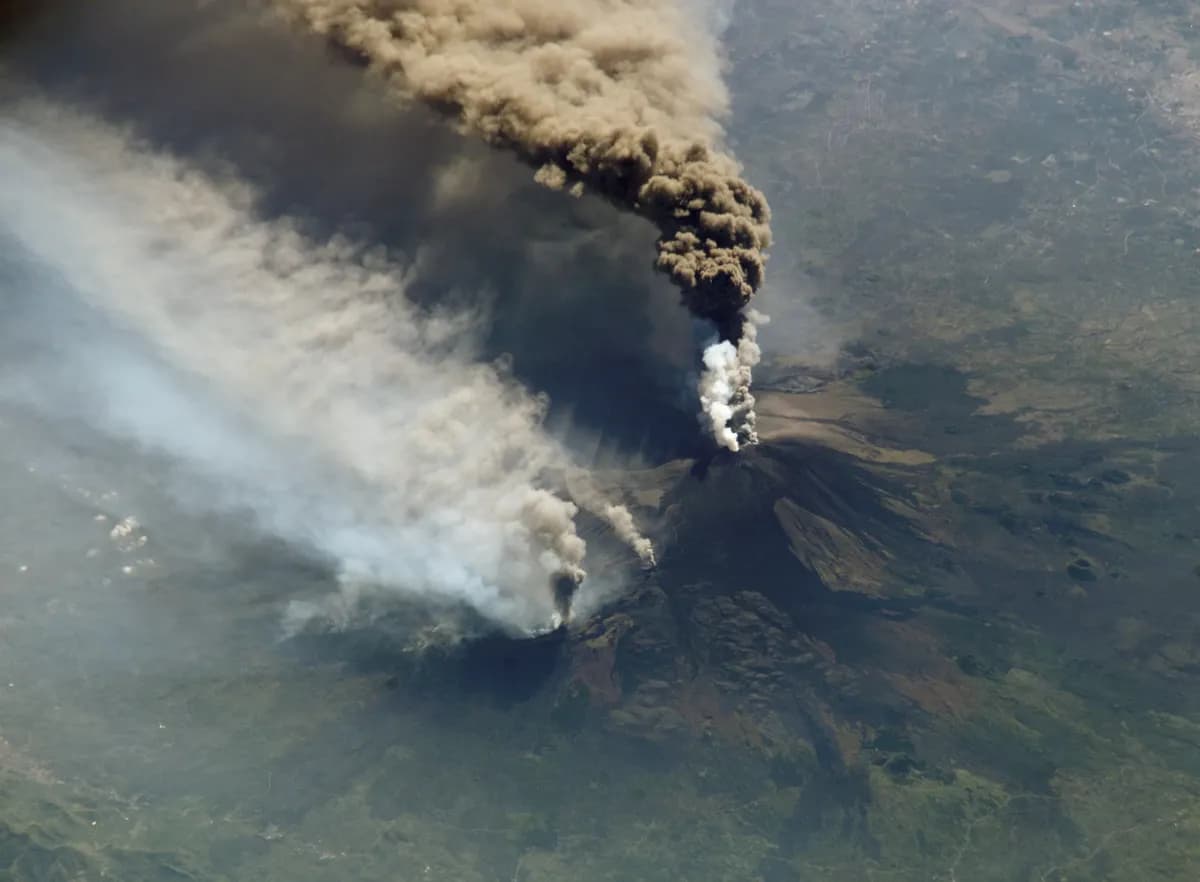
4 miles deep and leaving a large, shallow caldera. During that event, around 36 cubic miles of dense rock spewed across 1,700 square miles, with pyroclastic flows reaching up to 93 miles from the epicenter. That supereruption is thought to have wiped out the prehistoric Jomon civilisation in southern Japan.
In recent years, onlookers have noticed steam releases from the crater and the area has experienced more than a dozen small earthquakes. Researchers have discovered a region beneath the Kikai caldera has been slowly refilling with fresh magma over the last 3,900 years, and the volcano remains active with a lava dome gradually forming in the caldera center. Using airgun arrays to cause artificial seismic pulses, they measured wave movements through the Earth's crust to analyze the reservoir.
Due to its extent and location it is clear that this is in fact the same magma reservoir as in the previous eruption.
Analysis confirmed the hidden reservoir's size and shape, showing it is filling up with magma. ' Chemical analysis revealed that material from recent volcanic activity differs in composition from the last giant eruption. ' The study was published in the journal Communications Earth & Environment.
Scientists do not know when the next giant eruption might occur or how the rate of magma re-injection compares to other calderas. It remains unclear whether recent earthquakes and steam releases are directly linked to the refilling process or what specific monitoring measures are in place.
We must understand how such large quantities of magma can accumulate to understand how giant caldera eruptions occur.
This means that the magma that is now present in the reservoir under the lava dome is likely newly injected magma.
This magma re-injection model is consistent with the existence of large shallow magma reservoirs beneath other giant calderas like Yellowstone and Toba.
We want to refine the methods that have proved to be so useful in this study to more deeply understand the re-injection processes. Our ultimate goal is to become better able to monitor the crucial indicators of future giant eruptions.