

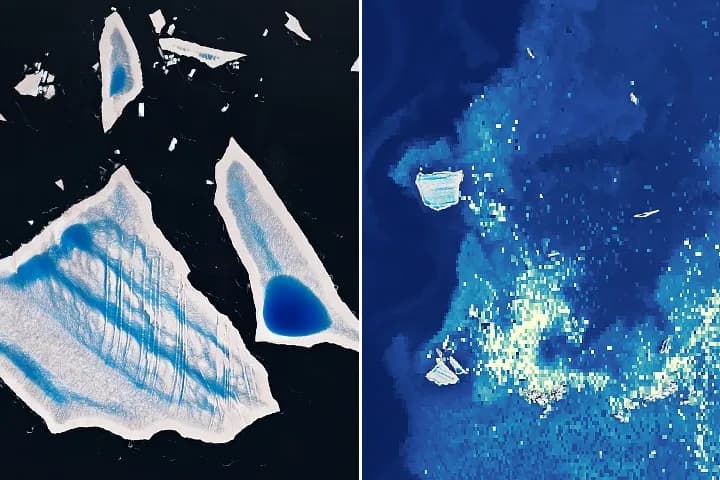
Iceberg A-23A has had a more eventful run than most large Antarctic icebergs in recent decades. It spent decades grounded in the Weddell Sea before drifting north, twirling in an ocean vortex for months, and nearly colliding with an island in 2025. By 2026, as it moved into warmer waters, shedding smaller bergs and meltwater, it put on one more show.
The VIIRS on the Suomi NPP satellite captured an image of the splintering berg on January 25, 2026, after it broke apart on January 9. A debris field was visible east of the largest remaining pieces. The OCI on NASA's PACE satellite detected plumes of chlorophyll-a around the bergs and debris on January 25.
Researchers use chlorophyll concentrations as a marker of phytoplankton abundance. The chunks of ice and meltwater left in Iceberg A-23A's wake appear to have fueled a surge in phytoplankton abundance, known as a bloom, observed by NASA satellites. Grant Bigg, an emeritus oceanographer at the University of Sheffield, noted that while blooms unconnected to icebergs occur regularly here, satellite imagery shows a connection persisting for weeks, increasing his confidence in a link.
' Phytoplankton harvest sunlight for photosynthesis, form the base of the marine food web, produce up to half of Earth's oxygen, and serve as part of the ocean's 'biological carbon pump,' transferring carbon dioxide to the deep ocean. According to Heidi Dierssen, an oceanographer at the University of Connecticut, the primary factors limiting phytoplankton here are light and nutrients. Light can be limiting even in summer due to mixing from winds.
Melting icebergs can boost phytoplankton by creating a stable surface layer and releasing meltwater rich in iron, a key nutrient scarce in this region. Research indicates icebergs also contain manganese and macronutrients like nitrates and phosphates that benefit phytoplankton. The exact size of the 2026 bloom has not been determined, and its long-term environmental impact remains unknown.