

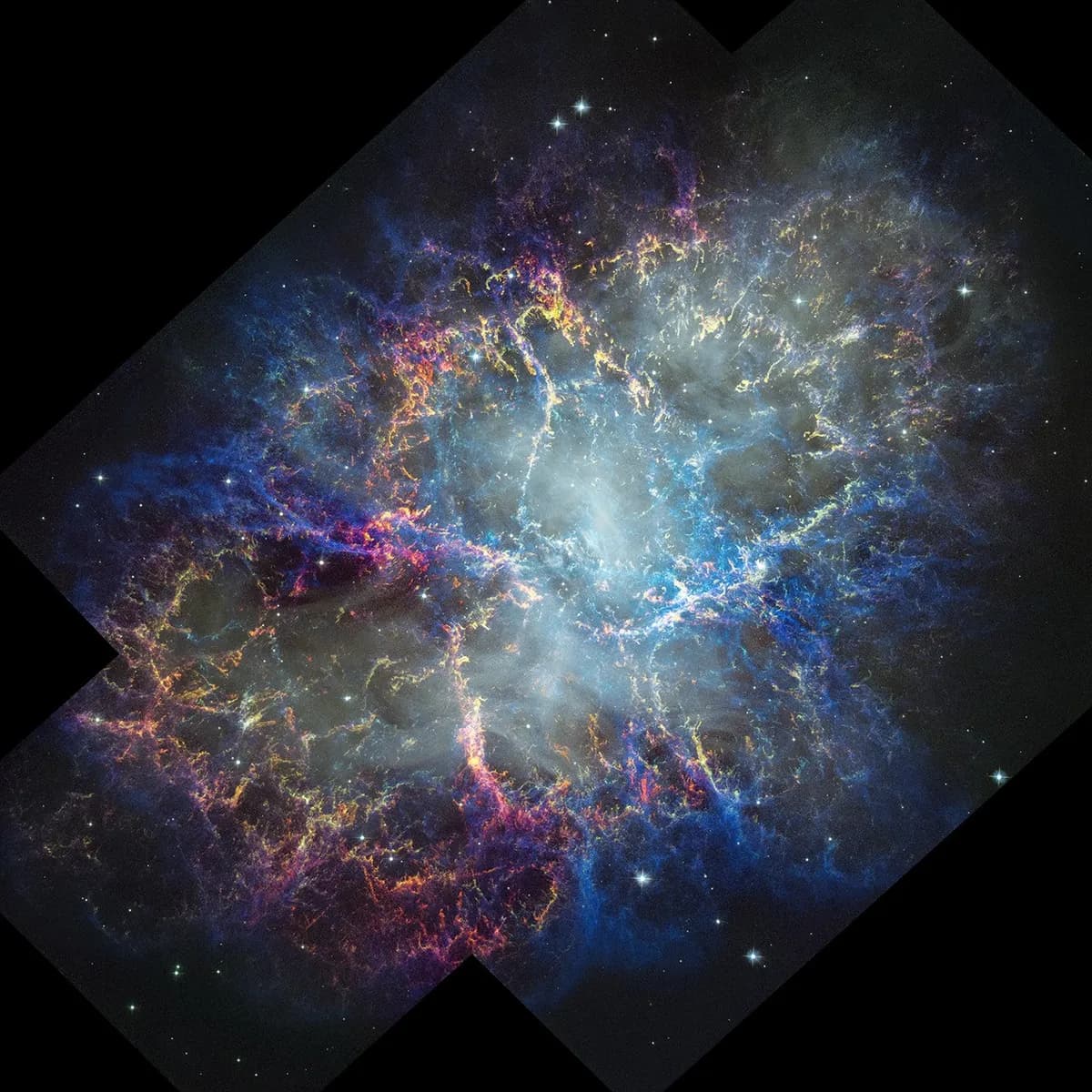
The Crab Nebula is the aftermath of supernova SN 1054, located 6,500 light-years from Earth in the constellation Taurus. Astronomers in 1054 recorded the supernova as a bright new star visible even during the day for weeks, and the remnant was discovered in the mid-18th century. In the 1950s, Edwin Hubble and others noted the correlation between Chinese astronomical records of a supernova and the position of the Crab Nebula.
Hubble is the only telescope with the combination of longevity and resolution capable of capturing these detailed changes, according to NASA. Hubble's 1999 image of the Crab Nebula was re-processed for better comparison with the new image, and the variation of colors in Hubble's images shows changes in local temperature, density of the gas, and its chemical composition.
We tend to think of the sky as being unchanging, immutable. However, with the longevity of the Hubble Space Telescope, even an object like the Crab Nebula is revealed to be in motion, still expanding from the explosion nearly a millennium ago.
The heart of the Crab Nebula contains a pulsar, a rapidly rotating neutron star that powers the nebula's expansion. Filaments around the periphery of the Crab Nebula appear to have moved more compared to those in the center, and they appear to have simply moved outward rather than stretching out over time. In other well-known supernova remnants, expansion is driven by shockwaves from the initial explosion, eroding surrounding shells of gas cast off by the dying star.
William Blair, an astronomer at Johns Hopkins University, said the sky is often seen as unchanging, but Hubble reveals the Crab Nebula's motion from an explosion nearly a millennium ago. He also noted the detailed structure and improved resolution with Hubble's Wide Field Camera 3 compared to 25 years ago. The paper does not specify what new scientific insights about the nebula's evolution are detailed, nor how the measured outward movement compares to previous estimates. The implications of the observed movement patterns for understanding pulsar wind nebulae versus other supernova remnants remain unclear.
Even though I’ve worked with Hubble quite a bit, I was still struck by the amount of detailed structure we can see and the increased resolution with the Wide Field Camera 3, as compared to 25 years ago.