

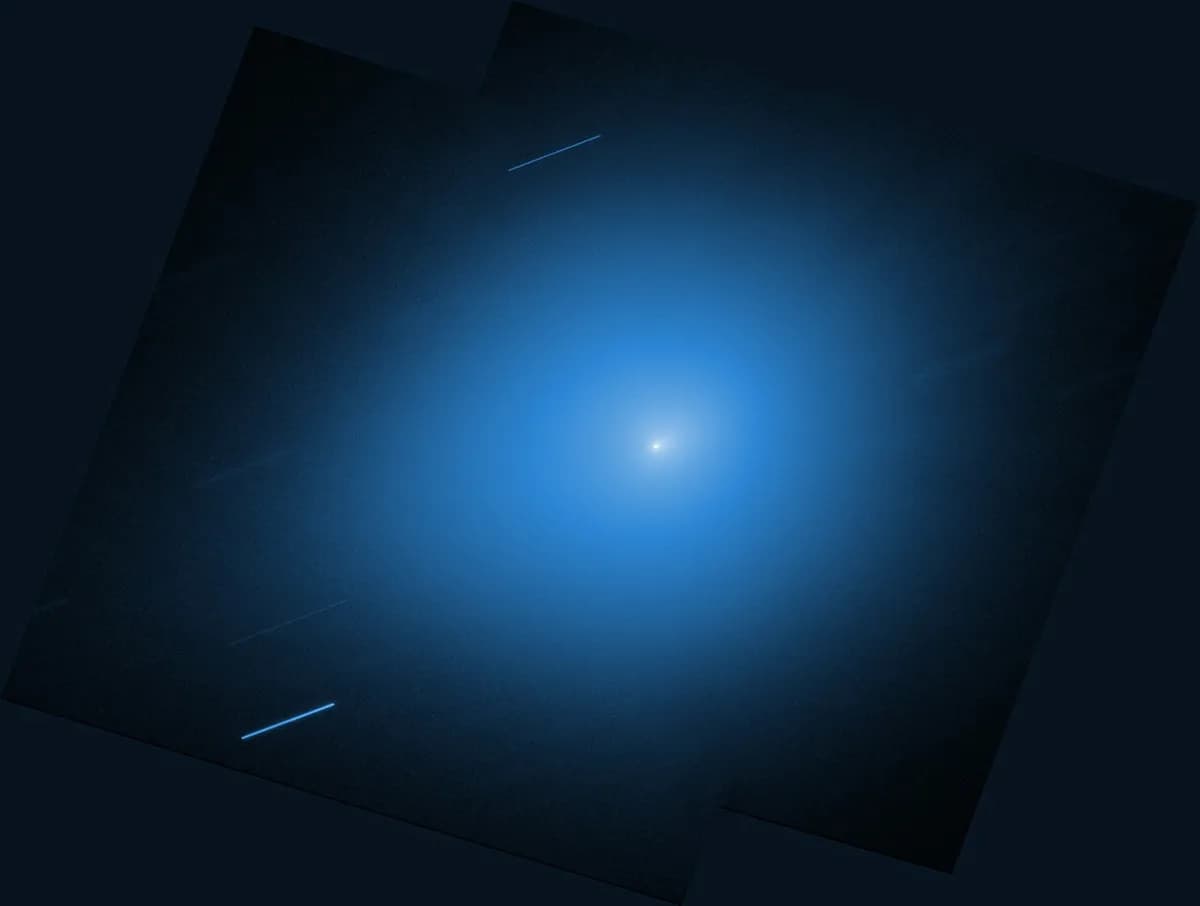
The Hubble Space Telescope observed comet C/2025 K1 (ATLAS) fragmenting into at least four pieces on November 8, 9, and 10, 2025, taking three 20-second images each day. The observation was accidental, as the original target was not viewable due to technical constraints. John Noonan, a research professor and co-investigator, said in a press conference: "Sometimes the best science happens by accident." He added that the team had to find a new target, and "right when we observed it, it happened to break apart, which is the slimmest of slim chances." Noonan recalled: "While I was taking an initial look at the data, I saw that there were four comets in those images when we only proposed to look at one. So we knew this was something really, really special."
According to official sources, comet K1's perihelion was inside Mercury's orbit, about one-third the distance from Earth to the Sun. The team estimates the comet began to disintegrate eight days before Hubble viewed it. The comet was likely about 5 miles across before fragmentation, officials said. Principal investigator Dennis Bodewits commented: "The irony is now we're just studying a regular comet and it crumbles in front of our eyes." He explained that comets are "leftovers of the era of solar system formation, so they're made of 'old stuff'—the primordial materials that made our solar system." By cracking open a comet, he said, "you can see the ancient material that has not been processed."
Sometimes the best science happens by accident.
In a separate development, the interstellar comet 3I/ATLAS was discovered on July 1, 2025 by the ATLAS survey telescope in Chile, according to official sources. It was first captured on camera by NASA's TESS satellite in May 2025. 3I/ATLAS is only the third identified interstellar object to visit our solar system. The Juice spacecraft, operated by the European Space Agency, observed 3I/ATLAS on November 6, 2025, seven days after its closest approach to the Sun, according to major media reports. Juice was about 66 million km from the comet when it took the image.
Researchers found that 3I/ATLAS's relative water, carbon dioxide, and carbon monoxide production rates differed from typical comets, according to official sources. The comet contains exceptionally high levels of deuterium, suggesting an origin in a very cold environment, according to official sources. It also contains unusually high concentrations of alcohol, according to official sources. The comet's exact composition remains unknown, and how it compares to solar system comets is still under study.
This comet got observed because our original comet was not viewable due to some new technical constraints after we won our proposal. We had to find a new target—and right when we observed it, it happened to break apart, which is the slimmest of slim chances.
GB News estimates 3I/ATLAS is up to 11 billion years old, more than twice the age of the Sun. The size of its nucleus is between 440 meters and 5.6 kilometers, according to GB News. The comet is moving away at 137,000 mph (220,000 kph), GB News reported. Its precise size and exact origin in the galaxy remain unknown.
The findings about comet K1 were published in the journal Icarus. Kevin Murphy, chief science data officer at NASA Headquarters, said in a statement: "NASA's scientific data archives are a gold mine of discoveries waiting to be made." Thomas Statler, lead scientist for Solar System Small Bodies at NASA Headquarters, added: "Open science, as a set of principles, has been pushing us as research communities and NASA to make data more accessible." The puzzling delay between comet K1's break-up and the brightening detected from Earth has not been explained.
While I was taking an initial look at the data, I saw that there were four comets in those images when we only proposed to look at one. So we knew this was something really, really special.
The irony is now we're just studying a regular comet and it crumbles in front of our eyes.
Comets are leftovers of the era of solar system formation, so they’re made of ‘old stuff’—the primordial materials that made our solar system. But they are not pristine—they've been heated; they've been irradiated by the Sun and by cosmic rays. So, when looking at a comet’s composition, the question we always have is, ‘Is this a primitive property or is this due to evolution?’ By cracking open a comet, you can see the ancient material that has not been processed.
NASA’s scientific data archives are a gold mine of discoveries waiting to be made.
Open science, as a set of principles, has been pushing us as research communities and NASA to make data more accessible. It’s worked into the way we structure and establish standards for our data.