

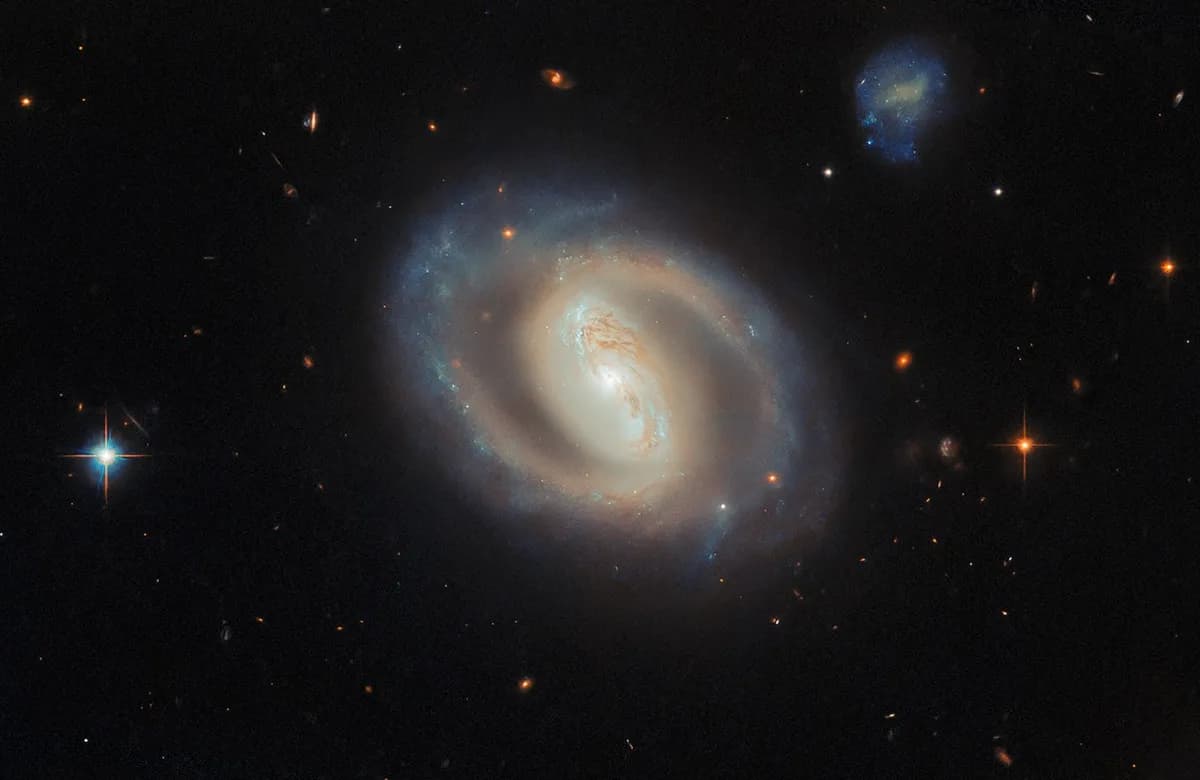
IC 486 is classified as a barred spiral galaxy, featuring a bright central bar-shaped structure with spiral arms unfurling around it. Hubble's image shows color variations across the galaxy: the pale, luminous center is dominated by older stars, while faint bluish regions in the disk indicate recent star formation, and wisps of dust trace regions of molecular gas where new stars are likely to form. At the center, a noticeable white glow outshines the surrounding starlight, which is light from its active galactic nucleus powered by a supermassive black hole over 100 million times the mass of the Sun.
The data for this image comes from two separate observing programs (#17310 and #15444) with similar aims: to survey nearby active galaxies like IC 486 and record detailed images of their central black holes and nearby stars. A key goal of the research is to understand how galaxies grow by linking large-scale structures such as bars and spiral arms to nuclear activity, using expert classifications, citizen science through Galaxy Zoo, and machine learning techniques. Beyond IC 486, the image includes distant background galaxies, foreground stars some with diffraction spikes, and reddish smudges representing more distant galaxies.
Specific findings from the observing programs regarding IC 486's black hole or star formation have not been detailed, and the exact timeline for public release of the datasets remains unclear. It is also unknown how machine learning techniques compare to human classifications in accuracy or efficiency for galaxy morphology studies.