

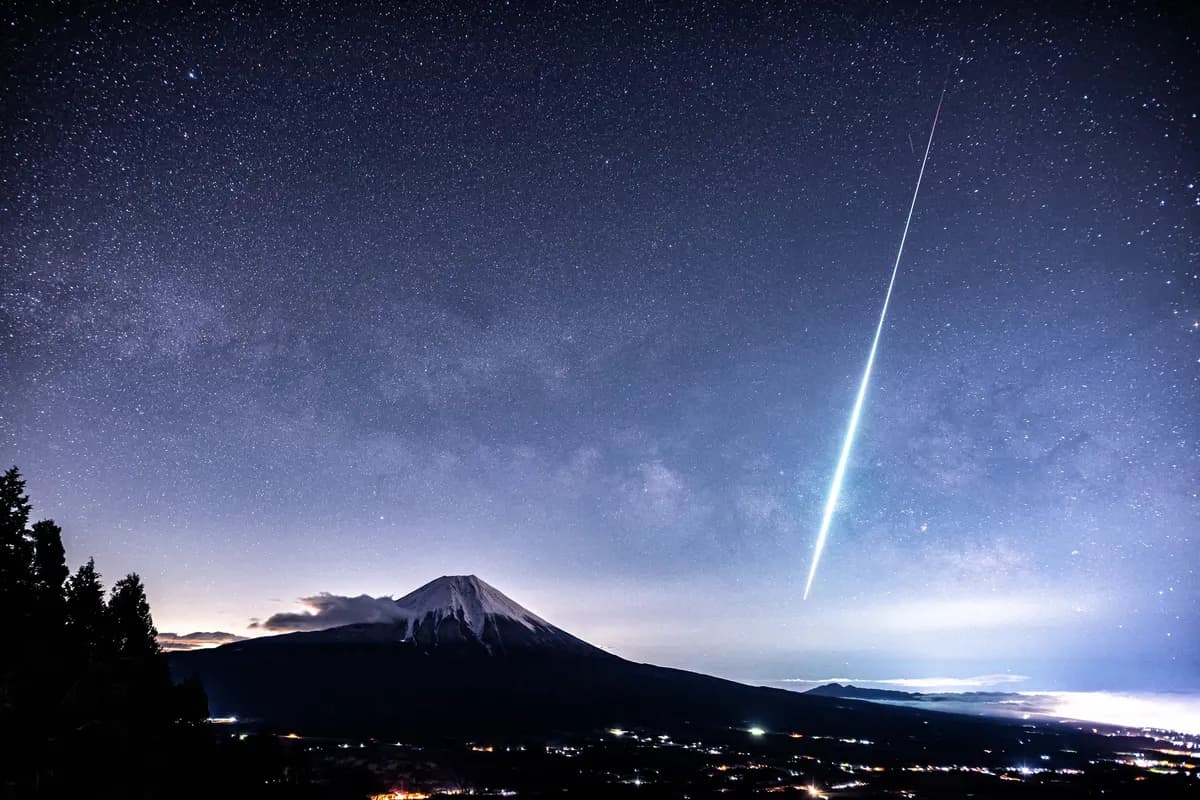
The Eta Aquariid meteor shower is set to peak on Wednesday night into early Thursday morning, offering skywatchers up to 40 shooting stars per hour under ideal conditions, according to multiple media reports. The best viewing is predicted to occur between midnight and the pre-dawn hours, when the radiant point in Aquarius rises above the horizon.
However, a bright waning gibbous moon, illuminated at over 80 percent, will significantly obscure many of the fainter meteors, reports say. Despite the moon's glare, the shower remains active until May 28, giving viewers additional chances to witness celestial activity. Under truly dark skies without moonlight, the Eta Aquariids are capable of producing higher rates, but the exact number of visible meteors is uncertain due to varying local conditions and the unpredictable nature of the debris stream.
The Eta Aquariids are produced by a trail of cosmic debris left behind by Halley's Comet, the famous periodic comet that returns to the inner solar system roughly every 76 years, according to major media. When Earth passes through this ancient stream of particles each year in May, the grains burn up in the atmosphere, creating the meteor display. Halley's Comet last graced Earth's skies in 1986 and is expected to return in 2061. This shower is one of two annual meteor showers originating from Halley's debris, the other being the Orionids in October.
The debris particles enter the Earth's atmosphere at a blistering speed of 45 miles per second (about 70 kilometers per second), according to reports. At such velocities, friction with the air heats the tiny grains to around 1,600 degrees Celsius (approximately 2,900 degrees Fahrenheit), causing them to incandesce and produce the bright streaks of light commonly called shooting stars. These meteors are known for being particularly swift and often leave behind persistent glowing trails that can be visible for several seconds.
The shower's apparent point of origin, or radiant, is located near the star Eta Aquarii in the constellation Aquarius, reports indicate. This shower strongly favors observers in the Southern Hemisphere, where the radiant climbs high into the sky and 40 meteors per hour is more likely. In northern latitudes, the radiant remains low on the eastern horizon, but the shower is still visible. For the best viewing, look just before dawn when the radiant has risen highest in the sky, reducing atmospheric extinction. However, reports note that meteors can start appearing from around midnight, when the radiant is still below the horizon, as some particles streak across the upper atmosphere as 'earthgrazers' that skim the sky tangentially. To maximize the experience, experts suggest finding a dark location away from city lights, lying flat on your back, and allowing at least 20 minutes for your eyes to adjust to the darkness.