

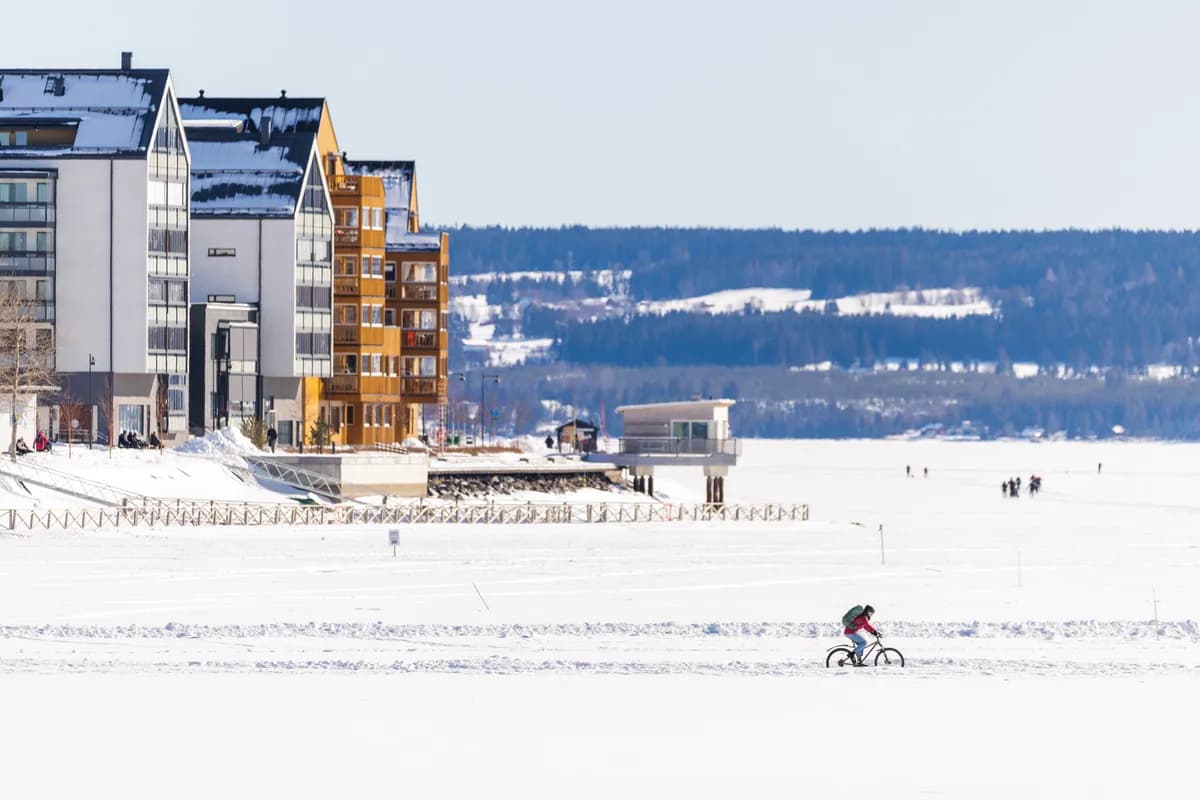
Current Easter ski conditions in Norway show regional variability, with some good snow at higher elevations but an overall reduced snowpack compared to normal. The Norwegian Trekking Association (DNT) states there are ski conditions at most places in the country this Easter, describing conditions in Jotunheimen, Skarvheimen, and Langsua as splendid, and good in Femundsmarka and Hardangervidda. However, for the country as a whole, snow amounts are now about 61% of normal, meaning nearly 40% of usual snow is missing for this time of year, according to senorge.no. In the high mountains, there is a lot of snow, and it will likely remain so for a while, according to meteorologist Johanne Ordahl.
Detailed snow depth measurements around a week before Easter, compiled from multiple reports, show significant variation across locations. At Sjusjøen, Nordseter, and Skei, there is about one meter of snow; in Trysil and Beitostølen, around 80 cm; in Kvitfjell, 70 cm; in Hafjell, 80 cm; at Norefjell, half a meter; on Geilo, 90 cm; and in Hemsedal, around 60 cm. At Sjusjøen specifically, trail groomer Johannes Haukåssveen reports about 1.20 meters of snow and brilliant sun. Snow lies surprisingly low in terrain in many places, but conditions are significantly better at higher elevations, according to Per Thomas Skaanes, who notes the best ski conditions are found from 1000 meters above sea level and higher. At Ljosland, Skaanes reports there is still 50-60 cm of snow evenly over terrain where wind hasn't taken too hard.
Climate change projections from the Norwegian Water Resources and Energy Directorate (NVE) paint a challenging future for Easter snow conditions. The ski season is becoming shorter, with snow creeping higher up, according to Thore Lae. NVE states the boundary for stable ski conditions will move significantly upward in terrain by the end of the century. By the end of the century, in Southern and Central Norway, one must go up to around 850 meters above sea level for the same probability of Easter ski conditions as found today at 500 meters, NVE projects. In Northern Norway, the boundary will be at 350 meters by the end of the century, compared to 150 meters today. Researcher Tuomo Saloranta noted in a press conference that there will still be winters with much snow, but they will become rarer; to find the same snow conditions as before, one must travel higher.
Many lowland ski areas have faced significant challenges this season, with multiple reports indicating it has not been a dream season for alpine centers. Many lowland ski areas have had to give up before this year's Easter, according to multiple reports. Varingskollen alpinsenter had to close for three weeks in December due to rain and above-freezing temperatures, according to Lasse Krogstad, who also stated the resort has had to lay artificial snow in two full rounds, requiring large amounts of electricity and water. Morten Akersveen identifies a shorter window for making snow as the biggest challenge with today's climate. At Hornindalen skisenter, it is uncertain if skiing will be possible at Easter; they had to close on Wednesday before Easter due to rain, according to operations manager Per Mattis Lødøen. At Sunnmørsalpane Skiarena Fjellsætra, they are waiting to see if snow forecast will allow opening, operations manager Florian Pühringer said.
Despite the challenges, some resorts report success stories, often crediting artificial snow. At Strandafjellet on Sunnmøre, conditions are good, and artificial snow has saved them, according to market manager Mari Riksheim, who added that Strandafjellet skisenter has had a surprisingly good season considering precipitation amounts. At Arena Overøye in Fjord municipality, all lifts are open, and they thank artificial snow for conditions, multiple reports indicate. At Surnadal alpinsenter, conditions are great, and they have snow through Easter, daily manager Helge Røv said. Most ski slopes in Pite älvdal are open during Easter weekend and the following week's school break, which differs from last year when many slopes were closed due to snow shortage, according to multiple reports. Lasse Sällström is satisfied with the winter so far in Bydalsfjällen, with full activity during the sports break and a well-visited restaurant, multiple reports indicate.
Specific resort conditions and operations vary widely across Norway. At Smuksjøseter Fjellstue in Rondane, the entire trail network is open, they are still driving over water, and there is no melting yet, according to Pål Erik Skaugen. Ingierkollen slalåmsenter's lifts are still in Easter, multiple reports confirm. Hillestadheia in Åmli is a good starting point for Easter tourists, lying between 600 and 850 meters above sea level, according to Dag Fagermyr. On Hillestadheia, 1.5 miles of newly groomed ski trails were prepared on Friday morning, Gunnar Hillestad reported. The ski resort Hovden is located in Setesdal, Norway, Aust-Agder, and has 42.5 km of slopes, 9 lifts, and elevations between 763 and 1,183 m, according to multiple sources. Hovden has mainly easy and intermediate slopes, children's and beginner areas, and a snow park, and the first chairlift on Nos in Hovden was put into operation in 1968.
Positive aspects of spring skiing in Norway are highlighted by multiple sources, focusing on weather and experience. Warmer temperatures in spring mean you can dress more lightly than in winter, making the experience enjoyable for children. There are fewer people in some slopes and often shorter queues in spring. Spring is a perfect time to learn to ski or improve skills, for both children and adults. Several resorts provide fire pans for grilling your own meal. Easter is one of the favourite times to ski in Norway, with deep snowpack, milder temperatures, and long Nordic spring days. Norway offers longer daylight hours in April than both the Alps and the UK. Norway has wide, crowd-free slopes in April, meaning more skiing and less queueing. The snowpack in Norwegian resorts typically peaks in March. Skiing in April is a complete non-issue due to snowpack and world-class snowmaking technology, according to research sources. According to www.visitnorway.com, Thomas T. Kleiven described springtime in the mountain slopes as a lucky mix of the best of the Norwegian winter and summer, and noted that sunny days make people super happy, also in the mountains.
Safety concerns and operational challenges are present during the Easter period. The Red Cross reports a busy start to Easter, with several assignments related to injured skiers, missing persons, and vehicles stuck off-road, according to Jarle Bjørge Øverland in Røde Kors Hjelpekorps. There is a forecast of moderate to considerable avalanche danger in large parts of the country, multiple reports indicate. There is yellow warning for snowdrift in the mountains in Southern Norway on Thursday and Friday. Skiing is an active sport with many risks, and you must identify and accept them before participating, research sources note.
Future projections from NVE indicate Easter will be even more snow-poor, but these calculations assume high greenhouse gas emissions and will change if emissions are reduced, according to multiple reports. The accuracy of these climate projections and their margins of error remain uncertain, as do the specific measures ski resorts are taking to adapt to the predicted reduction in reliable Easter snow. In the period 2071-2100 compared to 1991-2020, much larger areas will have less than a 10% chance of snow at Easter, multiple reports project. Chances for Easter snow in Oslomarka will reduce from 66% to 12%; in Oslo city center, almost all Easter snow disappears. On the West Coast and in Nordland, over one meter less snow is expected in spring towards the end of the century. At Geilo (800 m.a.s.l.), the chance for snow at Easter today is over 90%, but by the end of the century it will be under 60%. There will be no guarantee of snow at Easter even for areas above 1000 meters.
Resort operations, season details, and travel information provide practical context for visitors. Easter in 2026 comes 15 days earlier than in 2025. Some Norwegian resorts offer a 'snow guarantee' through to late April, promising a minimum number of open runs/lifts or your money back. Myrkdalen is Norway's snowiest resort, averaging six snowfall days and 58cm of fresh snow in April. In late April 2025, the author skied fresh powder in Narvik, Norway. You rarely queue for a lift in Norway, even over peak dates. Norway has minimal bottlenecks and cat tracks compared to other European destinations. The 2025/26 ski season in Eastern-Norway ends at 2027/03/28. Projected closing dates for ski resorts in Eastern-Norway are subject to change at each resort's discretion depending on snow conditions and other factors. The Foreign, Commonwealth & Development Office (FCDO) and National Travel Health Network and Centre have up-to-date advice on staying safe and healthy abroad. All flight-inclusive holidays on the Crystal Ski website are financially protected by the ATOL scheme. Crystal Ski Holidays is a trading name of TUI UK Limited, registered in England No: 2830117, ATOL No: 2524, ABTA No: V5126.
In a broader European context, late February 2026 is delivering a fresh, wintry top-up for several Alpine areas, with new snow favouring parts of Austria, Switzerland, and higher French resorts.