

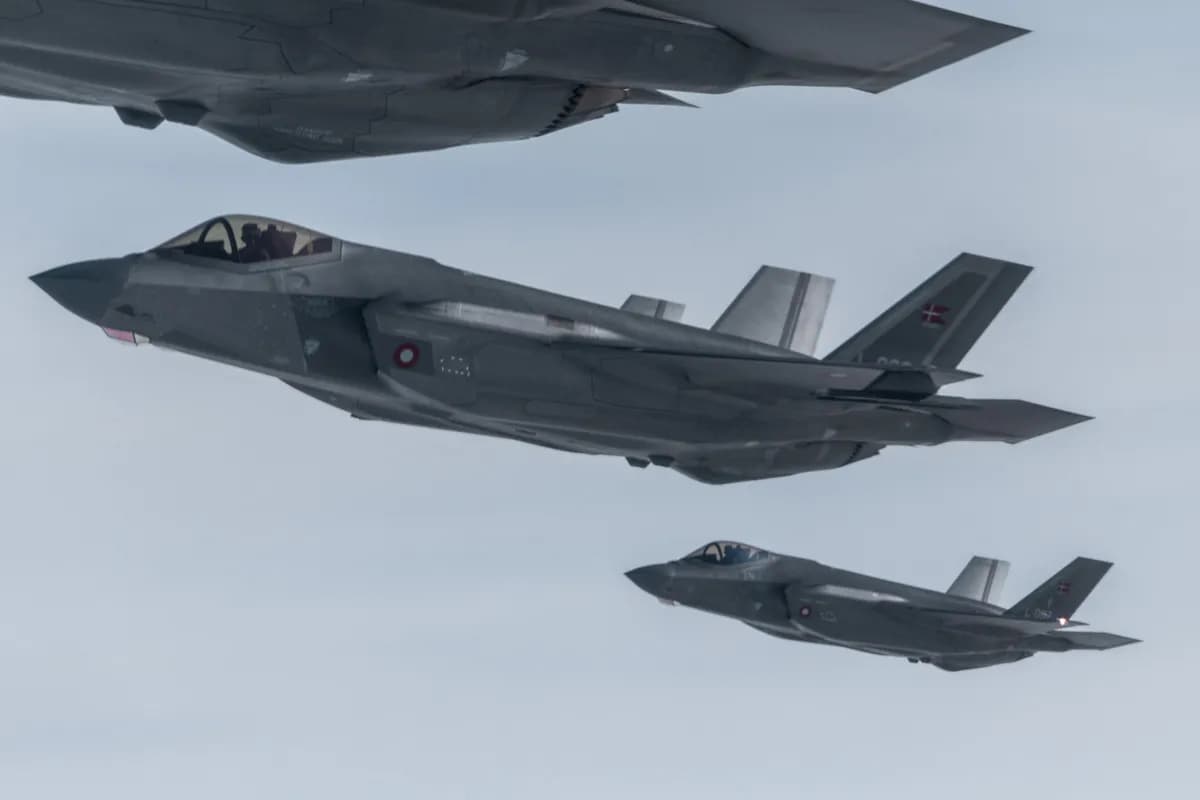
A mysterious YouTube campaign has emerged promoting the Gripen over the F-35, with hundreds of videos claiming the Swedish jet outperforms its American competitor and that the deal is essentially decided in Sweden's favor. According to SVT, when looking closer at the accounts behind these videos, nothing pointed to Saab, but instead in another direction, leaving the campaign's origins unclear. This online push coincides with active lobbying efforts by Saab, whose CEO traveled to Canada in late March hoping to sell the Gripen. The company has also offered to build a data center in Montreal if Canada selects its aircraft, according to reports.
Meanwhile, in Peru, conflicting reports surround another potential Gripen deal. According to the defense site defensa.com, Peru is on the verge of choosing the American F-16 fighter jet manufactured by Lockheed Martin, which would mean Saab loses the deal. However, Saab's press department stated that they have taken note of media reports but have no official information that Peru has chosen another supplier. The company added that they are following the process and believe Gripen would be the best and most cost-effective fighter jet for Peru. Multiple reports indicate Peru has evaluated eight suppliers since 2012 and is postponing its choice until the summer, meaning Saab still has a chance to win the billion-dollar deal.
Saab has been eyeing Canada, and vice versa, for several years, but this became highly relevant now due to the tariff war between the USA and Canada.
In Thailand, a Gripen deal has already been secured, with the country signing an agreement on August 25 last year for jets estimated to be worth 5.3 billion kronor, with deliveries in batches until 2030. The Gripen jets are intended to replace Thailand's older model F-16 planes, according to reports. Thailand has moved closer to China militarily in recent years and now has close cooperation, with the country already using Swedish Gripen jets in the annual Falcon Strike exercise with China, held in Udon Thani. During these exercises, China's air force has the opportunity to test its planes against the Gripen, with photos showing Gripen flying alongside Chinese J-11 and SU-27 fighters, and China's advanced Y-9LG aircraft for electronic warfare also participating.
Security concerns have been raised about technology transfer from these exercises. The Swedish Defence Materiel Administration (FMV) commissioned a report from the Swedish Defence Research Agency (FOI) on arms exports to Thailand, presented in January 2024, warning of risks of technology transfer to China and potentially Russia. According to TV4 Nyheterna, Mike Winnerstig described a risk of technology transfer from Sweden to countries like China, which could involve Chinese engineers learning too much about the Gripen through cooperation with the Thai air force. Martin Lundmark, also speaking to TV4 Nyheterna, said it is not in Sweden's interest for information about the Gripen system to leak to China and finds it surprising that it could happen, adding that these exercises pose a risk for Sweden as knowledge could end up in the hands of unwanted actors. He noted the FOI report's concern is that knowledge about Swedish defense technology could ultimately reach Russia, given constant information exchange between China and Russia. The FOI report was presented a year and a half before the contract with Thailand was approved, but the government proceeded with the sale of fourth-generation JAS planes to Thailand. FMV and the Inspectorate of Strategic Products (ISP) declined interviews, with FMV stating the FOI report was part of their environmental monitoring and not their task to assess risks. When the U.S. sold F-16s to Thailand, they conditioned the purchase on not using them in exercises with China, and according to TV4 Nyheterna, Martin Lundmark described that Sweden should definitely have set a similar condition for the JAS planes. The next joint air exercise between China and Thailand is planned for May this year.
We have taken note of media reports about Peru's choice of fighter jets. There is no official information we have received that Peru would have decided to choose another supplier of fighter jets.
Sweden's global Gripen exports include about 100 Gripens in operation, with previous exports to countries like Brazil, South Africa, Thailand, and leases to the Czech Republic and Hungary, involving about 10 to 40 planes per country, according to reports. The largest potential deal currently is with Ukraine, which has signed a letter of intent for 150 Gripen planes, but it is unclear how they would be paid for.
Back in Canada, the F-35 program faces significant challenges. The cost for Canada's F-35 planes is estimated at around 190 billion kronor, according to reports. Research indicates Canada is re-evaluating its multi-billion-dollar contract for 88 Lockheed Martin F-35s due to rising trade tensions and threats from the Trump administration. According to The Independent, to date, the Royal Canadian Air Force's F-35 program has exceeded its original budget by $8 billion. The RCAF's future F-35 fleet is at risk due to the widening gap between the world's closest allies, which is being exacerbated by President Donald Trump.
We are naturally following the process further and we are convinced that Gripen would be the best and most cost-effective fighter jet for Peru.
Canada is strategically hedging its bets. The country has recently moved forward with payments for 14 additional F-35 jets on top of the 16 already committed to 'keep options open', according to research. These payments ensure Canada maintains its place in the F-35 Lightning II's long global production line, as covered by CBC, and backing out now would mean losing years of progress if the relationship stabilizes. According to SVT Nyheter, John Granlund described that Saab has been eyeing Canada, and vice versa, for several years, but this became highly relevant now due to the tariff war between the USA and Canada. Canada is currently exploring a split or 'mixed' fleet strategy, and while the RCAF will get some F-35s, the final total remains to be seen.
The NORAD alliance implications are significant. Research suggests the NORAD Alliance's demise would be one of the biggest consequences of Canada's new path. North American Aerospace Defense Command has long served as the foundation for the claim that Canada ought to use the same military equipment and platforms as the United States, given the widespread use of data-link tactical network sharing across numerous Allied platforms made in Europe and other countries. The claim that the F-35 or nothing is the only option is increasingly seen as economic protectionism in 2026.
There is a risk of technology transfer from Sweden to countries like China, which could involve Chinese engineers learning too much about the Gripen through cooperation with the Thai air force.
The Gripen offers distinct advantages for Canada. Research praises the Saab Gripen E for its ease of maintenance in the Arctic and lower costs. A revived domestic military industrial aerospace industry for Canada is one of the advantages of the smaller, lighter, simpler, and more ruggedized Saab, and Canada would have complete sovereign control over mission software and data thanks to the Saab.
Military arguments highlight technological differences. Military leaders argue the Saab Gripen E lacks the stealth and sensor fusion required to survive against modern 'near-peer' threats like Russia or China. Research states the F-35 Lightning II is far superior to the Saab light fighter in terms of technology and combat performance, describing the American stealth fighter as a weapons technology powerhouse with an astounding technological advantage over the Gripen E.
It is not in Sweden's interest for information about the Gripen system to leak to China and finds it surprising that it could happen.
Domestic aerospace considerations and historical context also play a role. Given the unpredictability of the American supply chain under Donald Trump's administration, the Canadian government is seriously contemplating reinvesting in domestic aerospace and defense. The CF-105 Arrow, the world's most sophisticated interceptor, was originally manufactured in Canada, and its contentious 1959 cancellation is a notorious national pride issue.
Political tensions are creating an opportunity for the Gripen. Rapidly growing political tensions, as well as disagreements over economic sharing, have opened an opportunity for the Saab JAS 39 Gripen E to rise as a contender. The Canadian government has initiated a review of the deal that could result in the country choosing a European fighter jet, with Saab's Gripen coming in second after the F-35 in the evaluation, according to reports. According to Prime Minister Mark Carney, continuing payments for 'long-lead' items act as a bargaining chip in broader trade negotiations with the US.
These exercises pose a risk for Sweden, as knowledge about the Gripen could end up in the hands of actors where it is not wanted.
The FOI report's concern is that knowledge about Swedish defense technology could ultimately reach Russia, given constant information exchange between China and Russia.
Sweden should definitely have set a similar condition for the JAS planes.
Continuing payments for 'long-lead' items act as a bargaining chip in broader trade negotiations with the US.