

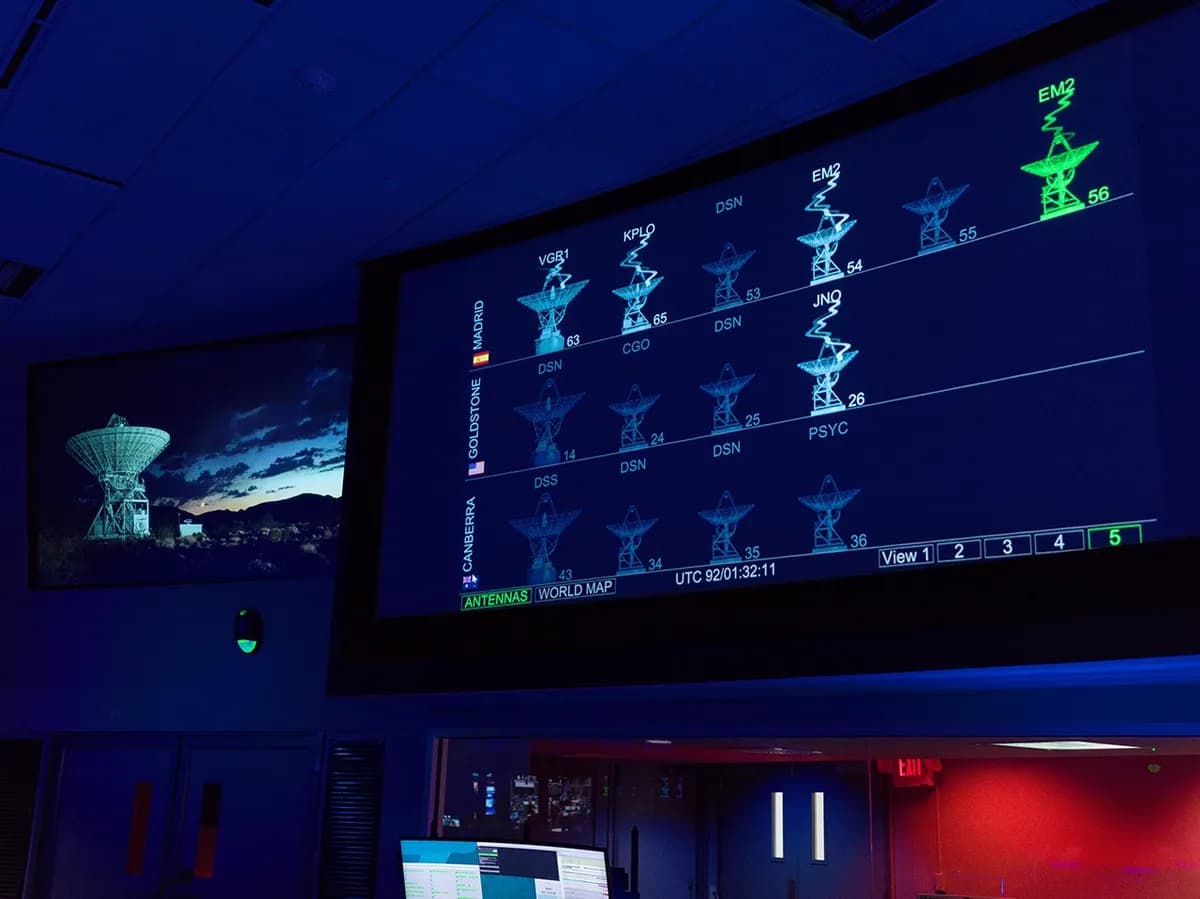
A graphical representation of the Deep Space Network's radio frequency antennas indicates signal acquisition from NASA's Artemis II mission to the Moon on April 1, 2026, inside the Space Flight Operations Facility at NASA's Jet Propulsion Laboratory in Southern California. However, multiple reports state that Artemis II was delayed after a recurrence of helium flow problems on February 25, pushing the launch back to April at the earliest. This contradiction suggests fundamental confusion about whether Artemis II has launched and is in flight or is still grounded due to technical issues. Adding to the uncertainty, Artemis II astronauts performed a Return Trajectory Correction 1 burn on April 7, lasting about 15 seconds and accelerating the ship by about 1.3 feet per second, according to research sources, while other reports claim Artemis II will launch soon, taking a crew of four astronauts around the far side of the Moon and back without landing. The exact current status of Artemis II—whether it has launched and is in flight or is still on the ground awaiting launch—remains unclear, as does the specific launch date if it has not yet launched.
The Deep Space Network, which is tracking these signals, operates from the Space Flight Operations Facility and comprises three complexes in Goldstone, California; Madrid, Spain; and Canberra, Australia. Each complex consists of several radio frequency antennas that communicate with dozens of spacecraft exploring the solar system in addition to the Artemis II mission. Two antennas at the Madrid Deep Space Communications Complex, Deep Space Station 54 and 56, can be seen communicating with Artemis II, with signals labelled 'EM2' or 'ART2'. A similar visualization can be found at DSN Now, which details all the missions that the network is communicating with 24 hours a day, seven days a week. The Deep Space Network allows missions to track, send commands to, and receive scientific data from faraway spacecraft, and it is managed by JPL for the agency's Space Communications and Navigation program, which is located at NASA Headquarters within the Space Operations Mission Directorate, with JPL itself managed by Caltech in Pasadena, California, for NASA.
NASA's moon landing program has experienced a recent delay due to technical, budgetary, workforce, and public perception challenges, according to research sources. The lag time since the last crewed U.S. spaceflight has stretched to three full years, compounding these issues. NASA identified the problem with Artemis II as a faulty helium seal in the SLS upper stage and is repairing it, but the Artemis program also depends on SpaceX's Starship Human Landing System as the initial human lander. SpaceX struggled in 2025 to perfect the Starship V3 rocket necessary for the HLS mission, adding another layer of complexity to the overall lunar exploration timeline.
Technical problems extend beyond launch delays to the spacecraft itself. NASA updated its mission timelines on December 5 and shared results of an investigation into the Orion heat shield after Artemis I. Orion's heat shield experienced an unexpected loss of charred material during re-entry of Artemis I in late 2022, and engineers determined that gases generated inside the heat shield's Avcoat material were not able to vent as expected, causing pressure buildup and cracking. Additionally, Artemis II's space toilet is working OK but astronauts cannot vent their urine properly due to a likely chemical reaction blocking a filter, according to research sources.
Artemis II is NASA's first crewed mission under the Artemis campaign and will travel around the Moon and back, according to research sources. The crew consists of Commander Reid Wiseman, Pilot Victor Glover, and Mission Specialists Christina Koch and Jeremy Hansen. During the mission, Artemis II astronauts set a new distance record from Earth, surpassing Apollo 13's record by more than 4,100 miles, and they will lose contact with Earth for about 40 minutes when passing behind the Moon.
Launch preparations have been marked by both progress and setbacks. The rollout of the Artemis II SLS rocket and Orion module occurred on January 17, 2026, taking about 12 hours, according to research sources. However, Artemis II has experienced delays in fuelling due to cold weather and liquid hydrogen leak problems.
Communication systems for Artemis II rely on S-band radio waves, similar to Apollo missions, with downlink at 2216.5 MHz, according to research sources. The mission depends on the Near Space Network and Deep Space Network for communications, managed by NASA's SCaN program.
International participation adds a collaborative dimension to the mission. The Goonhilly Earth Station in Cornwall is tracking Artemis II, marking the first time it has tracked a crewed spacecraft, according to research sources.
NASA's Artemis program aims to return humans to the Moon and establish a sustainable presence there, with Artemis II serving as a critical test flight before planned landings.
In response to the technical challenges and delays, NASA has been working to address issues such as the helium seal and heat shield concerns, though specific details on resolutions are not fully public.
The implications of Artemis II extend beyond its immediate goals, as it tests systems and procedures essential for future lunar exploration and potential Mars missions.
Key unknowns persist, including whether the helium seal and heat shield issues have been fully resolved and what the timeline is for any remaining repairs. The exact cause and resolution plan for the urine venting problem in the spacecraft's toilet also remain unclear. How NASA is addressing or reconciling the conflicting reports about the mission's status is another critical question.