

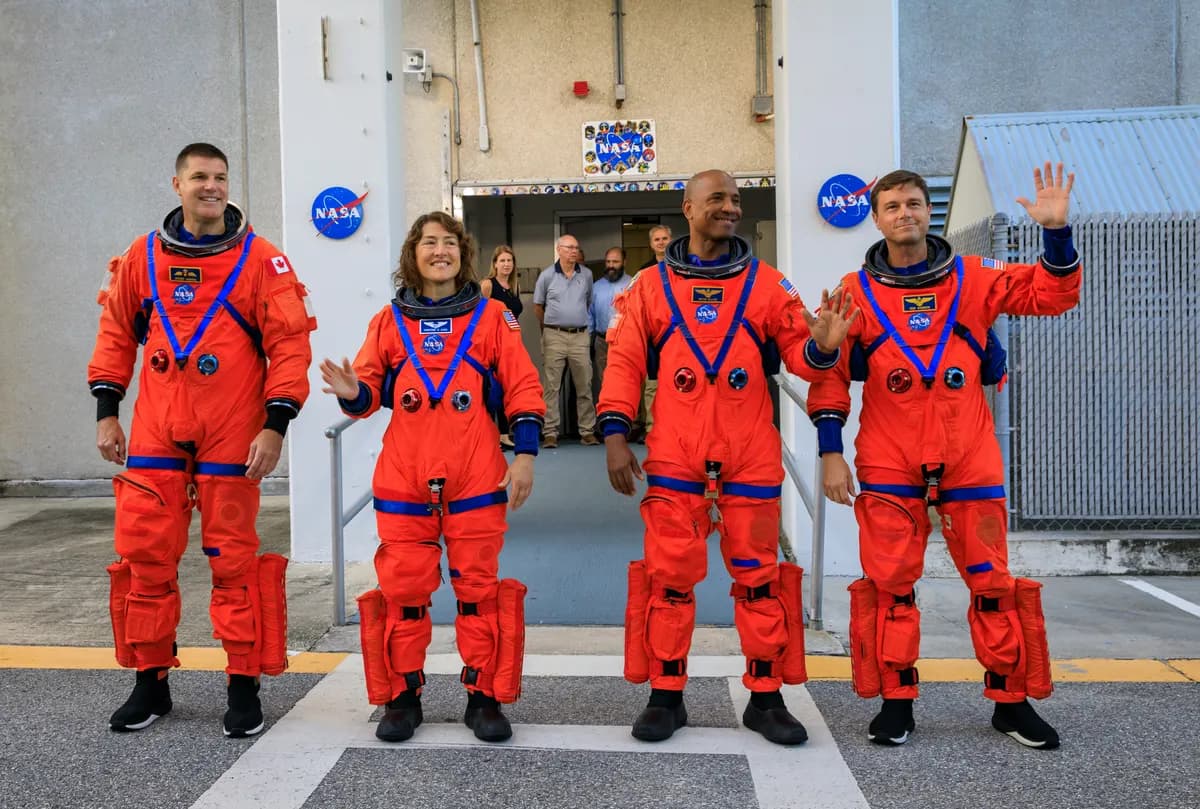
Artemis II represents NASA's first crewed mission under the Artemis program and builds on the success of the uncrewed Artemis I in 2022. This mission will mark humans' return to the Moon in more than half a century if successful, serving as a key step toward long-term lunar exploration and future missions to Mars. NASA describes Artemis II as demonstrating a broad range of capabilities needed on deep space missions, with science operations laying the foundation for safe and efficient human exploration of the Moon and Mars.
The crew for Artemis II includes NASA astronauts Reid Wiseman, Victor Glover, Christina Koch, and Canadian Space Agency astronaut Jeremy Hansen, who will embark on an approximately 10-day journey around the Moon. The mission will test the Orion spacecraft's life support systems for the first time with humans aboard, though it will not land on the lunar surface. Christina Koch holds the record for the longest single spaceflight by a woman at 328 consecutive days, adding to the mission's historic significance. The astronauts will fly about 4,700 miles beyond the far side of the Moon, surpassing the distance record set by Apollo 13, and will travel roughly 393,000 kilometers from Earth before looping around the Moon and returning home.
I'm excited about that, finally getting going on Artemis. I think it's gonna be a great programme.
NASA will provide live coverage of prelaunch, launch, and mission events for Artemis II, with briefings, events, and mission coverage available on NASA's YouTube channel. Viewers can watch launch, lunar flyby, and splashdown coverage on NASA+ and Amazon Prime. The deadline for media accreditation for in-person coverage of launch and mission events has passed. Beginning Thursday, April 2, briefings will occur from NASA Johnson, though the time of events is subject to change. On Friday, March 27, the Artemis II crew will arrive at Kennedy Space Center and answer questions from credentialed media, with NASA Administrator Jared Isaacman and CSA President Lisa Campbell attending the event.
The Space Launch System rocket currently sits ready for the milestone launch at Launch Complex 39B at the Kennedy Space Center. NASA's Orion spacecraft, which will be launched on the SLS rocket, stands 98 meters tall and produces more thrust at liftoff than the Saturn V rockets used during Apollo, despite being slightly shorter. SLS is the only rocket that can send Orion, astronauts, and cargo directly to the Moon in a single launch. Exploration Ground Systems, based at Kennedy Space Center, develops and operates the systems and facilities for Artemis missions.
Half the world's population weren't even born when we were Apollo... I think a very outstanding motivational tool for the young people to challenge them, say, 'well, let's go do that, that's what I want to do.'
Artemis II has faced significant delays and technical issues, with the postponement attributed to a recurrence of helium flow problems, pushing launch back to April at the earliest. The crew was supposed to have blasted off on a lunar flyaround earlier this year, but fuel leaks and other problems with the Space Launch System rocket interfered. NASA managed to plug hydrogen fuel leaks at the pad in February, but a helium-flow issue forced the space agency to return the rocket to the Vehicle Assembly Building for repairs, bumping the mission to April. NASA repaired the helium flow issue that forced the rollback of Artemis II to the Vehicle Assembly Building, and technicians accessed the launch vehicle stage adapter to inspect components that prevented helium from flowing to the upper stage after a Feb. 21 wet dress rehearsal. NASA engineers discovered a faulty seal in the quick disconnect section of the rocket was blocking the helium flow, with engineers making repairs and running tests to validate the fix to the upper stage, though the team is trying to determine how the seal became dislodged. Artemis II has seen issues including a liquid hydrogen leak during the first wet dress rehearsal, but the second wet dress rehearsal went well with a replacement seal showing a 1% leak rate.
This mission occurs in the context of NASA's historic Apollo lunar missions, where NASA sent 24 astronauts to the Moon, with twelve walking on the surface between 1968 and 1972. Charlie Duke, the lunar module pilot for Apollo 16, is cheering on NASA's new lunar exploration programme, and is now 90 years old, having been the youngest person ever to walk on the Moon at age 36. However, no reunion is planned for Apollo veterans to celebrate Artemis II.
I'm all for it and I'm all behind them and cheering them on. So it's going to be an exciting flight... they'll be able to see the whole backside of the Moon.
The long-term goals of the Artemis program include establishing a sustained human presence on the Moon, with NASA's aim for habitats, rovers, and infrastructure as a stepping stone for missions to Mars. NASA aims for a two-person landing in 2028, as part of the new Artemis programme, and Artemis III is scheduled for 2028 as the first human landing on the moon since Apollo 17 in 1972. Orion is developed to be capable of sending astronauts to the Moon and is a crucial step toward eventually sending crews to Mars. NASA Administrator Jared Isaacman released a blueprint for a moon base expected to cost $20 billion over the next seven years.
NASA's Artemis program depends on SpaceX's Starship Human Landing System as the initial human lander, with SpaceX signing a contract with NASA in 2021 to provide the lander. However, SpaceX struggled in 2025 to perfect the Starship V3 rocket necessary for the HLS mission, and the HLS mission is now pegged at roughly 12 fueling flights. This reliance introduces additional complexity and potential delays to the overall Artemis timeline.
Half the world's population was not yet born when he walked on the moon in 1972.
Recent issues with Boeing's Starliner capsule have also raised safety concerns, as NASA acknowledged failures that left two astronauts stuck on the ISS for nine months. The first crewed test launch of Starliner in June 2024 was classified as a 'Type A mishap' by NASA. NASA astronauts Suni Williams and Butch Wilmore returned to Earth in March 2025 after an extended stay on the ISS, coming home on a SpaceX Dragon spacecraft.
Under Administrator Jared Isaacman, NASA is accelerating the pace of Artemis launches, with he added a test flight in orbit around Earth to practice docking with lunar landers.
The current status of Artemis II remains uncertain, with the mission's four astronauts entering a second period of quarantine on Friday in anticipation of the new target launch date. Technicians activated new flight termination system batteries and replaced flight batteries on various stages while in the Vehicle Assembly Building, but NASA has not yet released the date for rolling the rocket back to Launch Pad 39B. There is confusion over the launch date: NASA states Artemis II launch is no earlier than April 1, 2026, but previously targeted no earlier than 6:24 p.m. EDT Wednesday, April with a two-hour launch window, and was planning to launch on 6 March after completing a fueling test. This discrepancy creates uncertainty about whether the launch is imminent or years away.
Broader implications include public perception challenges, as the lag time since the last crewed U.S. spaceflight has stretched to three full years.