

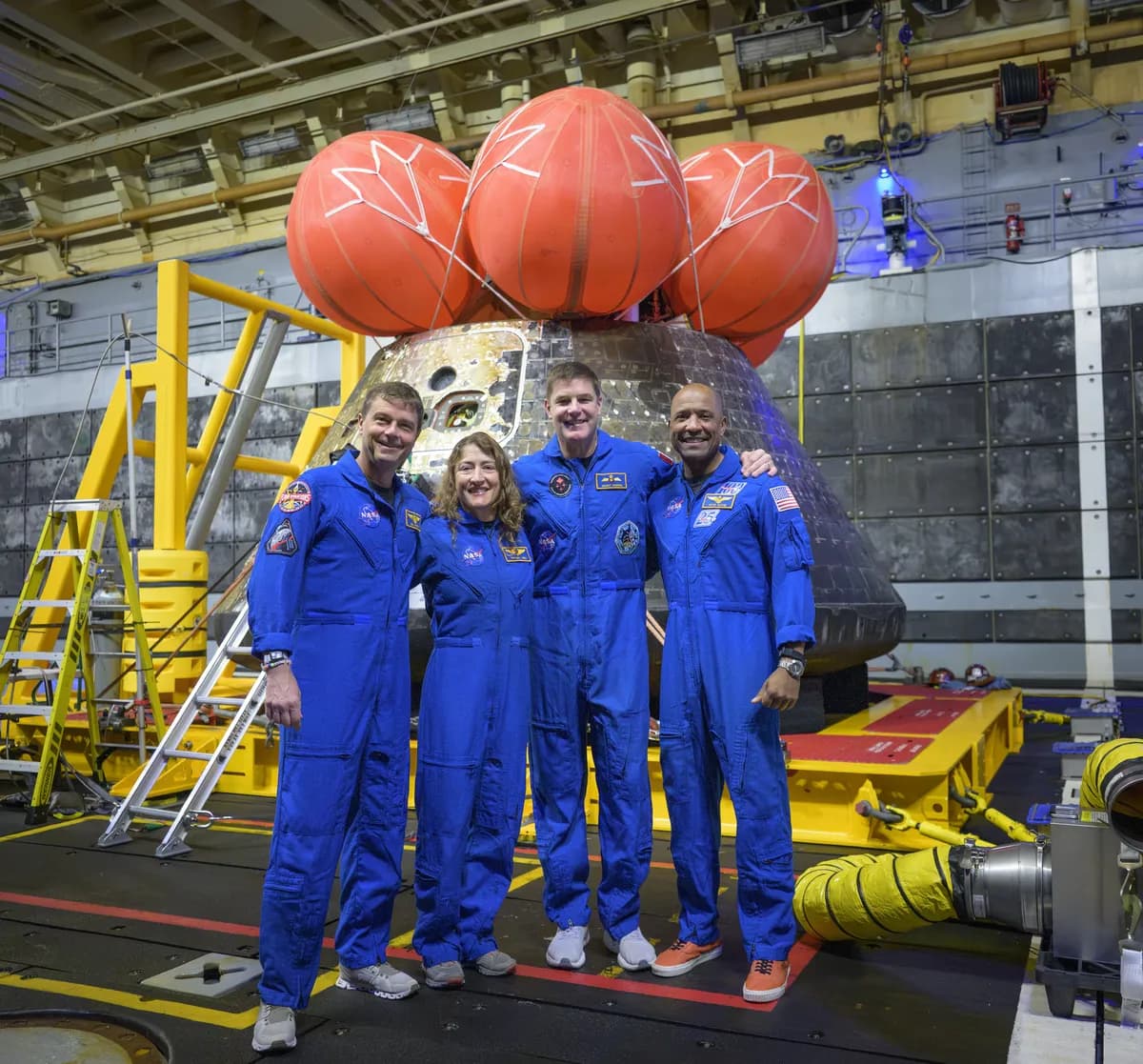
The Artemis II crew returned to Earth after a 10-day mission around the Moon, splashing down in the Pacific Ocean off the coast of California on Friday, April 10, 2026, at 5:07 p.m. PDT (8:07 p.m. EDT). The crew consists of NASA astronauts Reid Wiseman as commander, Christina Koch as mission specialist, Victor Glover as pilot, and CSA astronaut Jeremy Hansen as mission specialist. This mission represents a significant step forward in NASA's efforts to return humans to lunar exploration after decades.
Artemis II is the first crewed flight aboard NASA's human deep space capabilities, paving the way for future lunar surface missions. It will be the first crewed mission beyond low Earth orbit since Apollo 17 in 1972, with Glover, Koch, and Hansen set to become the first person of color, woman, and non-US citizen, respectively, to travel to the Moon's vicinity. The mission is set to be the furthest and fastest crewed space mission, reaching 4,700 miles beyond the Moon and reentering at 25,000 mph, and it took the crew 252,756 miles from Earth at their farthest distance.
After splashdown, the astronauts were assisted out of the spacecraft by a combined NASA and U.S. military team and transported via helicopter to the USS John P. Murtha for initial medical checkouts. The Artemis II crew will undergo medical evaluations, complete an 'obstacle course' test, and fly to Houston after their mission. They are expected to arrive at Ellington Field between 3 p.m. and 8 p.m. ET on Saturday, with an event possibly starting at 4:45 p.m. ET.
Mission managers recapped issues needing inspection post-splashdown, including the heat shield, a valve redesign for Orion's service module, and a toilet issue. Orion's heat shield has a known flaw, made of Avcoat, and was expected to return with divots and cracking, but performed well during splashdown. NASA plans to alter the heat shield material for future missions to avoid issues, but Artemis II's performance is crucial for understanding Avcoat.
Inspection of the heat shield has begun, with imagery and data gathered from aircraft and divers, and the capsule will be transported to Kennedy Space Center for detailed scans.
In February 2026, NASA's SLS rocket was on the launch pad for Artemis II, but faced issues with liquid propellant and the upper stage, causing a rollback. Artemis II faced delays, with NASA officials announcing a shake-up of the program's timeline.
During a wet dress rehearsal on Feb. 2, a hydrogen leak was detected at a service mast interface, attributed to moisture in Teflon seals. NASA postponed the launch to March 6 after the hydrogen leak, with a new wet dress rehearsal scheduled for Feb. 19. After the second wet dress rehearsal, a helium leak was found in the interim cryogenic propulsion stage, raising concerns.
These issues echoed challenges from Artemis I, which had recurring hydrogen leaks and 25 scrubbed or delayed launch attempts.
The 10-day mission carried NASA astronauts Reid Wiseman, Victor Glover, Christina Koch, and CSA astronaut Jeremy Hansen on a free-return trajectory around the Moon. Artemis II was originally designated Exploration Mission-2 and had its objectives revised after the cancellation of the Asteroid Redirect Mission. The trip broke the record for farthest space flight by humans and tested critical systems including life support, maneuverability, heat shield, and the first toilet to orbit the Moon.
Artemis II will be followed by Artemis III in 2027 and Artemis IV in 2028. NASA has a tight turnaround for Artemis III, slated for next year, and is learning to move quicker.
Refurbishment of ground systems like the mobile launch platform could delay the Artemis 2 launch, according to a Government Accountability Office report. If further issues arise with ground systems testing or integration, there will likely be delays to the September 2025 Artemis II launch date. NASA has been working on upgrades and repairs to ground systems after Artemis 1 caused more damage than expected to the mobile launcher.
NASA Administrator Bill Nelson reiterated the September 2025 launch date for Artemis 2 at the International Astronautical Congress. Delays in Artemis 2 could correspondingly delay Artemis III, with potential for more delays if the mobile launcher is damaged on Artemis 2.
The splashdown was projected on Jumbotrons in stadiums across the country, capturing national attention.
The successful return of the Artemis II crew demonstrates NASA's ability to overcome technical challenges and advance human spaceflight. However, unresolved issues such as heat shield performance and launch delays pose ongoing risks for future missions.
Key unknowns include what specific issues were found during the post-splashdown inspection of the heat shield, valve, and toilet, and how much damage Artemis 1 caused to the mobile launcher. Additionally, the exact cause of the hydrogen and helium leaks during the wet dress rehearsals, and whether they have been fully resolved, remains under investigation.