

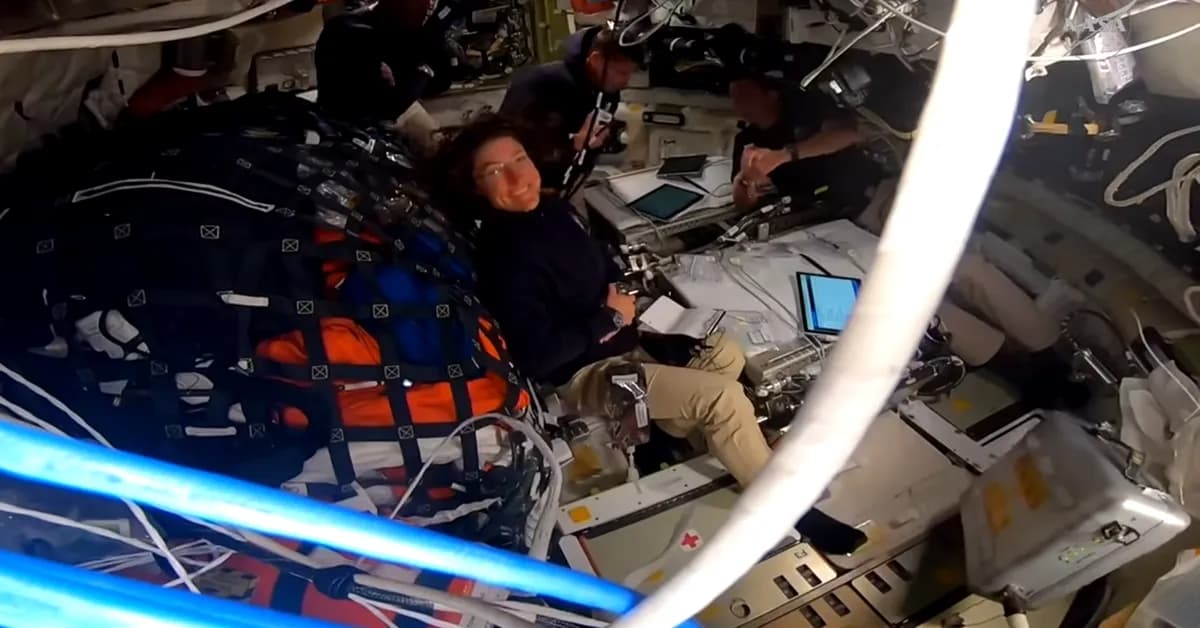
The Artemis II astronauts received a welcome home Saturday at Ellington Field near NASA's Johnson Space Center and Mission Control, according to major media reports. The crew flew in from San Diego where they splashed down just offshore the evening before, multiple reports indicate. The crowd at the homecoming included NASA Administrator Jared Isaacman, flight directors, launch director, Orion capsule and exploration system managers, high-ranking military officers, the space agency's entire blue-suited astronaut corps, and retired astronauts, major media reports. The homecoming occurred on the 56th anniversary of the launch of Apollo 13, according to those same reports.
During Artemis II's nearly 10-day mission, the astronauts voyaged deeper into space than the moon explorers of decades past. The astronauts captured views of the lunar far side never witnessed before by human eyes. Research indicates the four crew members reached a greater distance from Earth than any humans before them, with the astronauts reaching a maximum 252,756 miles (406,771 kilometers) from Earth before hanging a U-turn behind the moon, eclipsing Apollo's 13 distance record. Multiple reports indicate the astronauts spent nearly seven hours observing the moon's far side and capturing images, and even the Apollo astronauts couldn't view the moon's far side in this way because of the paths and timing of their flights. Major media reports add that a total solar eclipse added to the cosmic wonder during the mission, and the mission revealed a new side of our planet with an Earthset photo, showing Earth setting behind the moon, which echoed the famous Earthrise shot from 1968 taken by Apollo 8.
Welcome home Artemis II.
The four astronauts on NASA's Artemis II mission circled the moon today in their Orion spacecraft, according to research. At their closest, the crew members flew within 4,067 miles of the moon's surface, multiple reports indicate. The astronauts lifted off Wednesday from Kennedy Space Center in Cape Canaveral, Florida, and spent around 25 hours circling the Earth before Orion entered the lunar sphere of influence — where the pull of the moon's gravity is stronger than Earth's — early today, research shows. NASA astronauts Reid Wiseman, Christina Koch and Victor Glover and Canadian astronaut Jeremy Hansen are set to return to Earth on Friday evening after 10 days in space, with their Orion capsule scheduled to begin plunging through the atmosphere at around 7:53 p.m. ET on a fiery journey expected to last less than 15 minutes. If all goes well, the mission will culminate in a splashdown in the Pacific Ocean at 8:07 p.m. ET off San Diego, according to multiple reports.
Artemis II astronauts had to contend with a malfunctioning space toilet, major media reports. NASA promised a design fix for the space toilet before longer moon-landing missions, according to those reports.
There are a couple billion people back here on Earth that are extremely excited to look at the the imagery you’ve captured up there.
Wiseman, pilot Victor Glover, Christina Koch and Canada's Jeremy Hansen were the first humans to fly to the moon since Apollo 17 in 1972, major media reports. Twenty-four astronauts flew to the moon during Apollo, including 12 moonwalkers, according to those reports. Apollo 13 commander Jim Lovell cheered the Artemis II crew on in a wake-up message recorded before he died last summer, and Jim Lovell also flew on Apollo 8, major media indicates.
It was crucial for NASA that Artemis II go well, according to major media reports.
On behalf of NASA and space-loving people across the world, thank you for taking us with you to the moon.
NASA is already preparing for next year's Artemis III, which will see a new crew practice docking its capsule with a lunar lander in orbit around Earth, major media reports. Artemis III will set the stage for the all-important Artemis IV moon landing in 2028, when two astronauts attempt a touchdown near the lunar south pole, according to those reports.
Throughout February 2026, people at the Kennedy Space Center got to witness an exciting sight: NASA's behemoth Space Launch System rocket, SLS, standing on the launch pad, aimed toward the sky, multiple sources report. The launch system has been key to the Artemis program – an ambitious series of missions intended to culminate in a sustained human presence on the Moon, research indicates. NASA had initially planned to launch the second Artemis mission, which would take a crew of four people around the Moon, in February, but as anticipation for launch built, an issue with the liquid propellant arose, according to multiple reports. A few days later, the SLS faced another problem, this time with the rocket's upper stage, and had to roll back from the pad, and Artemis II faced a number of delays, with NASA officials announcing a shake-up of the larger program's timeline, research shows.
We've almost got a book to hand them.
It started on Feb. 2, during Artemis II's first wet dress rehearsal, according to multiple sources. During this major test, engineers assemble all components of the Space Launch System and fill its tanks with a combined 700,000 gallons of super-cold liquid hydrogen and liquid oxygen, which act as the propellant for the rocket during launch, research indicates. During the test, the team detected a hydrogen leak at the interface of a 33-foot-high (10 meters) service mast, the removable structure that brings the hydrogen and oxygen to the tank, and they attributed the cause of the issue to moisture accumulated in the Teflon seal of two interfaces between that mast and the vehicle's tank, multiple reports state. On the following day, NASA decided to postpone the launch until March 6, with a new wet dress rehearsal taking place on Feb. 19 to verify everything was working as expected, according to research. On the day of the second wet dress rehearsal, hydrogen operations proceeded smoothly, seemingly confirming plans for a March launch for Artemis II, multiple sources indicate.
A couple of days later another problem surfaced: They found the interim cryogenic propulsion stage was leaking helium, research shows. This upper stage of the rocket kicks in above 62 miles (100 kilometers), once the core stage expends all its propellant, and because helium is essential for pressurizing cryogenic tanks and for purging the pipelines that will carry highly reactive liquid oxygen, the leak raised concerns, according to multiple reports. Notably, these issues echoed the challenges SLS encountered ahead of its first launch for the Artemis I mission in 2022, with Artemis I launching nearly six years after NASA's original target date, ultimately accumulating 25 scrubbed or delayed launch attempts, research indicates. Recurring hydrogen leaks in the tail service mast umbilical – a very similar issue – caused several of these delays, multiple sources report.
how you pack is a huge impact to how you will live on the journey, adding that the next crew members should consider things like food and hygiene products.
The four astronauts who flew around the moon on NASA's Artemis II mission are nearly home, but one of the most dangerous and nerve-racking parts of the mission is still ahead, according to research. Re-entry is always one of the riskiest parts of spaceflight, as vehicles can be exposed to temperatures of around 5,000 degrees Fahrenheit as they streak through the atmosphere, multiple reports indicate. But that is particularly true for Artemis II, because the Orion spacecraft's heat shield — the critical layer of thermal protection at the bottom that protects astronauts from extreme temperatures — has known flaws in its design, and this mission is the first time the capsule is carrying a crew, research shows. After the Artemis I mission in 2022 — an uncrewed test flight of the Space Launch System rocket and Orion capsule — NASA found unexpected damage to the spacecraft's heat shield, according to multiple reports.
Because of those issues, NASA will modify the heat shield design for future Artemis flights, with the Orion spacecraft used for those missions featuring a more permeable layer of outer material, research indicates. But for Artemis II, the capsule had already been built and assembled when NASA learned of the damage sustained during Artemis I, so rather than redo the heat shield, NASA came up with a modified path for the capsule's re-entry to minimize risk to the astronauts, multiple reports state. Ordinarily, before it begins its final descent, the Orion spacecraft is meant to dip into the atmosphere, then pop up again — like a stone skipping on the water's surface — to reduce heat stress and G-force on the capsule, but there are significant risks — and four lives are on the line, according to research.
The current status of the technical issues with the Space Launch System rocket, such as the hydrogen and helium leaks, has not been confirmed, and it remains unknown whether they have been fully resolved. The specifics of the heat shield damage from Artemis I and the exact modifications made to the re-entry path for Artemis II to minimize risk have not been detailed in available reports. The exact timeline for the Artemis III and Artemis IV missions and potential new delays beyond those already announced remain uncertain.