

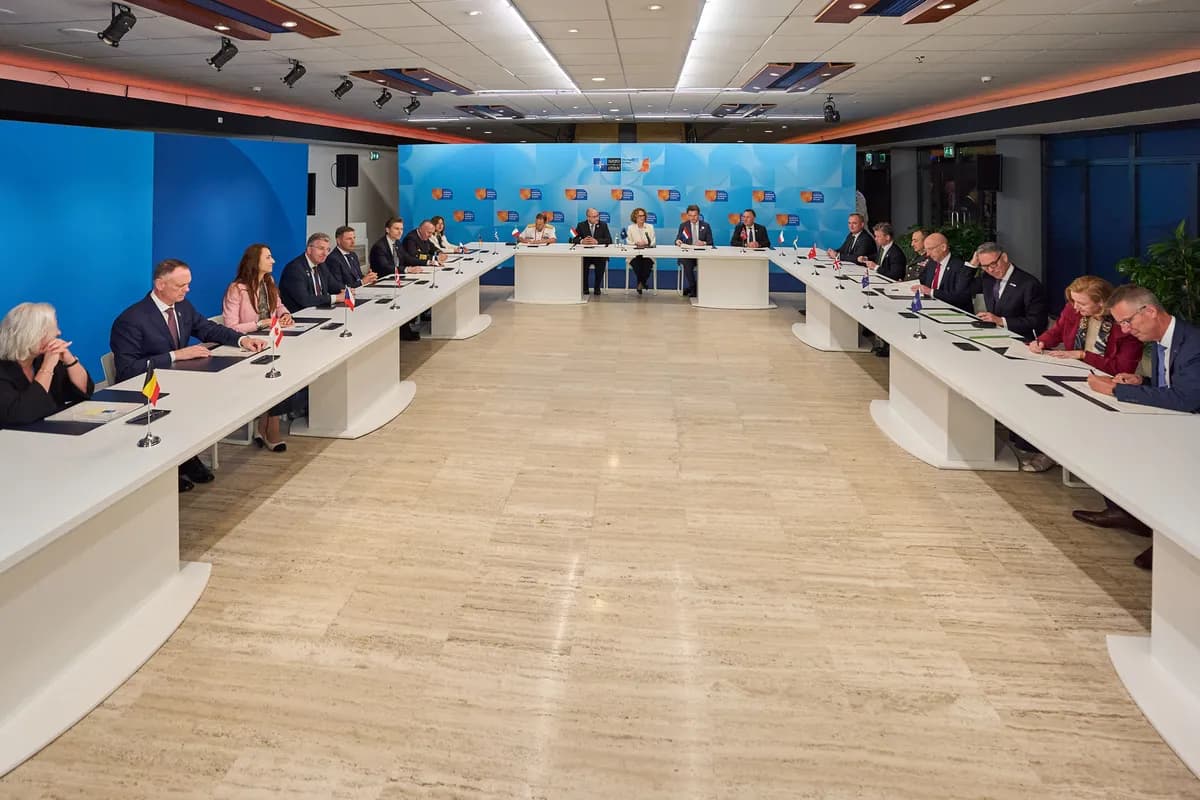
European and Canadian leaders convened in Yerevan for the European Political Community summit and the first EU-Armenia summit, a gathering that observers say marks Armenia's historic pivot from Russia to the European Union. Olesya Vartanyan, a Caucasus security analyst, said the summit is about signaling readiness for closer ties, and political scientist Alexander Iskandaryan noted that Armenia’s diversification strategy effectively means building relationships with the EU.
Armenia's pivot comes with significant constraints. President Vladimir Putin has stated that Armenia remains a member of the Eurasian Economic Union and hosts a Russian military base, and Russia sells gas to Armenia at $177.50 per 1,000 cubic meters, far below European prices. Putin warned Prime Minister Nikol Pashinyan in April that membership in both the EU and the Eurasian Economic Union is impossible, implying consequences for gas supplies. Armenia signed a comprehensive partnership agreement with the EU in 2017, and last year adopted a law declaring its intention to apply for membership, according to EU documents. In March 2025, Armenia's parliament passed a law to begin the accession process, according to legislative records. The first bilateral EU-Armenia summit on Tuesday was attended by European Commission President Ursula von der Leyen and European Council President António Costa, EU officials said. According to election schedules, Pashinyan's Civil Contract party faces parliamentary elections in June, and political analysts note that three opposition parties are more sympathetic to Moscow. How Russia will respond remains an open question.
Let's be honest, eight years ago, nobody would come here.
The shift follows the 2023 military operation in Nagorno-Karabakh: international observers said that Azerbaijan's operation expelled over 100,000 ethnic Armenians and that Russia did not intervene, drawing criticism of its peacekeepers. The European External Action Service said the EU deployed a civilian monitoring mission along the Armenia-Azerbaijan border after brokering a border recognition deal. The White House announced that Armenian and Azerbaijani leaders signed a peace agreement in August 2025 and unveiled the Trump Route connectivity corridor, though details remain unclear. Azerbaijan's parliament subsequently said it was suspending ties with the European Parliament over a resolution on Nagorno-Karabakh. Armenian officials have stated that, unlike Azerbaijan, they have not reported Iranian missiles landing on their territory. The durability of the peace deal remains uncertain, with opposition from some political parties. Thomas de Waal of Carnegie Europe, writing in The Guardian, noted that European leaders face a fine line in Yerevan, as they hold what looks like a pre-election rally for Pashinyan while needing a bigger conversation about building a more robust Armenia. He said the country is on the verge of a transformative peace agreement with Azerbaijan and has an opportunity to reduce dependence on Moscow.
The European Political Community summit on Monday was attended by dozens of European leaders and Canadian Prime Minister Mark Carney, with organisers noting that Canada was the first non-European country to participate. The forum, established in 2022 after Russia's invasion of Ukraine and championed by French President Emmanuel Macron, according to the Elysée Palace, discussed US plans to withdraw over 5,000 troops from Germany and the economic impact of the US-Iran conflict, officials briefed on the talks said. Ukrainian President Volodymyr Zelenskyy visited Armenia for the first time since 2019, marking the first Ukrainian head of state visit in 24 years; both governments said they discussed restoring dialogue and economic cooperation. The summit was co-chaired by European Council President António Costa and Armenian Prime Minister Nikol Pashinyan, according to official statements. Carney, who attended amid trade tensions with the US, has stated he aims to build new alliances after losing US markets under Trump. European defence analysts said the withdrawal of US troops from Germany underscores that Europe must take greater responsibility for its own security.
Eight years ago, this country was seen by a lot of countries around the table as a sort of de facto satellite of Russia.
European leaders used the platform to stress sovereignty and security. Carney said the international order 'will be rebuilt, but it will be rebuilt out of Europe' and that Europe will not submit to a brutal world. He identified a 'rupture' in US-led global governance. UK Prime Minister Keir Starmer said 'some of the alliances that we have come to rely on are not in the place where we would want them to be.' Macron said that eight years ago Armenia was seen as a de facto satellite of Russia and that Pashinyan de-risked the country, but it is still attacked daily. He highlighted Europe's reliability as a partner and called for a 'big derisking strategy' to reduce dependence on others for critical minerals. Zelenskyy said Russia faces a crucial moment this summer to either expand the war or move to diplomacy, and called for maintaining sanctions.
And it was and it is still attacked on a daily basis because of that.
We cannot deny some of the alliances that we have come to rely on are not in the place where we would want them to be. There is more tension in the alliances than there should be.
The big issue we have beyond the wars is a big derisking strategy. It needs more solidarity more investment and better organisation to derisk from the main geopolitical risks.