

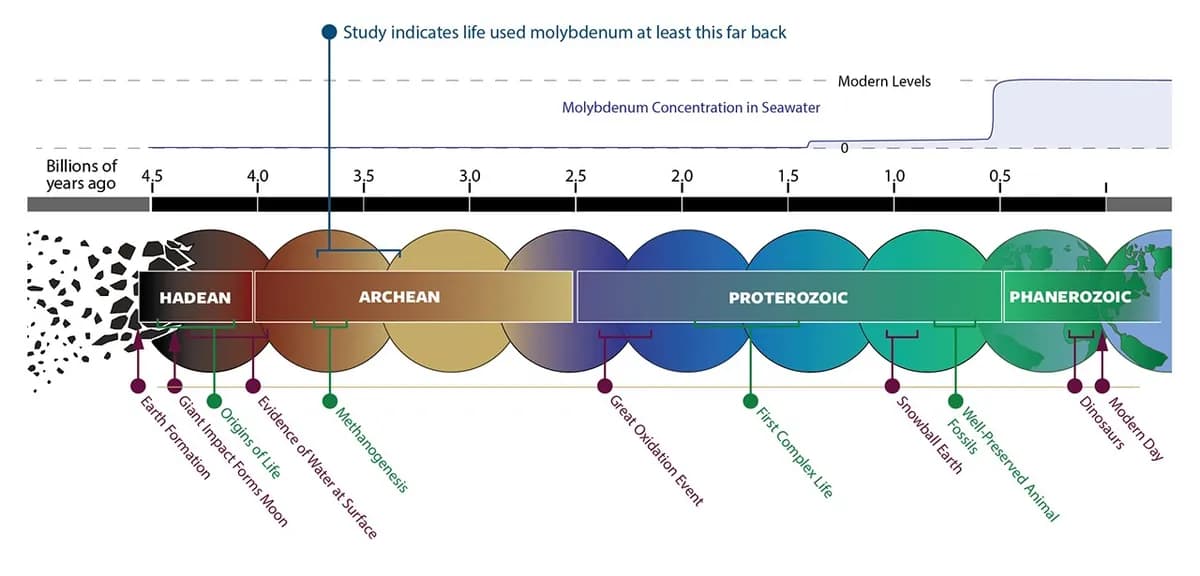
Molybdenum helps speed up vital biochemical reactions in cells and is a component of essential enzymes that drive major biological reactions. Without molybdenum, important reactions could still happen in nature but would be too slow to sustain life. Molybdenum levels increased around the time microorganisms began to use photosynthesis, which led to the Great Oxidation Event roughly 2.45 billion years ago. A previous NASA study suggested that the rise of molybdenum in the environment may have been necessary for the evolution of complex life.
Scientists previously theorized that life may have used tungsten first and then evolved to use molybdenum once it became more available. However, the new study suggests that both molybdenum and tungsten-using enzyme systems have Archean roots, indicating early life likely worked with both metals. The team gathered data on molybdenum prevalence through time and reconstructed the history of its use along the tree of life. The study was published in Nature Communications on Tuesday.
Molybdenum sits at the catalytic center of enzymes that run major carbon, nitrogen, and sulfur reactions.
Betül Kaçar, head of the Kaçar Lab at the University of Wisconsin-Madison and senior author on the study, said: "Molybdenum sits at the catalytic center of enzymes that run major carbon, nitrogen, and sulfur reactions." She added: "Asking when life began using molybdenum is really asking when some of the most consequential metabolic strategies became possible."
Asking when life began using molybdenum is really asking when some of the most consequential metabolic strategies became possible.