

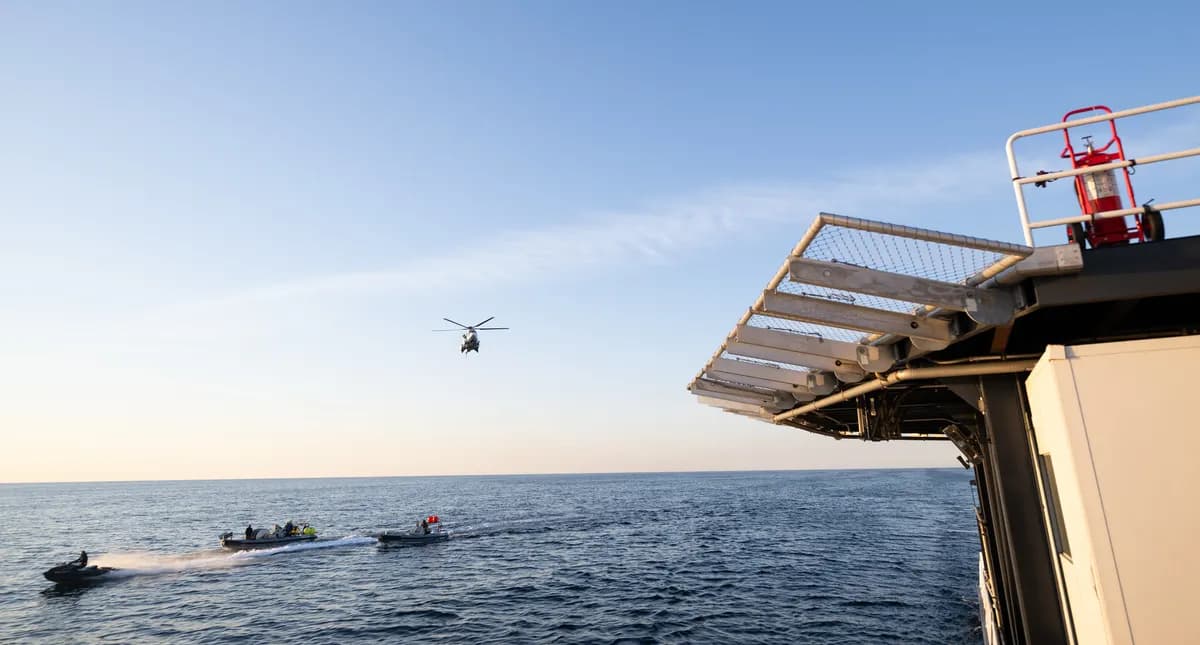
U.S. naval forces attacked the Iranian cargo ship Touska after it attempted to breach a U.S. blockade in the Gulf of Oman, according to high-confidence reports. The cargo ship ignored a warning from the USS Spruance, which responded by firing, high-confidence reports state. The U.S. warship stopped the Touska by shooting holes in its engine room, high-confidence reports confirm. U.S. naval forces have taken control of the Touska and are investigating its contents, with U.S. Marines now holding custody of the vessel, according to high-confidence and medium-confidence reports.
The Touska is a 294-meter-long cargo ship, according to medium-confidence sources. The ship was en route from Malaysia towards the Hormuz Strait while in the Gulf of Oman, marine data service Vesselfinder reported. The ship is under U.S. Treasury sanctions due to prior illegal activity, major media outlets indicate. What specific cargo was on board the Touska and whether it contained any prohibited or military items remains unknown, as U.S. authorities continue their examination.
U.S. Central Command released footage showing a naval vessel intercepting a cargo ship, with a gun firing in its direction, multiple reports confirm. The U.S. began its blockade of the Strait of Hormuz on April 13 after failed peace negotiations in Islamabad, according to major media. At least two ships were shot at when trying to pass through the Strait of Hormuz on Saturday, multiple reports indicate. There is a tense situation in the Hormuz Strait with ships being fired upon, an official source stated.
Iranian state media reported that officials will not participate in talks while the U.S. blockade remains.
The broader conflict began with U.S. and Israeli strikes across Iran on 28 February, followed by waves of attacks until a two-week truce, major media report. Trump announced the naval blockade after a first round of negotiations ended without agreement, according to multiple sources. Key issues in negotiations include Iran's nuclear programme and control of the Strait of Hormuz, medium-confidence sources note. The ceasefire between the U.S. and Iran is expiring soon, an official source noted, leaving its current status uncertain amid recent violations.
Diplomatic efforts have seen preparations for further discussions begin in Islamabad, Pakistan, with U.S. representatives arriving on Monday, major media report. Guests at the hotel where previous talks occurred were told to leave, medium-confidence sources state. Pakistan's Prime Minister Shehbaz Sharif spoke to Iran's President Masoud Pezeshkian on Sunday evening, according to multiple sources. However, Iranian state news agency IRNA said reports of a second round of talks with the U.S. are 'not true,' and Iranian state media suggested that new talks with the U.S. will not take place on Monday. This contradiction indicates a fundamental disagreement on whether negotiations are proceeding, with U.S. sources claiming talks are scheduled while Iranian sources deny them, impacting the likelihood of diplomatic resolution.
In a major escalation, a U.S. submarine sank the Iranian frigate IRIS Dena off the southern coast of Sri Lanka on Wednesday, high-confidence reports confirm. The event marks the first time a U.S. submarine has launched a torpedo in combat or engaged and destroyed a ship since the Second World War, high-confidence reports state. The IRIS Dena had been sailing home from an east Indian port, where it had participated in an international naval conference hosted by India in February, research sources indicate.
Iranian state media suggested that new talks with the U.S. will not take place on Monday.
Casualties from the Dena sinking are reported with conflicting figures. According to major media, 87 people were killed in the sinking of the IRIS Dena. Authorities in Sri Lanka say more than 80 crew were killed in the sinking of the Iranian warship. Sri Lankan officials report at least 87 bodies have been recovered so far, while some 32 others were rescued by the Sri Lankan Navy. Some 130 people were believed to have been on board the vessel when the first distress call was received on Wednesday, according to an Iranian official. The exact number of casualties remains unknown, as reports vary from 87 killed to over 80 killed with 130 believed on board.
Iran’s naval doctrine in the Gulf is shaped by geography, historical experience, and threat perceptions, featuring a layered defense posture, according to research. The IRIN and IRGCN share responsibility for securing maritime approaches to the Gulf, with the IRGCN focusing on asymmetric warfare and area-denial in the Gulf, while the IRIN handles anti-access functions in the Gulf of Oman, research sources note. Major naval facilities, including Bandar Abbas, Chabahar, and Konarak, were targeted within the first hours of Operation Epic Fury using Tomahawk land-attack cruise missiles, research indicates.
U.S. claims of destroying Iranian vessels show a significant discrepancy. Since the beginning of Operation Epic Fury, U.S. forces have destroyed or incapacitated more than 120 Iranian naval vessels across both the IRIN and IRGCN, according to research sources. In contrast, Adm. Brad Cooper, commander of U.S. Central Command, stated the U.S. has destroyed more than 17 Iranian ships thus far, including the most operational Iranian submarine that now has a hole in its side. This discrepancy, with a factor of over 7x difference, affects the scale of U.S. military success and the extent of damage to Iran's naval capabilities, leaving the full extent of actions unknown.
Iran's Revolutionary Guard stated that any ship approaching the closed Strait of Hormuz will be considered hostile and targeted.
Iran's supreme military command, Khatam al-Anbiya, accused the U.S. of breaking the ceasefire by shooting at an Iranian ship in the Gulf of Oman. Iran says it may retaliate for the attack, according to an Iranian military spokesman. Iran identified the vessel as the Iris Dena and vowed vengeance for what it described as an 'atrocity.' This response contradicts earlier reports that Iran had not yet commented on the ship interception, showing conflicting information on Iran's official stance and potential for escalation.
The broader regional context includes a war between Iran, the U.S., and Israel, an official source stated. There is a ceasefire between Israel and Lebanon, according to another official. These dynamics add layers to the ongoing tensions, with the U.S.-Iran conflict intersecting with other regional hostilities.
Implications of these events leave the ceasefire status uncertain, with risks of retaliation and a diplomatic stalemate. The current status of the ceasefire between the U.S. and Iran, including whether it has officially expired or been violated, remains unclear. Whether a second round of U.S.-Iran talks will actually occur is also unknown, given conflicting statements from U.S. and Iranian sources.
Multiple unknowns persist beyond the immediate incidents. In addition to the Touska cargo and Dena casualties, the scheduling of talks and ceasefire status are ambiguous. Trump said U.S. representatives will arrive in Pakistan on Monday for talks, with a ceasefire expiring on Wednesday, and a White House official said the U.S. delegation will include Vice-President JD Vance, Steve Witkoff, and Jared Kushner. However, Iranian state media reported that officials will not participate in talks while the U.S. blockade remains, and Trump warned that any Iranian ships approaching the blockade will be 'immediately eliminated.' Iran's Revolutionary Guard stated that any ship approaching the closed Strait of Hormuz will be considered hostile and targeted, further heightening the risk of miscalculation.