

A severe dust storm originating in the Sahara Desert has impacted Greece with deadly consequences and widespread disruptions. Strong southern storm winds covered the Greek island of Crete with desert sand, turning the air completely orange. The strong winds forced ferries to stay in ports and flights to be canceled. A man died in Greece due to the weather, found trapped under a car in Nea Makri. Storm Erminio caused widespread destruction in Greece, including in Attica where the fatality occurred. The Greek weather service warned of a 'serious weather situation' in parts of the country on Thursday with 'prolonged and intense rain and storm winds, likely also hail'.
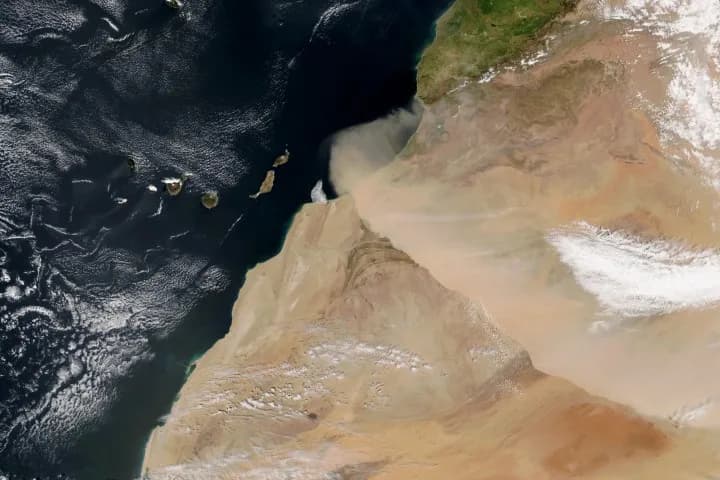
The storm's origins trace back to northwestern Africa in early spring 2026, where a dry, dust-laden wind known as the harmattan swept across the region. Cold temperatures, high winds, and blowing dust prompted officials to issue an alert for several regions of Morocco due to low visibility and harsh conditions. Satellites tracked a wall of dust on March 30 as it moved southwest from the Sahara Desert toward the Atlantic Ocean. NASA’s Terra satellite captured an image of the dust at about 10:00 Universal Time (11 a.m. local time in Morocco). The NOAA-21 satellite captured an image about four hours later, and Meteosat-12, operated by EUMETSAT, captured another view of the dust storm. The geostationary weather satellite showed the dust’s movement as it moved closer to the Canary Islands.
According to Spain’s state meteorological agency (AEMET), the harmattan winds blow from the northeast between November and April, often producing dust storms as winds lift dust particles from the Sahara. During the March 30 event, AEMET noted that conditions were right for a harmattan surge, which happens when winds get stronger near the ground with the passing of a cold front. That day, winds converged perpendicular to the High Atlas mountain range before shifting southwest. Researchers using NASA data have previously reported that the most intense Saharan dust storms occur in the spring, when dust is typically lifted from the sand seas, or ergs, of central North Africa and areas along the Mediterranean coast. In the warmer months, another peak occurs in the central Sahara.
The Canary Islands faced severe dust impacts, with forecasts calling for the Saharan dust to ultimately engulf the islands, triggering what islanders know as calima. The dust episode was expected to worsen air quality and visibility across the islands through April 1. An 800-mile wall of dust is affecting the Canary Islands, reducing air quality and visibility. People in the Canary Islands have been warned to stay indoors, stay hydrated, and keep windows shut due to incoming Saharan dust. Six vulnerable groups—minors, elderly, those with chronic respiratory or cardiac conditions, pregnant women, outdoor workers, and smokers—are urged to exercise extra caution in the Canary Islands due to the dust. A massive dust plume was expected to arrive in the Canary Islands at 12 noon on March 30, with yellow weather warnings in place. Dry and warm Sahara winds with sand and dust are hitting the Canary Islands, expected to turn the sky orange.
This is an extreme dust episode that occurs once every ten years.
Health risks from Saharan dust exposure are significant, with hospital visits increasing during dust events, even up to five days after they end. Saharan dust can cause health issues like nasal and throat irritation, itchy eyes, coughing, asthma attacks, and respiratory infections. Cyprus has been engulfed in a thick cloud of Saharan dust, with authorities warning it is dangerous to go outside. Air quality in Cyprus is severely compromised, with some spots recording particulate density 36 times greater than the EU's safe level. Health experts advise people with respiratory diseases in the Canary Islands to wear masks or avoid leaving home. The dust particles could cause 'coughing and wheezing' or a dangerous health emergency, especially for asthma and COPD sufferers. Saharan dust is a form of air pollution, and 49% of surveyed people said their lung condition was triggered by toxic air.
Flight disruptions and transportation chaos spread across the Mediterranean. On Wednesday, several Easter holiday flights to Crete had to be rerouted due to Saharan dust. A British Airways service from London to Crete was rerouted to Corfu, and a SKY Express flight from Brussels to Crete was sent to Athens. Winds of up to force 9 on the Beaufort scale carried dust to Crete, forcing flight reroutes. Visibility dropped to around 1,000 metres at Heraklion airport, considered unsafe for landing. Incoming flights to Santorini were diverted to Crete, Athens, and Corfu, and a flight from Manchester to Rhodes was diverted to another island.
Crete experienced extreme conditions, with dust blanketing cities like Heraklion, Rethymno, and Chania, turning the sky orange. Meteorologists reported extremely high dust levels in Crete, exceeding 1,000 micrograms per cubic meter. The Greek national meteorological service placed a red warning over Crete for heavy rain and violent thunderstorms from Storm Erminio. Flooding in Greece poses a significant risk to life, with evacuations possible. Rain mixed with dust in Crete coated vehicles and buildings with mud. A Mediterranean tourist hotspot has been bathed in a blood-red glow due to a dust storm. According to Aftonbladet, Nea Kriti described the air in Crete as 'suffocating' with extremely high levels of African dust.
Additional regional impacts included a dust storm hitting Libya, with authorities declaring a state of emergency in Tobruk. Heavy rainfall triggered a mudslide in Piceno, Italy, blocking the main road, and a bridge collapsed in Montenero di Bisaccia, Italy, due to flooding. Spain's state weather agency Aemet has issued warnings for strong gusts and rough seas in areas like Aragon, Catalunya, Balearic Islands, and Valencian Community.
The air in Crete is 'suffocating' with extremely high levels of African dust.
The dust is spreading northward across Europe and towards the UK this week. A separate storm earlier in March also sent dust toward the Canaries, along with another plume that dispersed widely across Europe. Saharan dust plumes from the Sahara desert travel thousands of kilometres to Europe, causing hazy skies and 'blood rain'. The Sahara accounts for more than half of the world's total dust emissions, and dust plumes move north towards Europe particularly between February and June. A Saharan dust plume is forecast to hit the UK on Saturday and Sunday, urging millions to stay indoors and shut windows.
The phenomenon of 'blood rain' refers to rain that takes on a reddish tint due to dust particles like iron oxides. Genuinely red rain is extremely rare in the UK; dust-laden rain usually appears normal but leaves a dust film after drying. Dust concentrations this week are expected to be low, so rainfall is unlikely to appear noticeably red. Dust may settle with rain on Wednesday and Thursday, leaving a light yellowish or brownish residue on surfaces. Dust can turn sunrises and sunsets vivid gold, amber, or burnt orange.
Climate change could increase Saharan dust emissions by 40% to 60% by the end of the century under extreme warming scenarios. However, some Saharan dust storms have become rarer and less intense over the past two decades due to increased vegetation and weaker winds. In Spain and Italy, Saharan dust may account for up to 44% of deaths linked to PM10 pollution. Dust can darken snow in the Alps, accelerating melting, and reduce solar panel efficiency.
Public health recommendations include keeping windows closed, staying indoors, and showering after exposure to reduce dust impact. According to Karen Spillett, deputy head of health advice at Asthma + Lung UK, Saharan dust could pose a serious risk to people with asthma and lung conditions, causing irritation and flare-ups. Around 1.7 million Brits have COPD, and 7.2 million have asthma.
Key unknowns remain, including whether the storm affecting Greece is named 'Storm Erminio' or 'Storm Therese', or if these are different storms. The exact timing of the dust arrival in the Canary Islands is unclear, as sources give conflicting details, such as March 30 at noon versus earlier in the week. The full extent of flight diversions from Crete and Santorini has not been confirmed, with reports varying on specific flights and destinations.
Further unknowns include the overall health impact and number of hospitalizations directly caused by the dust storms across affected regions. The long-term environmental and economic consequences of the dust events, such as damage to infrastructure and agriculture, are also not yet fully assessed. According to Daily Mail - Home, a local forecaster described this as an extreme dust episode that occurs once every ten years.