

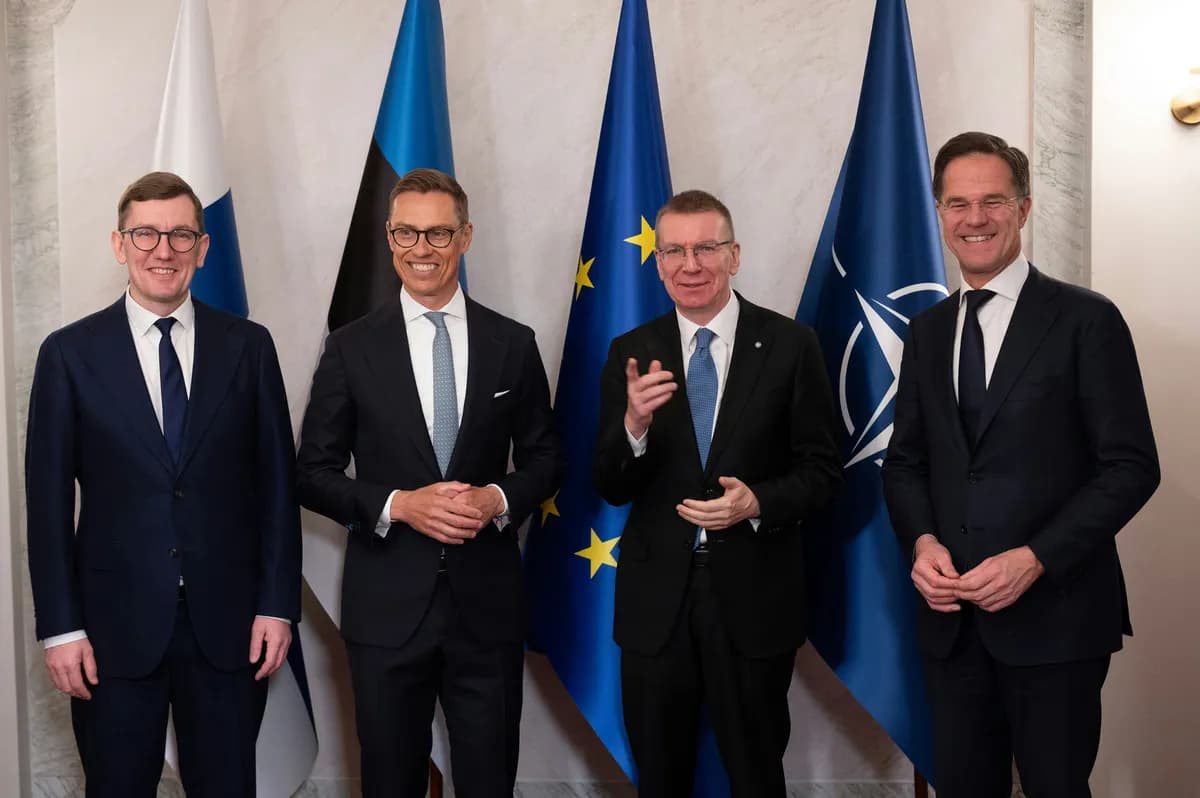
The meeting in Helsinki on Thursday brought together a large group of state leaders, including British Prime Minister Keir Starmer, Lithuanian President Gitanas Nauseda, Norwegian Prime Minister Jonas Gahr Støre, Swedish Prime Minister Ulf Kristersson, Latvian Prime Minister Evika Silina, Estonian Prime Minister Kristen Michal, Icelandic Prime Minister Kristrun Frostadottir, and Dutch Prime Minister Rob Jetten, according to reports. Danish Prime Minister Mette Frederiksen had a substitute at the meeting, reports indicate. This gathering is for the Joint Expeditionary Force (JEF) defense cooperation framework, which is led by Britain and involves Britain, Finland, the Netherlands, Iceland, Latvia, Lithuania, Norway, Sweden, Denmark, and Estonia as a multilateral defense cooperation framework. Last year, the meeting was held in Oslo, Norway, where participants gathered for a group photo, as reported.
The Joint Expeditionary Force (JEF) is a UK-led Northern European multi-national military partnership designed for rapid response and expeditionary operations, according to research from three sources. JEF is not officially part of NATO, but its purpose is to complement NATO's functions, aiming to be a more agile actor on the regional defence stage than NATO, while also being an asset to NATO, as per research from three sources. It is not an army or a combat force, but an advantage and difference from NATO is JEF's flexibility, as operations do not require consensus from all JEF countries; countries can participate or stay out based on their national decisions, reports suggest. This structure allows for tailored responses to crises without the need for unanimous agreement among all members.
The most important topic at a JEF leaders' meeting was supporting and arming Ukraine.
Historically, the JEF was established in 2014 and has been fully operational since June 2018, according to research from three sources. It was initially conceived as a UK-only formation, a successor to the Joint Rapid Reaction Force (JRRF), based on research from three sources. On 5 September 2014, the multinational JEF was officially launched with a letter of intent signed by Denmark, Estonia, Latvia, Lithuania, the Netherlands, and Norway, as research from three sources indicates. Sweden did not sign the initial letter of intent in 2014, and in 2015, Swedish Defence Minister Peter Hultqvist explained no formal process existed for Sweden to join, but Finland and Sweden joined JEF in 2017. On 30 November 2015, seven countries (UK, Denmark, Estonia, Latvia, Lithuania, Netherlands, and Norway) signed the contract to establish the JEF, according to research from three sources.
Operationally, the JEF provides a framework with specific capabilities and structures. The operations command headquarters, The Standing Joint Force Headquarters (SJFHQ), is located in Northwood, London, reports indicate. The goal of JEF cooperation is to develop the military capabilities of participating countries, prevent various crises, and act together in crisis situations when necessary, according to reports. Allies train and operate together, and JEF provides a forum for discussion on allies' defense and security issues, as reported. JEF applies an 'opt-in' principle, meaning that when two or more JEF member countries agree on cooperation, an exercise can be carried out after practical details are agreed upon later, reports suggest. The JEF can act independently or be deployed in support of NATO or other cooperative ventures like UN peacekeeping, according to research from three sources, with a geographical focus on Northern Europe and the Baltic Sea region, primarily focusing on the defence of Northern Europe and the Baltic region, as per research from three sources.
Providing defence aid to Ukraine is important because Ukraine needs to be strong when entering eventual peace negotiations.
Security concerns have been a key driver for JEF's importance. One of the most important reasons for establishing JEF was the rapid change in the security environment, which started at least when Russia occupied the Crimean peninsula in 2014, reports indicate. Russia's actions in Ukraine have increased concerns about the security of the Baltic Sea region, as reported. A vision approved by JEF leaders in 2023 states that Russia's attack on Ukraine has increased JEF's importance as an 'enabler of regional security' for its member countries, highlighting how regional tensions have solidified the force's role in deterrence and response, according to reports.
At the Helsinki summit, Ukraine was a central topic of discussion. JEF leaders agreed that military aid for Ukraine must continue, despite discussions about a possible ceasefire and peace negotiations, according to JEF leaders. JEF leaders emphasised the need for security guarantees for Ukraine, and Stubb said Ukraine joining JEF would not offer such guarantees, as per JEF leaders and Finnish President Alexander Stubb. JEF discussed the possibility of including Ukraine as a member, according to research from three sources, and Ukrainian President Volodymyr Zelensky met with the JEF group via video link, based on research from three sources. Finnish President Alexander Stubb stated in a press conference that supporting and arming Ukraine was the most important topic, and he added that providing defence aid to Ukraine is important because Ukraine needs to be strong when entering eventual peace negotiations, as per Finnish President Alexander Stubb. He also noted that security guarantees for Ukraine would come from NATO and Article 5, and that Finland supports Ukraine joining NATO, while commenting that talk about sending peacekeeping forces to Ukraine was premature and not realistic due to escalation risks and troop requirements, according to Finnish President Alexander Stubb.
Security guarantees for Ukraine would come from NATO and Article 5.
Reactions and diplomatic context extended beyond the summit itself. Canada has announced it is considering joining JEF, though the current status of this consideration and when a decision might be made remain unclear, reports indicate. In related diplomatic movements, Moldovan President Maia Sandu will make a working visit to Finland on 31 March 2026, hosted by President Alexander Stubb, according to research from three sources. Stubb and Sandu will discuss bilateral relations, Russia's illegal war in Ukraine, European security, Moldova's EU accession process, transatlantic relations, and global challenges, as per research from three sources, indicating broader regional coordination efforts.
The implications for European security are significant, as the JEF summit discussions will include support for Ukraine and the general European security situation, according to research from three sources. President Alexander Stubb will host a JEF summit in Helsinki on 26 March 2026, as research from three sources indicates, suggesting ongoing high-level engagement. Stubb expressed openness to expansion, stating in a press conference that he was open to expanding JEF membership, possibly including other NATO countries around the Baltic Sea like Poland and Germany, which could enhance the force's reach and interoperability, as per Finnish President Alexander Stubb.
Finland supports Ukraine joining NATO.
Specific outcomes from the Helsinki summit, such as what military aid packages or amounts were discussed or agreed upon for Ukraine, have not been disclosed. Similarly, concrete decisions made regarding support for Ukraine remain unspecified. The details of security guarantees for Ukraine discussed at the meeting, and how they differ from NATO's Article 5, are not yet public, leaving uncertainties about the practical steps forward.
Further unknowns include the operational specifics of the 'opt-in' principle, such as recent exercises or operations conducted under this framework, which have not been detailed. Membership considerations, including Canada's potential accession and the timeline for any decision, are still under review without confirmed timelines. These gaps highlight the evolving nature of JEF's role in a complex security landscape.
Talk about sending peacekeeping forces to Ukraine was premature and not realistic due to escalation risks and troop requirements.
I was open to expanding JEF membership, possibly including other NATO countries around the Baltic Sea like Poland and Germany.